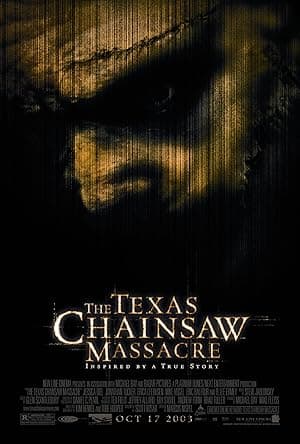
The Texas Chainsaw Massacre
A road trip that ends with a chainsaw, a corrupt sheriff and one woman who refuses to be finished.
Feature presentation
There’s a particular shot in this 2003 remake where everything narrows down to one person: Erin. Marcus Nispel’s take on The Texas Chainsaw Massacre is built around her getting trapped, held and refusing to give up — and that single through-line is why the film still sparks conversation.
THE MOVIE
Erin is still the reason this movie works
Start with Erin. The 2003 Texas Chainsaw Massacre keeps its eye on her from the moment fate pulls this group of young people off the road. Much of the film’s momentum comes from watching her go from traveller to captive and, crucially, from someone who keeps trying to get out.
It’s a remake that sets its story in the summer of 1973: five friends on their way to a Lynyrd Skynyrd concert whose decision to pick up a troubled hitchhiker drags them into a small town’s terrible orbit. Marcus Nispel directed the picture — his first feature after a career making commercials and music videos — and he keeps the runtime tight at just over an hour and a half.
Underneath the gore and the shocks the movie rests on a few simple ideas: outsiders stranded in a hostile rural place, local authority that doesn’t help, and a household — renamed the Hewitts here — functioning like a single monstrous organism. That combination is what makes Erin’s fight feel urgent rather than just performative.
THE SETUP
The idea that sets The Texas Chainsaw Massacre in motion
The premise is disarmingly simple: it’s 1973, five friends on a road trip to a rock concert, and a decision to pick up a hitchhiker that goes badly. That single choice is the hinge that swings the story from ordinary weekend plans into something much darker.
When the group needs help they look for it in the local town and at a nearby mill — and that’s where the film turns the safety of law enforcement inside out. The sheriff who should rescue them instead becomes a figure who escalates their danger.
Once the Hewitt household enters the picture the stakes close in. The central conflict becomes Erin and her friends pitted against a family unit that acts together, and against a chainsaw-wielding presence at its centre.
As a studio remake the 2003 picture reworks the premise of the 1974 original and places a modern stamp on the old idea, with a director making his feature debut after time in commercials and music videos.
THE CHARACTER
Why Erin matters
Jessica Biel plays Erin, and she’s the film’s centre of gravity. The remake doesn’t scatter focus; it follows her capture and the practical business of trying to get away.
That focus matters because the movie isn’t only about shocks — it’s about endurance. Erin’s arc is measured in attempts to escape and in small acts of grit while everything around her unravels.
Her path is the audience’s route into the Hewitt household as a functional monster: a family that survives by enforcing brutal behaviours. Seeing it through Erin’s eyes keeps the terror personalised.
Renaming the clan the Hewitts and expanding the household in this continuity makes Erin’s ordeal feel larger-scale: she’s not just fighting one isolated madman, she’s resisting a whole way of life that the house represents.
UNDER THE SURFACE
The Texas Chainsaw Massacre has more on its mind than the plot suggests
First: isolation and entrapment. The story is built around city or outsider youths who get stranded in an inhospitable rural place, and the movie squeezes suspense out of that feeling of being cut off.
Second: corrupted authority. The film turns the idea of rescue on its head by having the figure who should protect the group act instead to worsen their plight. That twist converts a standard plea-for-help scene into something clinical and cruel.
Third: family-as-monster. The Hewitt household operates as a unit that keeps its own perverse system going — the family is not merely wallpaper for the killer, it’s the mechanism that enforces the violence.
Finally, survival and the ‘final girl’ idea are never abstract here; the movie maps endurance in bodily terms. The film wants you to feel fatigue, panic and the stubbornness required to keep going when every route out looks closed.
THE FILMMAKING
How The Texas Chainsaw Massacre was put together
Marcus Nispel came to this film from a different lane: years directing commercials and music videos. The 2003 picture was his first feature job.
That background shows up in the film’s pacing and in the way sequences are constructed with an eye for condensed energy rather than lingering deliberation. The film keeps moving — it never dilly-dallies.
Putting a director with commercial experience onto a remake like this was a clear studio choice: someone who could deliver a compact, attention-grabbing version of a familiar story.
Seen as a production fact, Nispel’s debut is part of why the movie feels like a product of its moment — a horror title made with an emphasis on momentum and immediacy.
PRACTICAL EFFECTS
The effects work that gives The Texas Chainsaw Massacre its physical personality
The remake leaned heavily on special makeup and prosthetics to change Leatherface’s look and to create the film’s more physical gore beats. There are credited artists on set whose work shapes much of the film’s roughness.
Those practical pieces are the tangible stuff that makes close-up violence feel immediate: rubber, fake blood, masks and prosthetic appliances that an actor can interact with.
The production didn’t treat everything as purely practical, though. Selected close-up shots received digital enhancements, so the film blends hands-on effects with careful digital work where the camera demands it.
That combination keeps some scenes feeling tactile while allowing the filmmakers to push specific images further than pure makeup alone would permit.
PURE 00s
The Texas Chainsaw Massacre could not belong to any other decade
This remake is very much a product of the early 2000s studio trend: companies like Platinum Dunes were taking 1970s and 1980s horror titles and reworking them for a new market. The 2003 Chainsaw sits squarely inside that movement.
Releasing in 2003, it’s part of an era when remakes were a visible route for studios to bank on name recognition while updating the mechanics of scares.
A deliberate bit of continuity-building is the decision to change the killers’ name to the Hewitts and to enlarge the family — that gives the remake a slightly different mythology and a bigger ensemble to populate the household.
There’s also a neat production footnote that ties the two versions together: Daniel C. Pearl, who shot the 1974 original, worked as the cinematographer on this 2003 picture, which creates an uncommon link between old and new.
WATCHING IT NOW
What has aged — and what hasn't
One aspect that keeps working is the film’s presentation of the household as a collective threat. Turning the family into a functioning, almost industrialised source of brutality still feels potent — it’s a simple, durable idea.
The remake’s choice to rename and expand the family into the Hewitts gives the story more bodies and a clearer sense of logistics: it’s easier for a modern audience to register how the household sustains its methods.
Those two choices — family-as-system and a larger family unit — mean the movie’s core menace still scans as plausible within the film’s logic, even years on.
So if anything from the remake has retained its bite, it’s the way the household is presented as the engine of the horror.
THE LEGACY
Why The Texas Chainsaw Massacre still matters
On a practical level the 2003 film matters because it led to another entry: a 2006 prequel that continued the Platinum Dunes continuity and dug into the Hewitts’ origins.
It also helped establish Platinum Dunes as a commercially successful producer of studio-backed horror remakes; that production strategy became a notable strand of 2000s horror business.
Relative to its modest budget the picture performed well enough worldwide to justify further franchise spending and more projects in the remake vein.
So while it might not have rewritten the rules of horror, it mattered for the industry moment it helped to define.
THE VERDICT
Does The Texas Chainsaw Massacre still hold up?
Short answer: yes — if you’re watching for a taut, relentless remake that centres a single survivor. The film opens with a straightforward road-trip premise (five friends in 1973 detoured by a hitchhiker) and then commits to the consequences of that choice.
A key strength is the way the movie turns standard rescue beats inside out: the authorities who should help become part of the problem, and the Hewitt household functions as a collective threat rather than a lone antagonist. That concentration of menace gives Erin something credible to resist.
The picture clocks in at a brisk ninety-eight minutes, directed by Marcus Nispel in his first feature outing, and it uses a short faux-documentary framing device to bookend the story and remind the audience we’re being shown a dramatisation of horrific events.
If you care about survival stories with a female lead at the centre, or you want to see how early-00s studios repackaged 1970s horrors for new audiences, this is worth a watch. It’s compact, purposeful and built around a simple, stubborn refusal to let the heroine be finished.
Share this movie
Keep watching
More movies from the 00s

2002
The Pianist
A quiet life unmade by war — and a pianist who refuses to stop listening.
Read the retrospective
→
2006
Blood Diamond
A mercenary, a fisherman and a pink diamond — and a film that still asks who pays for our jewellery.
Read the retrospective
→
2003
Kill Bill: Volume 1
A yellow jumpsuit, a long list of enemies and one woman who refuses to be finished.
Read the retrospective
→