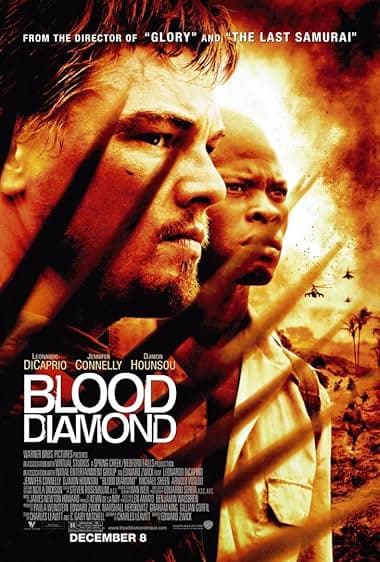
Blood Diamond
A mercenary, a fisherman and a pink diamond — and a film that still asks who pays for our jewellery.
Feature presentation
Blood Diamond packs Hollywood scale into a story that keeps its focus on two men whose lives collide over a single stone. Revisit it for the scrappy moral duel at its centre, and for how the movie tries — loudly and not always neatly — to connect violence on the ground to buyers far away.
THE MOVIE
Danny Archer is still the reason this movie works
Blood Diamond opens with a hook that's simple and combustible: wartime violence, a rare pink stone and a pair of very different men whose futures hinge on that rock. It’s the sort of set-up that promises adventure, but the film is keener on moral scrabble than straightforward treasure-hunt fun.
Central to that scrabble is Danny Archer: an ex‑mercenary turned smuggler whose first language is self‑interest and whose way out of trouble looks an awful lot like money. Having him as the engine — a man who can choose to help or to exploit — keeps the film interesting in ways a straight victim‑rescue drama wouldn’t be.
Edward Zwick directs the whole thing with that mid‑00s studio appetite for serious subject matter packaged as a crowd‑pleasing drama: big stakes, clear moral pressure and a runtime that gives the story room to push its themes into the foreground.
THE SETUP
The idea that sets Blood Diamond in motion
Strip the movie back a touch and you have a compact proposition: a war in Sierra Leone, a father desperate to get his son back, and one single, very valuable diamond that every shady actor thinks will buy them a different life. That tidy central object is what turns personal agony into a chase with international angles.
The diamond functions as both McGuffin and magnifying glass. On one level it’s the obvious prize that could change circumstances for whoever controls it; on another it’s how the film links frontline violence to distant markets and brokers, making the trade itself a character of sorts.
The screenplay credits go to Charles Leavitt (with story credit shared), and the script uses the diamond hunt to move three strands together: the fisherman trying to reunite his family, the mercenary trying to escape his past, and a journalist trying to expose the trade.
That balance — a personal rescue, a pursuit of profit and an effort to bear witness — is what keeps the setup from collapsing into melodrama. The movie wants its thrills, but it keeps sketching the costs behind them.
THE CHARACTER
Why Danny Archer matters
Danny Archer exists to make us squirm. He’s introduced as a hard, practical man: ex‑mercenary, diamond smuggler, someone whose moral compass is set to whatever the next payday requires. That’s a usefuling: the film can watch its own ethics through his shifting choices.
Because Archer’s immediate aim is escape and profit, every generous or brave move he makes counts as a small miracle. The narrative frames his arc as a choice — help or exploit — and the tension is watchable precisely because Archer’s default isn’t noble. He’s the character who tests whether the story will take the easy, feel‑good route or push a real struggle.
Putting a character like Archer at the centre also lets the film speak to larger themes without turning them into a lecture. The man who trades in the commodity gives us a front‑row seat to how resource exploitation actually looks when it’s carried out by brittle, self‑interested people.
And yes: having Leonardo DiCaprio play Archer made the role a focal point for awards attention, which mattered for how the film was talked about on release.
THE PERFORMANCE
Why Djimon Hounsou's performance matters
Solomon Vandy is the moral anchor around which the film’s urgency revolves: a father set on finding his kidnapped son, and the man whose knowledge of a diamond’s location ropes him into the wider scramble. That role needed an actor who could carry the film’s emotional stakes.
Djimon Hounsou’s work in the part drew serious awards attention from the moment the film arrived, culminating in a National Board of Review win for Best Supporting Actor and multiple critics’ nominations.
Those recognitions tell you how the industry and critics read the performance: as a vital, award‑worthy piece of the movie’s structure rather than a mere foil for the mercenary plotline.
Whatever you make of the film’s broader ambitions, Solomon Vandy’s presence — backed by the accolades — is a major reason the human cost at the heart of the story registers with the audience.
UNDER THE SURFACE
Blood Diamond has more on its mind than the plot suggests
At face value it’s an adventure about a chase for a stone. Under the surface, the film is busy connecting that chase to long supply chains and the people crushed by them. Resource exploitation — diamonds turned into cash and escape routes — is the engine that drives violence and human misery on screen.
Child soldiers and wartime kidnapping are not background colour here; they’re driving forces that affect every character’s choices. The kidnappings aren’t abstract statistics in a speech — they’re the immediate, wrenching reason Solomon does what he does and why the search for the diamond matters so urgently.
Redemption and moral choice sit in the film’s centre. The story frequently asks whether someone can change course when the easiest option is profit. That question lands differently depending on who’s being watched — a journalist, a father, a smuggler — but it’s the throughline.
Finally, the movie nudges at media responsibility and consumer complicity: it doesn’t just stage violence, it tries to show how distant markets and purchasers are implicated. The diamond is both an object of desire and a symbol of responsibility.
THE FILMMAKING
How Blood Diamond was put together
Blood Diamond is a fairly traditional studio drama in its construction: the kind of film that lines up a clear narrative engine and then outfits it with experienced craftspeople so the machinery runs smoothly.
Credits that matter here include the cinematographer Eduardo Serra and editor Steven Rosenblum — the technical backbone that shapes how the chase and the quieter moments sit next to each other — and James Newton Howard, who provided the credited original score.
Those names tell you something about the production’s intent: this was a film aiming for a polished, widescreen treatment rather than rough‑hewn immediacy. The filmmaking choices keep the story legible while giving the bigger themes space to breathe.
Put another way: the movie wants you to be able to follow the moral puzzle without getting lost in stylistic flourishes, and the credited crew are the people who made that happen.
PURE 00s
Blood Diamond could not belong to any other decade
Blood Diamond sits squarely in a mid‑00s moment when mainstream American films were frequently dramatizing recent African conflicts for Western audiences. It’s the sort of studio picture critics and scholars tended to group with films of the same period that tackled similar subject matter.
That placement matters: the movie arrived after the industry and NGOs had already tried to address conflict diamonds with measures like the Kimberley Process, and the film’s publicity renewed attention to those conversations in the mid‑2000s.
Released in 2006, Blood Diamond reflects the decade’s appetite for putting big moral topics into crowd‑pleasing drama — a blend of commerce and conscience that feels very much of its time.
Seen this way, the film is a snapshot of how Hollywood wanted to be useful in the decade: raise awareness, entertain, and prod industry and public debate all at once.
THE LEGACY
Why Blood Diamond still matters
Part of Blood Diamond’s afterlife comes from the attention it garnered on awards circuits: the film picked up five Academy Award nominations, including acting nods for its two leads, and it earned other industry recognition as well.
But awards only tell half the story. The film’s release and publicity refocused public and industry attention on conflict diamonds, prompting responses from diamond‑industry actors and NGOs and entering media and academic discussions about cinematic representation of African conflicts.
Because it did both — aim for awards and push at an uncomfortable subject — the movie lives on as a touchstone in conversations about how Hollywood engages with real‑world humanitarian issues.
It’s remembered not just as a thriller with high stakes but as a film that tried, in a loud Hollywood way, to make audiences care about the downstream cost of a single gemstone.
THE VERDICT
Does Blood Diamond still hold up?
Short answer: yes — with reservations. The film still works because its central human collision is clear and forceful: a father trying to recover his son is tied to a mercenary whose first instinct is escape and profit, and the diamond is the knot that binds them.
That knot matters because the narrative keeps reminding you that the violence in Sierra Leone isn’t isolated; the movie uses smuggling networks and the trade in gems to connect frontline suffering to distant brokers and buyers. It’s a moral chain the film makes visible on screen.
The performances and the awards attention the film attracted underline the stakes: both lead actors were recognised, and the supporting recognition reflects how the story’s emotional core landed with audiences and critics alike.
If you watch it now, expect a well‑crafted studio drama that wears its intentions on its sleeve — it wants to entertain and instruct at the same time. For viewers interested in a dramatic take on commodity exploitation, child abduction in wartime and the hard choices people make, it still repays attention.
Share this movie
Keep watching
More movies from the 00s

2002
The Pianist
A quiet life unmade by war — and a pianist who refuses to stop listening.
Read the retrospective
→
2003
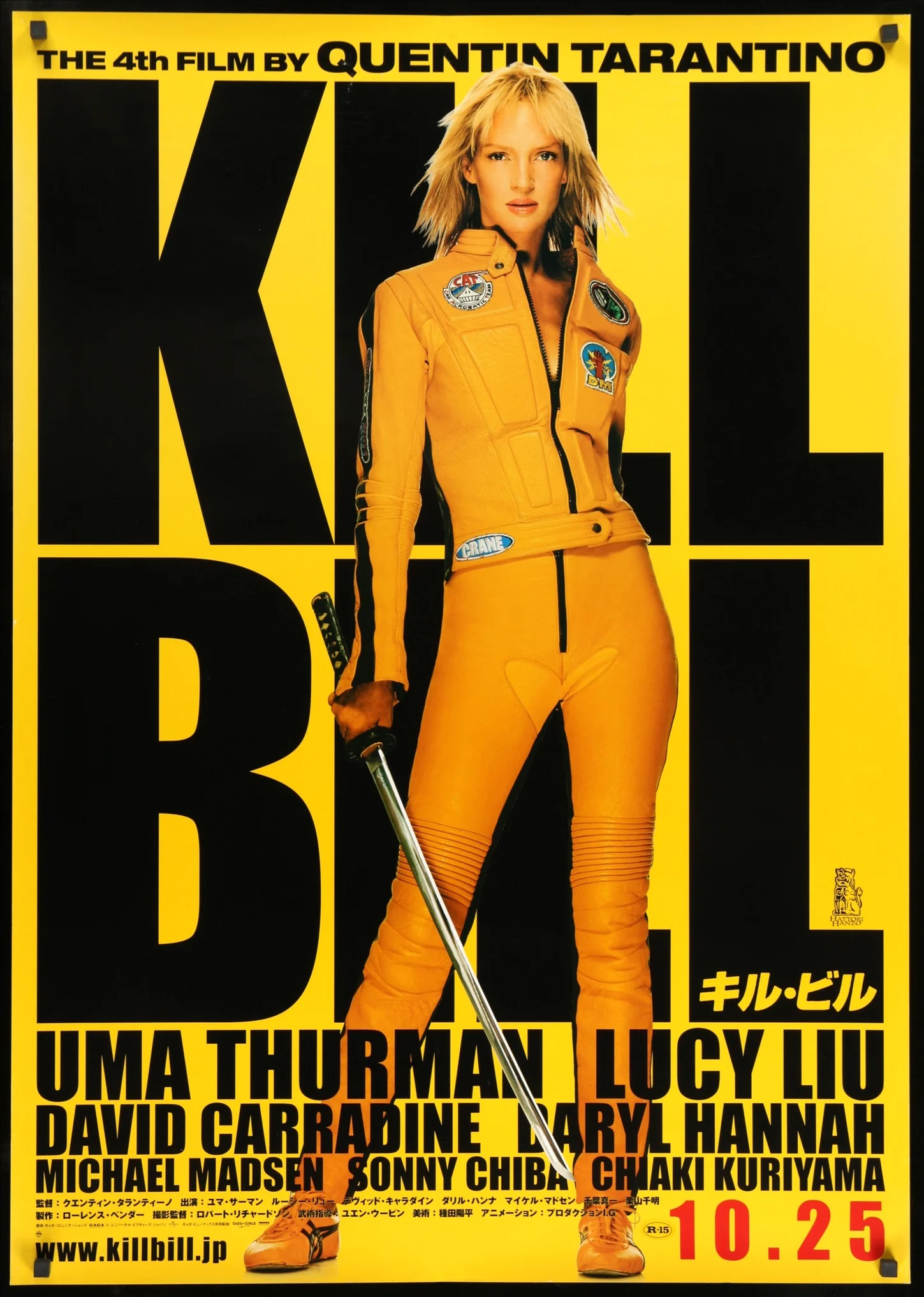
Kill Bill: Volume 1
A yellow jumpsuit, a long list of enemies and one woman who refuses to be finished.
Read the retrospective
→
2006
Children of Men
A single pregnancy, a tired man and a camera that refuses to blink.
Read the retrospective
→