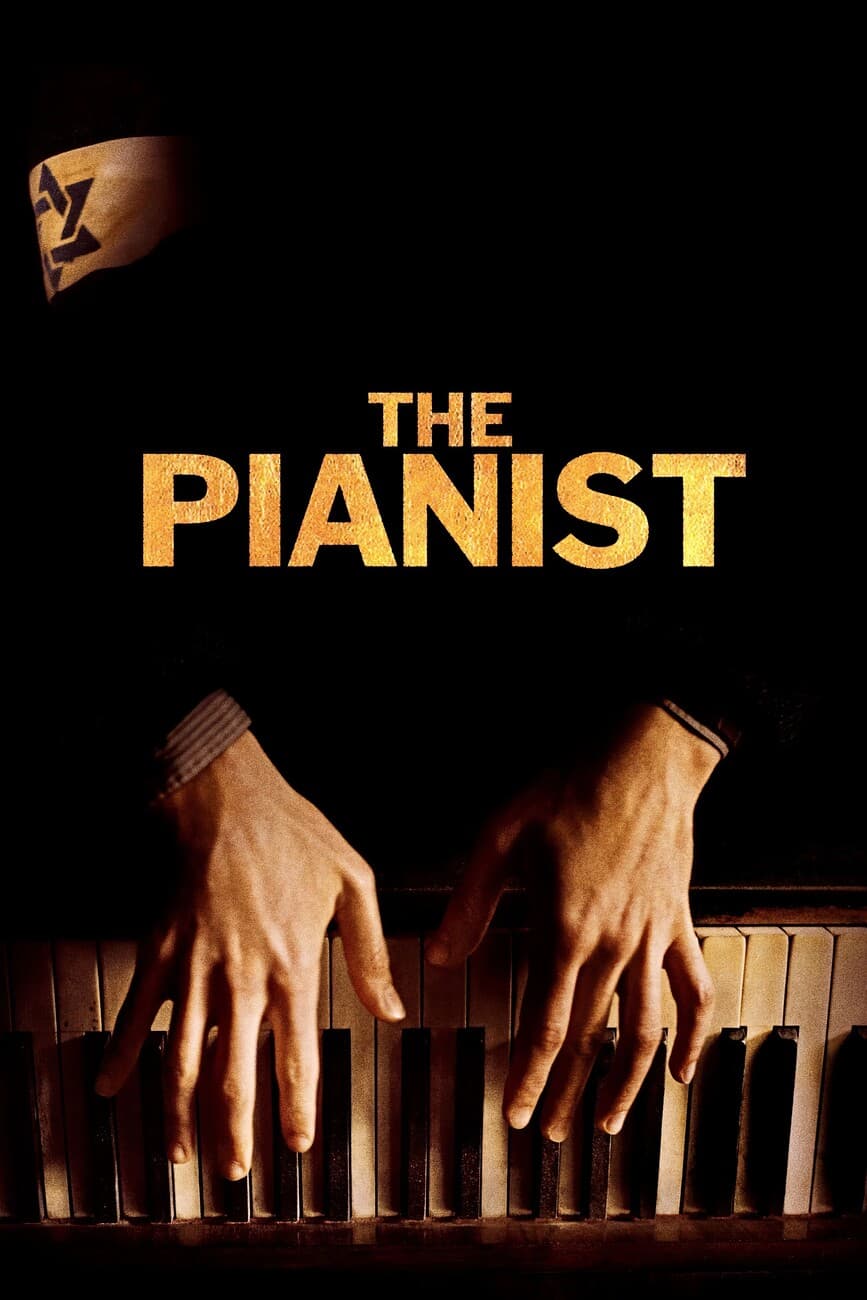
The Pianist
A quiet life unmade by war — and a pianist who refuses to stop listening.
Feature presentation
You start The Pianist with a man at a piano and a city falling apart around him. Roman Polanski’s film, adapted from Władysław Szpilman’s memoir, lets the smallest choices — a missed tram, a shared loaf, a song played in secret — decide whether a life continues. It still grips because it trusts us to watch someone survive rather than turn survival into spectacle.
THE MOVIE
Władysław Szpilman is still the reason this movie works
The Pianist begins not with a battle but with a performance: Szpilman’s live radio recital is shattered by the German bombing of Warsaw. That single interruption — a public life halted mid-note — gives the whole film its rhythm. It’s a neat move; from that moment the film narrows from music into survival, and everything that follows reads as the aftershock of that first broken bar.
This is an adaptation of Władysław Szpilman’s wartime memoir, shaped as a close, chronological portrait of one man’s life from the bombing through ghettoisation and years in hiding. The story is stubbornly domestic: loss of work, loss of home, the small humiliations and the random mercies that add up to staying alive. It’s not a panoramic war movie; it’s a life watched very closely.
Roman Polanski directs with that particular economy he brings to personal histories — nothing wasted, nothing theatrical for its own sake — and Adrien Brody plays Szpilman, the pianist at the film’s stubborn centre. The result runs long, quietly deliberate, and keeps returning to music and identity as the ties that pull Szpilman through the war’s contingency.
THE SETUP
The idea that sets The Pianist in motion
The Pianist trusts a simple structural idea: follow Szpilman in sequence and keep the camera close to what he experiences. That chronological, close-point-of-view approach makes the film feel immediate — we live the erosion of normality through his interrupted performances, his shrinking work prospects and the step-by-step collapse of his world.
Because the film privileges everyday survival over grand military set-pieces, its drama comes from losses you can recognise: a job gone, a home taken, relatives deported. Those small, accumulating blows are the engine of the story; the plot advances via a series of episodes that change Szpilman’s immediate prospects rather than through a single heroic arc.
And Polanski’s set-up keeps contingency at the centre. Szpilman survives by a combination of concealment, the goodwill (or indifference) of strangers and sheer chance. That late turning point — the moment a German officer discovers Szpilman and, upon learning he is a pianist, offers food and shelter — is decisive precisely because the film has established survival as a matter of fragile, local transactions.
THE CHARACTER
Why Władysław Szpilman matters
Szpilman matters because he is not cast as a symbol but as a person whose identity is built around a craft. The film keeps coming back to music: it’s not just what he did for a living, it’s what keeps him thinking in human terms when everything around him is being reduced to numbers and orders. That attachment to the piano gives his choices shape — it’s a recurring motive you can follow when nothing else seems to make sense.
His family are ordinary anchors: parents, siblings and daily routines that the film treats as losses rather than as shorthand for suffering. Their deportations and separations provide the story’s personal stakes, so Szpilman’s endurance is always measured against a pile of private griefs rather than dramatic set-pieces.
The supporting people in Szpilman’s life — neighbours, friends, casual helpers — arrive episodically and matter because they alter his immediate chances. The picture the film paints is of survival woven out of small human interactions rather than grand moral pronouncements, which is why Szpilman’s quiet persistence remains so memorable.
Adrien Brody plays Szpilman, and the casting keeps the film focused on a single life navigating enormous events.
THE PERFORMANCE
Why Adrien Brody's performance matters
There’s a straightforward industry fact worth noting: Adrien Brody’s portrayal of Władysław Szpilman received major awards recognition, including the Academy Award for Best Actor. That tells you the performance was central to how the film was received and marketed.
More than decoration, the casting functions narratively: the movie is anchored on one man’s experiences and the actor’s role is to carry us through those quiet stretches of contingency and waiting. The Oscar is a formal marker that the industry treated this central performance as crucial to the film’s success.
Whether you think awards equal quality is up to you. But in The Pianist the performance was clearly integral to the storytelling strategy — the film is built around a single viewpoint and the actor’s work is the tool that lets that viewpoint feel lived-in for almost two-and-a-half hours.
UNDER THE SURFACE
The Pianist has more on its mind than the plot suggests
On the surface it’s a wartime survival story. Underneath, the film keeps returning to how contingency — random acts of cruelty or kindness — shapes a life. Survival here is not heroic in a classical sense; it’s the product of luck, small favours and a refusal to let the self be reduced to a number.
Memory and testimony are built into the project from the start: it’s an adaptation of Szpilman’s own wartime account, and the film reads like a witness trying to preserve the texture of ordinary experience amid annihilation. That focus on testimony means the film often stops long enough to record the small details that prove a life happened.
Music and identity are another recurrent idea. Szpilman’s pianism is not merely biographical detail — it’s a language the film uses to argue that art can survive within atrocity and that a profession can anchor a person when social structures collapse.
Finally, moral ambiguity threads through the picture. The late encounter with a German officer who offers aid complicates tidy enemy–ally binaries. The Pianist is interested in uneven capacities for compassion as much as it is in the mechanics of survival.
THE FILMMAKING
How The Pianist was put together
Two names help explain the film’s look and practical feel: Paweł Edelman as director of photography and Allan Starski as production designer. Those credits ground the movie in technical crafts that shape how intimate history reads on screen.
Polanski’s direction, working with that team, keeps the camera allied with Szpilman’s perspective rather than pulling for grand visual statements. The design and photography together create a world that feels structured around the small, telling moments the story depends on.
PRACTICAL EFFECTS
The effects work that gives The Pianist its physical personality
The production committed to physical reconstruction: wartime Warsaw was rebuilt on Studio Babelsberg stages and by dressing surviving period buildings in Warsaw’s Praga district. That hands-on approach lets the film feel like a place you could walk through rather than a backdrop assembled on a computer.
Large crowd moments, including the Umschlagplatz sequence, were staged on location with period set dressing. Those scenes rely on practical staging — real bodies and carefully realised streets — which keeps the film’s most harrowing sequences rooted in tangible human presence.
PURE 00s
The Pianist could not belong to any other decade
The Pianist landed at Cannes in 2002 and won the Palme d’Or, which immediately marked it as a festival favourite that would travel through the awards season circuit. That festival-to-awards trajectory was a familiar early-00s pattern for prestige international films.
It’s also a product of the period’s co-production and distribution networks: a multinational European production that found a North American home with an art-house distributor. The way it moved from festival acclaim to awards recognition — including multiple national prizes — reflects how certain international films reached global audiences in the early 2000s.
So while the subject matter is historical, the movie’s lifecycle — festival premiere, Palme d’Or, awards-season momentum — is very much of its moment in 2002.
THE LEGACY
Why The Pianist still matters
The Pianist’s awards haul is part of its legacy: Palme d’Or at Cannes and three Oscars, including Best Director and Best Actor, secured its place in the conversation about early-00s prestige cinema. Those accolades made the film unavoidable in festival and awards-era talk.
Beyond trophies, the film’s particular combination of Chopin’s music and a close, survival-focused narrative keeps it in later critical discussions about how music functions in Holocaust representation. The use of piano and the intimacy of the storytelling are recurring points whenever critics and scholars revisit how cinema deals with testimony.
So its remembered qualities are both formal — a certain musical through-line and narrow viewpoint — and institutional: festival prizes and awards that amplified its visibility at the time.
THE VERDICT
Does The Pianist still hold up?
Yes — but not because it tries to be everything. The Pianist endures because it keeps faith with its own modest promises: a faithful adaptation of Szpilman’s memoir that follows one life from the radio recital interrupted by bombing through ghettoisation and long periods in hiding. That tight focus is the film’s strength; it turns large historical horror into a series of human moments you can watch and feel.
The structure matters. By building the story from episodes of loss and small survivals rather than a heroic crescendo, the film makes contingency and local kindness feel decisive. The late turning point — when a German officer learns Szpilman is a pianist and offers aid — is striking because the film has already established how fragile existence is, and how unpredictable help can be.
Polanski’s direction and the narrative’s single-point perspective keep the experience direct, and the constant return to music and identity makes Szpilman more than a passive witness: his profession is the thread that runs through the chaos. If you want history turned into spectacle, this is not the film for you. If you want to be asked to listen, to follow one person’s improbable survival, it still works.
So should you watch it today? If you’re willing to sit with a film that prefers closeness and contingency over broad strokes, absolutely. The Pianist is a film that asks you to pay attention — and it rewards that attention by letting a single life, and the music that defines it, do the heavy lifting.
Share this movie
Keep watching
More movies from the 00s
2006
Blood Diamond
A mercenary, a fisherman and a pink diamond — and a film that still asks who pays for our jewellery.
Read the retrospective
→
2003
Kill Bill: Volume 1
A yellow jumpsuit, a long list of enemies and one woman who refuses to be finished.
Read the retrospective
→
2006
Children of Men
A single pregnancy, a tired man and a camera that refuses to blink.
Read the retrospective
→