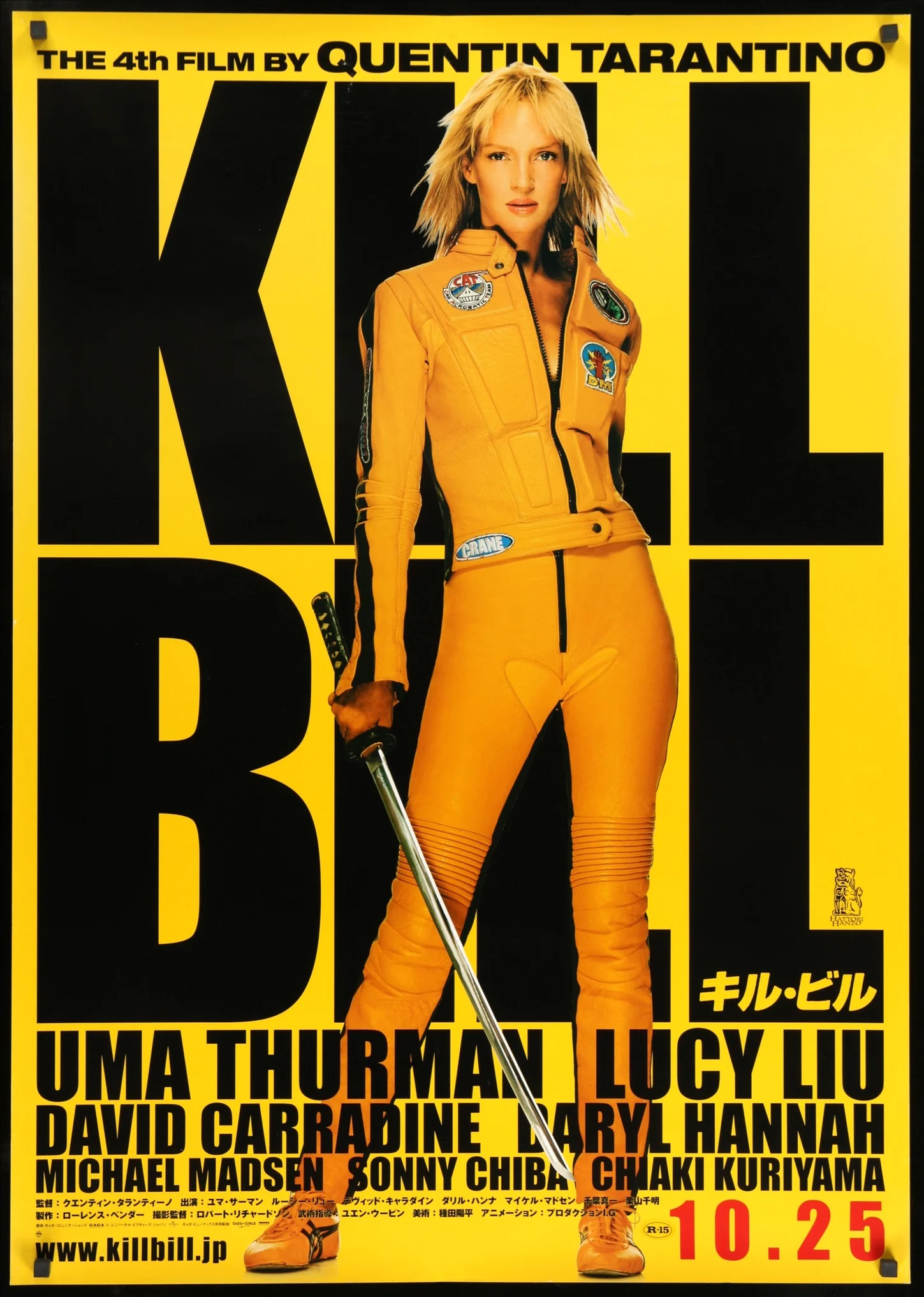
Kill Bill: Volume 1
A yellow jumpsuit, a long list of enemies and one woman who refuses to be finished.
Feature presentation
There’s a particular moment in Kill Bill: Volume 1 when you stop thinking about style and realise you’re watching someone make vengeance feel like an art form. Quentin Tarantino’s 2003 set-piece machine funnels samurai, wuxia and grindhouse into a single, episodic rampage — and at the centre of it all is Beatrix Kiddo, the Bride, waking up and getting to work.
THE MOVIE
Beatrix Kiddo / The Bride is still the reason this movie works
Kill Bill: Volume 1 hooks you on a promise: a woman who was left for dead at her own wedding wakes from a coma and starts methodically hunting down the people who destroyed her life. That straightforward engine — waking, remembering, recalculating — gives Tarantino something simple and relentless to spin a very noisy, very stylish film around.
Tarantino stages that hunt as an episodic checklist. Each chapter feels like a compact film of its own — background, build-up, and then a gladiatorial set piece — which keeps the momentum jagged and exciting rather than merely linear.
At the film’s centre is Uma Thurman’s Bride. The movie’s appetite for revenge and the Bride’s struggle to recover agency after violent betrayal are not window dressing; they’re the emotional motor that makes the action matter.
THE SETUP
The idea that sets Kill Bill: Volume 1 in motion
The film gives you the essentials quickly: the Bride survives an ambush at her wedding, wakes up years later and begins ticking off members of the Deadly Viper Assassination Squad. That is the plot’s spine — simple, relentless and easy to follow.
Tarantino structures these episodes like chapters in a book. One chapter will detour into a character’s backstory, another will build into a single, contained combat sequence — which keeps the film energetic and allows every vignette to land with the weight of a mini-movie.
Because Volume 1 is deliberately partial — it stops before the whole story is told — the setup also serves as a tease. The movie is content to leave some questions until the next instalment, which makes the hunt feel like an unfolding ledger rather than a neatly tied-up tale.
THE CHARACTER
Why Beatrix Kiddo / The Bride matters
Beatrix Kiddo is not just a target list with a face. The whole point is that she was disempowered — betrayed and left for dead at her wedding — and the film watches her take back that power in deliberate, often brutal steps.
Her decisions carry extra charge because many of the people she confronts are not anonymous thugs but former colleagues and rivals. Having Vernita Green, Elle Driver or Budd on her list turns each encounter into an argument with her past, not just another fight.
Tarantino didn’t pull this character out of nowhere. The Bride’s origins are rooted in motifs he was already developing in earlier work, and that sense of a lead character reworked from previous ideas gives the part a crisp dramatic purpose: she’s a vehicle for revenge, transformation and cinematic pastiche all at once.
THE PERFORMANCE
Why Uma Thurman's performance matters
Contemporary coverage singled out Uma Thurman’s physical commitment and the sheer demands the role placed on her. That matters because Kill Bill is a physical film: its beats live and die on movement and endurance.
When the movie asks the Bride to move from cold calculation to frantic, up-close combat, contemporary viewers registered that shift as central to the film’s impact. The performance is therefore not an optional ornament but part of what makes the set pieces land.
Put simply: the casting and the physical stakes were treated — at the time — as essential to getting Tarantino’s idea on screen.
UNDER THE SURFACE
Kill Bill: Volume 1 has more on its mind than the plot suggests
On the surface the film is revenge in its purest form: a list, a journey, retribution. But Tarantino layers that with questions about what revenge costs. The Bride’s campaign is a recovery of agency, yes, but it’s also a narrowing of life into purpose.
Identity and reinvention thread through the story. Characters reinvent themselves into positions of criminal leadership, and the Bride herself changes from comatose victim into a single‑minded instrument of retribution.
All of this plays out through a deliberate pastiche. The movie wears its influences — samurai films, wuxia, spaghetti westerns and exploitation cinema — on its sleeve, using genre blending as both a decorative choice and a way to let those themes breathe in different registers.
That pastiche is not accidental; films like Lady Snowblood are frequently referenced as a visual and narrative touchstone for the revenge structure Tarantino assembles here.
THE FILMMAKING
How Kill Bill: Volume 1 was put together
Tarantino and his production designers didn’t pretend Tokyo was Tokyo; they hybridised and stylised environments, building large sets that feel like heightened versions of real places — the House of Blue Leaves is the clearest example of that studio-and-location blend.
The film’s visual machinery was run by Robert Richardson behind the camera and Sally Menke in the edit suite. Those two names are part of why the film hangs together: cinematography and editing are the scaffolding that lets Tarantino cut from homages to extended fight set pieces without collapsing the tone.
The result is a deliberate construction rather than accidental glamour: every chapter is assembled to hit a different genre note, but the choices are anchored in production craft rather than pastiche alone.
PRACTICAL EFFECTS
The effects work that gives Kill Bill: Volume 1 its physical personality
The movie’s messy, tactile moments come from real-world craft: special make-up and prosthetics teams were employed to handle staged blood and the more graphic elements, giving the film a physical texture you can feel even on screen.
Fight sequences relied heavily on wirework and dedicated stunt crews, so the martial-arts choreography reads as practiced theatre as much as combat — the kind of rigging that lets bodies move in ways a straightforward stunt would not allow.
And then there’s the anime chapter: an entire origin sequence for O‑Ren Ishii was outsourced to a Japanese studio and inserted as a finished animated film within the live-action narrative, which is a bold, obviously artificial break — and one that the film uses to expand a character’s backstory without slowing the main hunt.
PURE 00s
Kill Bill: Volume 1 could not belong to any other decade
Kill Bill landed in 2003 at a moment when mainstream American cinema was more openly borrowing East Asian genre aesthetics — not as a background flourish, but as a structural ingredient. That context made Tarantino’s pastiche feel timely rather than merely referential.
The decision to split the project into two theatrical volumes is also very of its moment. Tarantino conceived a single long work and released it in parts — a distribution and marketing approach that fit early-2000s strategies for handling ambitious, long-form auteur projects.
Those two facts — stylistic cross-pollination and the two-volume release — are what tie the film to the era in a meaningful way, beyond any surface-level nostalgia.
THE LEGACY
Why Kill Bill: Volume 1 still matters
Part of the film’s afterlife comes from the way it was released: Tarantino and his team conceived a single, longer work that was split into two volumes and later collected in discussions of 'The Whole Bloody Affair'. That structural choice keeps conversations about the film alive — it invites viewers to think about form as well as content.
The animated O‑Ren Ishii sequence remains a headline example of a mainstream American director commissioning Japanese anime for a Hollywood feature. It’s an unusual, high-profile collision of styles that people still point to when they talk about cross-cultural collaboration in genre cinema.
More broadly, Volume 1 is often discussed as an early‑2000s exemplar of cross-cultural pastiche: its piling up of samurai, wuxia, spaghetti western and exploitation references made it a prominent example of how genre blending could be deployed in a blockbuster‑scale auteur project.
THE VERDICT
Does Kill Bill: Volume 1 still hold up?
Yes — if you’re coming for style, structure and a razor-focused revenge story, Kill Bill: Volume 1 still delivers. It is organised around a single animating idea: the Bride wakes from a coma and methodically hunts the people who ruined her life, and that single-minded mission keeps the film taut even when its flourishes get loud.
The episodic structure — chapters that detour into backstory and build toward set pieces — means the film never overstays any single idea, and it lets Tarantino change tone without losing momentum. At the same time, the decision to postpone some revelations and reserve certain answers for the second volume is part of the experience; Volume 1 is intentionally partial.
The film’s production elements reinforce the premise: there’s a clear turning point when an elder swordsmith, Hattori Hanzō, gives the Bride the weapon that prepares her for the climactic duels, and technical craft — from cinematography and editing to prosthetics and stunt work — underpins the spectacle. Contemporary coverage also flagged Thurman’s physical commitment as central, which helps explain why the action reads as earned rather than gratuitous.
In short: watch it for the Bride. Watch it for the audacious genre-mashing and the odd, brilliant choices — like an entire anime chapter — that announce the film as something made by someone who loves cinema enough to mash up the parts. It’s a bloody, joyful bit of showmanship that still feels like cinema trying to have fun and be clever at the same time.
Share this movie
Keep watching
More movies from the 00s

2002
The Pianist
A quiet life unmade by war — and a pianist who refuses to stop listening.
Read the retrospective
→
2006
Blood Diamond
A mercenary, a fisherman and a pink diamond — and a film that still asks who pays for our jewellery.
Read the retrospective
→
2006
Children of Men
A single pregnancy, a tired man and a camera that refuses to blink.
Read the retrospective
→