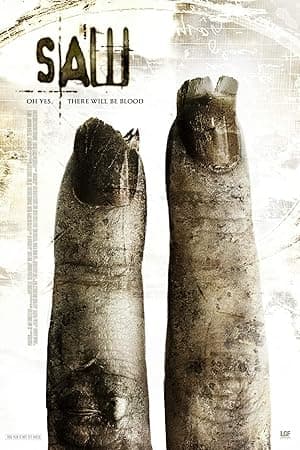
Saw II
A frantic father, a captured killer on camera and a house full of horrible choices — and yes, it still makes your stomach drop.
Feature presentation
Saw II doesn't waste time reintroducing Jigsaw; it drops a detective into a live nightmare and asks what you're willing to do when the clock eats your options. Revisit Darren Lynn Bousman's follow-up and you'll find a film built around one angry, guilty cop, a set of engineered moral tests, and a filmmaking shorthand that keeps the pressure high for 93 minutes.
THE MOVIE
Detective Eric Matthews is still the reason this movie works
Start with the image the film refuses to let go of: police have John Kramer in custody, but the monitors in the station show eight strangers locked inside a house, racing against a ticking threat. That split between a contained standoff and a distant, televised terror is the hook that gives Saw II its breathless centre.
Donnie Wahlberg's Detective Eric Matthews matters because he isn't just another cop trying to solve a puzzle — he's a father with a broken relationship who wears guilt and anger like a second uniform. His personal stakes make the procedural setup a lot less abstract: this is about a man who can’t save his son, and that frustration drives how he approaches the entire case.
All of which sits inside a straightforward, grim device: violence as test. Bousman directs a film that keeps returning to engineered moral choices — people forced to answer for their lives under time pressure — and that framing is what propels Saw II faster than the usual sequel machinery.
THE SETUP
The idea that sets Saw II in motion
The premise is elegant and mean in equal measure: a Jigsaw-style corpse leads the police to John Kramer, but Kramer’s capture is complicated by live footage of eight people trapped in a house, one of them the detective’s son. The film splits its energy between the station and that claustrophobic game, which keeps you watching both sides for answers.
Inside the house the rules are blunt. The captives must find syringes of antidote while they endure individual contraptions that test something about their choices or pasts. It’s a survival puzzle that demands both urgency and moral reckoning — identify the needle, or pay a far worse price.
On the other side of those monitors, the police narrative is boxer-thin but effective: a standoff around a captured Jigsaw that must grapple with events happening out of reach. That separation — hands on the prisoner, eyes on the screen — creates the parallel timelines that keep the film hopping and the audience guessing.
Finally, Saw II is not reinventing the wheel so much as doubling down on a recognised formula. It continues the Jigsaw story from the original film, turning one grim idea into a wider, more procedural game.
THE CHARACTER
Why Detective Eric Matthews matters
Donnie Wahlberg plays Detective Eric Matthews, and the movie rests on what that character is willing to do when the rules start to bend. Matthews is not an abstract moral calculator; he’s a father whose failure to connect with his son sits at the heart of the film’s stakes.
That guilt and anger shape how Matthews behaves when the house game appears on the monitors. He isn't merely solving a case — he’s trying to close the gap his own mistakes opened. That personal dimension keeps the procedural side from becoming purely schematic.
Because his choices have consequences for people we already know — his son above all — Matthews converts the film’s time pressure into something intimate. The audience is not only following a plot, they’re watching a man try to be better when the clock offers him no time to practise.
In short: Matthews matters because his personal failure is what the movie uses to make the traps feel like they land. The moral arithmetic is no longer a theoretical exercise; it has a face, a voice and a list of debts to settle.
THE PERFORMANCE
Why Tobin Bell's performance matters
Tobin Bell returned as John Kramer and the film leaned into the presence he established in the first movie. The performance was visible enough to attract mainstream attention — Bell earned a nomination in MTV’s Best Villain category the following year.
That recognition matters because Jigsaw is the franchise’s moral engine: a measured, ominous figure who organises tests rather than simply slaughtering people. Bell’s portrayal kept the character grounded as an architect of consequence, which helped the film treat its gruesome setups as grim thought experiments rather than randomness.
In practical terms, having Kramer back in custody while his designs play out elsewhere also lets Bell occupy a different sort of authority. He’s still central to the story even when he’s out of reach — a reminder that the villain’s gravity isn’t only in what he does on-screen but what the others react to.
So while the traps scream for attention, Bell’s nomination was a sign that the role still commanded the conversation; the movie needed a Jigsaw who felt less like a costume and more like the reason the tests existed.
UNDER THE SURFACE
Saw II has more on its mind than the plot suggests
At face value, Saw II is an efficient horror puzzle about survival. Under the skin, it’s preoccupied with moral testing — the idea that trauma and punishment can be rephrased as exams for character, and that violence can be organised into lessons.
Those tests are tied to consequences and responsibility. People are put into situations where choices have immediate, irreversible outcomes; the film asks, repeatedly and without apology, who is owed an explanation and who deserves mercy.
Cranking the tension is the ever-present clock: survival under time pressure isn’t just a dramatic device here, it’s the logic of the moral experiment. With seconds bleeding away, characters are forced into decisions that reveal past misdeeds and current priorities.
Put together, the movie’s recurring ideas — testing, accountability, and urgency — make it more than a sequence of gory set-pieces. They give the film a spine: the traps are not arbitrary shocks, they are mechanisms for asking uncomfortable questions.
THE FILMMAKING
How Saw II was put together
Saw II’s look and pace are the result of a compact crew with clear roles: David A. Armstrong is credited as director of photography and Kevin Greutert as editor, while production designer David Hackl built multiple sets on soundstages. That combination gives the film a tight, stage-like energy.
Shooting traps and the house environments on soundstages matters because it makes the space feel claustrophobic and controlled. The movie trades on that manufactured pressure: when everything is designed to constrain movement, the clock and the choices have more bite.
Editing and photography work together to maintain tension between the station and the house. Cutting back and forth — the monitors as a narrative hinge — keeps both strands urgent and connected even when they are physically separate.
Darren Lynn Bousman directs with a keen sense of how to wring drama from structure: the production design and the team’s roles are not background details, they are the scaffolding that lets the film’s premise run uninterrupted for its 93-minute sprint.
PRACTICAL EFFECTS
The effects work that gives Saw II its physical personality
Saw II leaned on hands-on methods: the production built numerous practical trap sets on soundstages and used prosthetics, staged props and stunt performers to sell sequences such as the furnace and needle-pit scenes. That craft anchors the film’s physicality.
For safety and realism the production substituted prosthetic body parts and blunted or modified prop syringes in some moments, a reminder that the onscreen horror often came from careful, controlled technique rather than dangerous improvisation.
Because the traps are so central to the story, those practical choices weren’t mere gimmicks. They helped make the contraptions feel like objects in the world of the film — convincing enough to threaten the characters and convincing enough to demand the audience’s attention.
The result is a movie where the unpleasant, tactile detail of the effects supports the premise: when the apparatuses look and behave like real threats, the moral tests feel consequential rather than theatrical.
PURE 00s
Saw II could not belong to any other decade
Saw II arrived squarely in the mid-2000s moment when low-budget horror franchises proved a very tidy business model: modest budgets and punchy concepts that could be expanded into annual instalments. The film sits comfortably in that cycle, arriving in 2005 and picking up the Jigsaw story where the first movie left off.
The movie’s production and release pattern — a leanly budgeted sequel that doubled down on one central idea — is precisely the kind of strategy that turned Jigsaw into a dependable franchise property. Tobin Bell’s return and the continuation into another sequel the next year cemented that annual rhythm.
That approach mattered beyond the studio ledger. It gave the film licence to be more episodic and schematic, privileging a tight premise over grand reinvention. Saw II wasn’t trying to be anything other than an effective, brutal expansion of its predecessor.
In short: Saw II’s personality — its brief running time, its economical plotting and its place inside a yearly franchise schedule — is very much of its time, a mid-00s product that knew how to convert shock and setup into a reliable entertainment engine.
THE LEGACY
Why Saw II still matters
Saw II mattered for the franchise because it reinforced a pattern: continuing Jigsaw’s story into a second and then a third chapter, and locking the franchise into an almost-annual release cadence through the 2000s. That steady output kept the series in the cultural conversation in a way one-offs often aren’t.
Commercially, the film’s success also validated a business plan. Its performance — including robust home-video returns — helped confirm the idea that small-scale horror could be a reliable investment for companies like Lionsgate and Twisted Pictures.
Beyond balance sheets, Saw II also matters because it sharpened the parts of the series that audiences tended to discuss: moral games, father-son stakes and the particular figure of Jigsaw organising it all. Those elements are what the franchise kept returning to.
So while it sits squarely inside the franchise machine, Saw II helped define that machine: it was a proof-of-concept that the series could continue to build on its central conceit rather than collapse into repetition.
THE VERDICT
Does Saw II still hold up?
Yes — with a caveat. If you come for efficient, stomach-twisting horror that ties its shocks to a recognisable set of moral questions, Saw II still delivers. The film’s core engine — a captured Jigsaw, monitors showing a distant house game and a father trying to redeem himself while the clock runs — remains sharply designed to keep you hooked.
Donnie Wahlberg’s Eric Matthews provides the emotional friction the film needs; his fractured relationship with his son gives the procedural standoff a human cost. And Tobin Bell’s continued presence as Jigsaw, acknowledged by mainstream recognition at the time, keeps the antagonist’s logic coherent when the action moves between locations.
On the practical side, the movie’s 93-minute runtime, stage-like production choices and reliance on constructed trap sets mean it rarely lingers where it shouldn’t. It knows what it is, and it leans into the engine of moral testing and shrinking options until the last possible second.
So should you watch it? If you’re curious about the early-00s horror machine or you want a sequel that refines exactly what made the first film unsettling, Saw II is still worth your time. It’s not high art — it’s a well-calibrated moral horror that remembers the one thing that matters most to its formula: people, responsibility and a clock that refuses to be kind.
Share this movie
Keep watching
More movies from the 00s

2002
The Pianist
A quiet life unmade by war — and a pianist who refuses to stop listening.
Read the retrospective
→
2006
Blood Diamond
A mercenary, a fisherman and a pink diamond — and a film that still asks who pays for our jewellery.
Read the retrospective
→
2003
Kill Bill: Volume 1
A yellow jumpsuit, a long list of enemies and one woman who refuses to be finished.
Read the retrospective
→