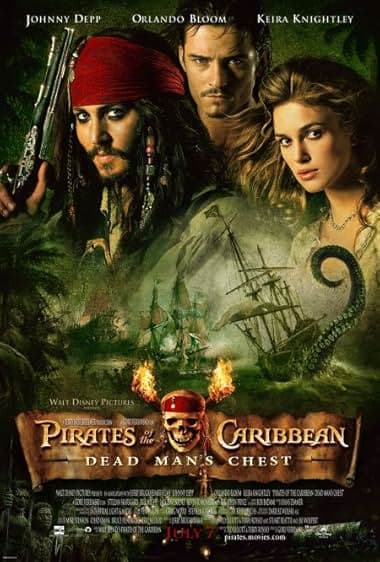
Pirates of the Caribbean: Dead Man's Chest
Debt, bargains and one gloriously unreliable pirate.
Feature presentation
Remember that moment when the stakes of rum, reputation and a very literal contract all collide? Pirates of the Caribbean: Dead Man's Chest takes Jack Sparrow’s slipperiest instincts and plugs them into a story about debt, monsters and corporate men in uniforms — and it’s exactly the sort of mid‑2000s blockbuster that either delights or exhausts you, depending on your tolerance for high-seas melodrama. Directed by Gore Verbinski and sitting squarely on Johnny Depp’s shoulders, it still invites a proper rewatch.
THE MOVIE
Captain Jack Sparrow is still the reason this movie works
If you had to pick one short answer to why people still talk about Pirates of the Caribbean: Dead Man's Chest, it starts and ends with Jack Sparrow. The movie spins out from a very particular setup — Jack is up against an unpaid bargain with Davy Jones — and most of the film's energy comes from how that single debt ripples through every other character's choices.
This isn’t just supernatural spectacle. The East India Trading Company moves like a different kind of monster, too: Lord Cutler Beckett and his offer to Will Turner turn a chase for a magic chest into a wider fight about control and consequence. That tug between pirate freedom and institutional order gives the plot teeth.
Gore Verbinski directs the whole thing with the widescreen confidence of a summer tentpole, and at 151 minutes the film knows it has space to let chaos breathe. Whether you love it or groan at the length, Jack Sparrow — played by Johnny Depp — is the magnetic centre that keeps the ship upright long enough for the rest of the story to matter.
THE SETUP
The idea that sets Pirates of the Caribbean: Dead Man's Chest in motion
The engine here is simple: a literal bargain gone wrong. Roughly a year after the events of the first film, Jack Sparrow discovers he owes something terrible to Davy Jones, and that unpaid debt drags him into immediate peril.
Once that bargain is in play, two separate pressures hem the characters in. On one hand there is the supernatural threat — Davy Jones and the Kraken are not metaphors; they are the kind of problems that swallow ships. On the other is an institutional menace: the East India Trading Company, which wants the chest for its own ends.
Those two forces — mythic and corporate — don’t operate in isolation. They crisscross through Jack, Will and Elizabeth’s choices, turning a treasure hunt into a battleground of loyalties, bargains and moral compromises.
It’s a tidy premise for a middle film: personal obligation makes the stakes immediate, while external powers raise the cost of failure for everyone involved.
THE CHARACTER
Why Captain Jack Sparrow matters
Jack Sparrow isn’t just the lead; he’s the engine that changes the movie from an adventure into a personality‑driven spectacle. The plot is built around his problem — that unpaid bargain — so the film asks you to follow his recklessness as a strategy, not a quirk.
Because Ted Elliott and Terry Rossio shaped these characters across the franchise, Jack arrives here as something already well tuned: a pirate who treats danger like a negotiation, a performance and a survival tactic all at once. The story bends to accommodate his unpredictability.
When the movie needs momentum it hands Jack a problem he can dodge, outwit or exacerbate — which keeps things interesting because you never quite know which tactic he’ll reach for next.
That matters because Dead Man's Chest is less interested in tidy hero arcs than in how a charismatic troublemaker forces other people to react — and those reactions reveal the film’s moral tensions.
THE PERFORMANCE
Why Johnny Depp's performance matters
Contemporary coverage and reviews homed in on Johnny Depp’s Jack Sparrow as the film’s central screen presence, and that observation tells you how the movie’s tone is carried. When everyone else plays the scene straight, Jack is the wild card that sets the film’s flavour.
That concentration of attention isn’t accidental: the narrative relies on Jack being someone the audience wants to follow even when he’s making poor decisions. He’s not merely colourful — he’s the compass the film uses to navigate chaos.
So the performance functions as a kind of tonal anchor. Even in scenes where the plot takes a sombre turn, the memory of Jack’s irreverence keeps the film from becoming purely operatic.
Put simply: lots of Dead Man's Chest is about monsters, chases and conspiracies, but the reviews kept returning to Jack because his presence shapes how you feel about all of it.
UNDER THE SURFACE
Pirates of the Caribbean: Dead Man's Chest has more on its mind than the plot suggests
At face value it’s a search for a chest. Underneath that is a steady interest in debt and obligation — Jack’s bargain with Davy Jones is a contract that keeps resurfacing, in legal and emotional forms.
That material ties directly into loyalty and betrayal. Characters keep choosing between blood, friendship and self‑interest; those choices land differently when there’s a literal heart at stake.
There’s also a clear man‑versus‑supernatural thread: Davy Jones and his monstrous assets are not just set pieces but forces that demand payment in familiar human currencies — promises, lives, freedom.
Finally, the film stages a contest between corporate order and pirate freedom. The East India Trading Company’s manoeuvres make piracy feel less like costume drama and more like a political position worth defending — or exploiting.
THE FILMMAKING
How Pirates of the Caribbean: Dead Man's Chest was put together
Dead Man's Chest was assembled with a solid studio crew behind it: Dariusz Wolski served as director of photography, Craig Wood and Stephen E. Rivkin handled the editing, and Rick Heinrichs was the production designer. Those choices give the film a professional, big‑screen texture.
Gore Verbinski directs with the sort of confidence you expect from a franchise second act — there’s an appetite for spectacle, but the practical decisions (locations plus constructed sets) keep the chaos readable.
Editing is part of how the film manages its length: at around 151 minutes the rhythm needs regular small bursts of clarity to avoid sagging, so the editors’ job is to keep momentum between the set pieces and the quieter interpersonal moments.
Those decisions combine into a visible directing style: widescreen adventure that wants to be both bombastic and legible, with a production team chosen to deliver at scale.
PRACTICAL EFFECTS
The effects work that gives Pirates of the Caribbean: Dead Man's Chest its physical personality
To make Davy Jones feel present on set, ILM developed a lightweight on-set motion-capture system (iMocap) so Bill Nighy’s performance could be captured while actors performed together on location. That kept reactions authentic rather than imagined in isolation.
Although Jones and his crew are realised primarily as CG characters, that VFX work was driven by animation and pipeline choices at ILM that aimed to integrate the digital figures into live action convincingly.
ILM presented the VFX for Davy Jones as a technical advance at the time — the tentacle work and facial integration were treated as a breakthrough in performance-driven digital character creation.
So while much of the monster work is computer-driven, the production deliberately bridged the gap between actor and effect to preserve the physicality of performance.
PURE 00s
Pirates of the Caribbean: Dead Man's Chest could not belong to any other decade
Released in 2006, Dead Man's Chest sits firmly in the mid‑2000s era of big summer tentpoles. It’s the sort of expensive, spectacle-first blockbuster that studios leaned on to anchor franchise slates.
The film exemplifies a particular 00s production logic: location shoots, extensive on-set capture techniques and heavy ILM digital character work combined to make something that felt both epic and technologically modern for its time.
Its release strategy — a big summer opening and a Disneyland premiere — is characteristic of how studios treated franchise cinema then: events rather than mere releases.
Taken together, those elements place the film in a moment when studios were comfortable spending to create widescreen adventures that blended practical production with cutting-edge visual effects pipelines.
WATCHING IT NOW
What has aged — and what hasn't
One concrete thing that still stands up is the VFX achievement around Davy Jones. ILM’s work — including the on-set motion-capture system — is repeatedly highlighted in later coverage as a landmark step in performance capture and character animation.
That technical backbone means some sequences retain a sense of wonder because they were genuinely pushing pipeline boundaries at the time. The ambition is still detectable even if tastes in effects have shifted.
On the other hand, the film’s middle‑act structure — it’s intentionally the middle piece of a larger arc shot back‑to‑back with the next film — means it sometimes feels like a bridge rather than a full home. That design choice still affects how satisfying the film can feel on its own.
So parts of Dead Man's Chest age well because of technical achievement and boldness; other parts feel like the compromises of a middle chapter written to keep a larger story going.
THE LEGACY
Why Pirates of the Caribbean: Dead Man's Chest still matters
Part of the film’s afterlife is the recognition it received for visual effects: it won Best Visual Effects at the 79th Academy Awards, and that award remains part of the movie’s official record.
As the middle film of a connected story arc — conceived and produced alongside the third instalment — Dead Man's Chest matters for how it pushed the franchise into broader, more operatic territory.
Davy Jones emerged from this film as a distinctive franchise character, and the way he was created is frequently cited in VFX histories. That keeps the movie in conversations about technical progress as well as franchise storytelling.
So the film’s continuing relevance is twofold: it’s both a central chapter in a major franchise and a milestone in performance‑driven visual effects.
THE VERDICT
Does Pirates of the Caribbean: Dead Man's Chest still hold up?
If you’re asking whether to watch Dead Man's Chest today, it depends on what you want from it. If you’re after a neat, standalone adventure you might find it less satisfying — the film was written to be the middle act of a larger arc and even ends on a deliberate cliff‑hanger.
But if you come for the characters and the central tensions — Jack Sparrow’s literal contract with Davy Jones, Will Turner’s bargain with evolving loyalties, and the East India Trading Company’s push for control — there’s a lot that remains rewarding. Those story pressures still create sharp, interesting choices.
Technically, the film retains value: ILM’s on‑set motion capture and the visual work on Davy Jones were breakthroughs then and remain a key reason to revisit the movie if you’re interested in how performance capture advanced.
Ultimately: watch it for Jack Sparrow and the audacity of its ideas. Watch it less if you need a tidy ending. Dead Man's Chest still works, but mostly as a gloriously messy middle chapter — loud, ambitious and indebted to its own mythology.
Featured in
Explore more about Pirates of the Caribbean: Dead Man's Chest
Share this movie
Keep watching
More movies from the 00s

2002
The Pianist
A quiet life unmade by war — and a pianist who refuses to stop listening.
Read the retrospective
→
2006
Blood Diamond
A mercenary, a fisherman and a pink diamond — and a film that still asks who pays for our jewellery.
Read the retrospective
→
2003
Kill Bill: Volume 1
A yellow jumpsuit, a long list of enemies and one woman who refuses to be finished.
Read the retrospective
→