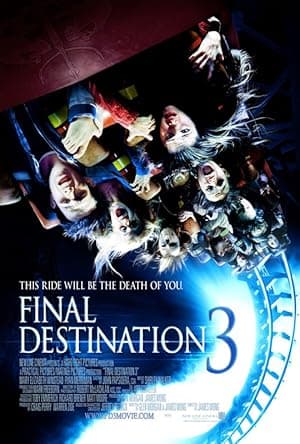
Final Destination 3
A roller-coaster premonition, a stack of telling photos and one woman trying to out-think an inevitable plan.
Feature presentation
Final Destination 3 hooks you in the first three minutes: Wendy Christensen sees a roller-coaster collapse, talks half a car-full of people off the ride, then watches the world reassemble itself into a sequence of deaths she can only half-predict. It’s James Wong’s return to the series in 2006, a compact 93-minute horror that turns photographic clues and Rube-Goldberg accidents into a grim logic game.
THE MOVIE
Wendy Christensen is still the reason this movie works
People still talk about Final Destination 3 because it gives you two perfectly clear promises up front: there will be a vivid, public disaster, and there will be a paranoid, obsessive response you can follow like a breadcrumb trail. Wendy Christensen sees the roller-coaster collapse in a premonition, persuades people to get off, and then has to live with the knowledge that getting them off the ride was only the beginning.
What lifts the setup from simple contrivance into something you care about is how the film turns photographs into a detective’s kit: images Wendy took on the night of the derailment contain clues about how the survivors will be picked off. That mechanical logic — foreshadowing as puzzle — gives the whole thing focus and a grim sort of fairness.
James Wong returned to direct this third chapter in 2006 and keeps it tight: 93 minutes, a small core of characters led by Mary Elizabeth Winstead’s anxious, control-conscious Wendy, and a single, insistent theme — the clash between wanting control and discovering you can’t have it.
THE SETUP
The idea that sets Final Destination 3 in motion
At its centre the movie runs on a deceptively simple contract: a premonition saves a group from a public catastrophe, and that very salvation starts a new, ordered chain of deaths. The survivors begin dying in the same order they would have on the coaster, which turns what should be random misfortune into a pattern you can almost read.
That pattern is physical and visual. Wendy’s photographs from the night of the derailment don’t just remind her of what happened; they hide elements that foreshadow future accidents. The film invites you to squint at a snapshot and see the future — or at least the mechanism Death will use.
The central conflict isn’t a whodunnit. It’s interpretation and intervention: Wendy and her allies are trying to decode those photographic clues and then stop the inevitable sequences they reveal. It turns the movie into a tense, puzzle-led ride with a moral edge: you can see fate coming, but you can’t necessarily stop its motion.
Because the premise is a franchise staple — premonition, survivors targeted by Death — this installment plays like a refinement of the idea rather than a reinvention. It’s focused on the how of survival and the what of prevention, and that focus keeps the plot brisk without losing the dread.
THE CHARACTER
Why Wendy Christensen matters
Wendy is the lens you view everything through. Mary Elizabeth Winstead’s character is introduced as anxious and control-conscious, which is exactly the temperament you need when fate starts arranging itself like a machine with a vendetta.
Her premonition and the choices that follow are not just plot engines; they’re expressive of who she is. Wendy’s attempts to save people are obsessive and procedural — she reads photographs like case files, and that methodical response makes the film feel like a thriller as much as a slasher.
She’s not alone. Kevin Fischer is her close friend and occasional romantic interest, the sensible foil who supports the investigation into the photographs. That partnership anchors the film’s more frantic sequences: someone has to try and act while Wendy untangles the clues.
Around them sits a cast of supporting survivors — Ian, Erin, Lewis, Julie, Perry, Frankie, Ashley and Ashlyn — whose fates give Wendy’s puzzle its stakes. Without that small community of characters, the photographic game would be abstract; instead, it’s personal.
THE PERFORMANCE
Why Mary Elizabeth Winstead's performance matters
Contemporary reviewers picked up on something practical and useful in Winstead’s work: critics noted that she was able to convey Wendy’s emotions in a way that kept the story believable. That matters here because the movie relies on you caring about a protagonist whose main job is worry.
When your lead’s primary dramatic function is to be right and anxious about being right, she needs to make that state feel lived-in rather than staged. The praise the film received at the time points to Winstead providing that steady center.
That steadiness isn’t about star turns or scene-stealing. It’s the quieter task of being credible under pressure — someone you’ll follow as the photographic clues accumulate and the mechanical deaths close in.
Put simply: Wendy’s reactions are the movie’s emotional thread. Contemporary response singled that out, and without that readable human core the chain-reaction concept would feel colder and less involving.
UNDER THE SURFACE
Final Destination 3 has more on its mind than the plot suggests
At face value the film is a sequence of inventive deaths. Underneath, it’s arguing with the idea of control. The filmmakers themselves pointed to loss of control versus the desire for control as a major theme, and the movie stages that argument with chilling clarity.
Wendy wants to manage risk. Fate, in the movie’s terms, is a system that punishes the illusion of management. The survivors discover that cheating a single disaster doesn’t grant freedom — it merely rearranges the terms of their mortality.
That leads to the franchise’s recurring meditation on inevitability: death is not random chaos here so much as a cold arithmetic. The film turns misfortune into cause-and-effect machinery; accidents are not isolated; they are links in a chain.
And the photographic foreshadowing sharpens the point. The images make the future legible, which forces the characters — and the audience — into a peculiar moral position: you can see how people will die, but seeing it doesn’t mean you can stop the mechanism that makes them die.
PRACTICAL EFFECTS
The effects work that gives Final Destination 3 its physical personality
The movie’s personality owes a lot to how physical its set pieces feel. The roller-coaster opening was a heavy VFX undertaking: Meteor Studios and others supplied a vast number of effects shots, with the coaster sequence alone reported at 144 VFX shots and roughly 340 VFX shots for the whole film.
That workload included digital doubles and greenscreen plates for the more dangerous moments, plus rigged carts and bespoke CG coaster elements to sell the illusion of a public catastrophe while keeping actors safe.
Late in production the filmmakers even added a subway-derailment climax, and that sequence mixed miniature practical elements with digital augmentation. The miniature work was completed on a tight schedule and gave the finale a tactile quality that pure CG sometimes lacks.
So the film’s spectacle is a hybrid: practical miniatures and on-set rigs amplified by substantial visual effects, which together create the rubbery, mechanical-feeling accidents that define the movie.
PURE 00s
Final Destination 3 could not belong to any other decade
Released in 2006, Final Destination 3 sits inside the 2000s wave of franchise horror that turned up the spectacle dial. Sequels in that period often escalated both set-piece ambition and effects work, and this film follows that trend with an opening designed to shock and a concluding sequence added late to raise the stakes.
James Wong’s return to the director’s chair — he directed the original in 2000 and came back for this third entry — also ties the movie to the era’s appetite for franchise continuity: familiar premises stretched into new permutations rather than complete reinventions.
At release the film became the most financially successful entry in the series, a sign that audiences were still responsive to the format: a strong, specific hook plus bigger, more elaborate ways of executing it.
Put another way: Final Destination 3 is of its time because the 00s wanted horror that looked like a technical problem solved on schedule — bigger, faster, and with a glossy finish that mixed practical and digital craft.
THE LEGACY
Why Final Destination 3 still matters
Part of the film’s afterlife is business as much as aesthetics: its box-office success helped secure further sequels, and its home-video releases — including a 'Thrill Ride Edition' DVD with an interactive 'Choose Their Fate' feature — became part of the series’ story beyond cinemas.
On a production level, the movie’s elaborate opening and the revised subway climax are often mentioned in industry coverage as examples of mid-2000s effects workflows where practical miniature work and digital augmentation had to be married quickly under pressure.
Those two facts — commercial momentum and a concrete place in VFX conversation — explain why the film remains a point of reference for people interested in how horror sequels were staged in the 00s.
So it matters partly because of what it earned the franchise, and partly because it stands as a practical example of how films of that period balanced miniatures, rigs and heavy VFX counts to sell spectacle.
THE VERDICT
Does Final Destination 3 still hold up?
Yes — with a caveat. If you want a short, lean horror film that converts a single premise into a sequence of escalating problem-solving scenes, Final Destination 3 still delivers. Its opening promise — Wendy’s coaster premonition and the photographic clues that follow — remains a tidy engine for 93 minutes of narrative propulsion.
The movie’s central mechanism is unchanged: cheating a disaster only defers death, which then pursues survivors through elaborate cause-and-effect accidents. That logic gives the film discipline: each death matters because it fits the pattern, and the photographic foreshadowing keeps you engaged in decoding how the next accident will be arranged.
Mary Elizabeth Winstead’s Wendy is the film’s necessary human thread. Contemporary reviewers singled her out as a competent anchor whose emotional clarity makes the puzzle feel inhabited rather than schematic. Kevin Fischer’s role as ally and occasional romantic interest supplies the practical counterweight: someone who helps act on Wendy’s reading of the clues.
So if you enjoy the procedural nastiness of Rube-Goldberg deaths, the tension of trying to out-guess a mechanised fate, and a compact runtime that doesn’t overstay its welcome, Final Destination 3 is still worth watching. It’s not trying to be anything other than a polished mid-00s horror amusement — and it remains very good at that job.
Share this movie
Keep watching
More movies from the 00s

2002
The Pianist
A quiet life unmade by war — and a pianist who refuses to stop listening.
Read the retrospective
→
2006
Blood Diamond
A mercenary, a fisherman and a pink diamond — and a film that still asks who pays for our jewellery.
Read the retrospective
→
2003
Kill Bill: Volume 1
A yellow jumpsuit, a long list of enemies and one woman who refuses to be finished.
Read the retrospective
→