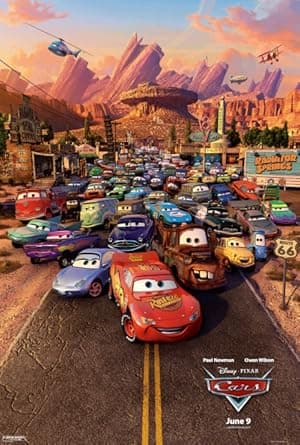
Cars
Racetrack flash and small‑town heart — and Lightning McQueen is the reason it still lands.
Feature presentation
Cars is the kind of Pixar film that dresses up a lesson in friendship as a speedway spectacle. Directed by John Lasseter and centred on a driven rookie racer, it swaps podiums for potholes and asks whether trophies are worth a lonely life in the fast lane.
THE MOVIE
Lightning McQueen is still the reason this movie works
Put simply: Cars is about a young race car whose whole life is fuelled by speed and sponsorship — until he gets marooned in Radiator Springs and has to stop long enough to notice people. That collision between ambition and small‑town life is the movie’s engine.
John Lasseter and his team frame the story so Lightning McQueen’s single‑minded chase of the Piston Cup becomes a personal problem to solve, not an abstract goal. He’s shipped into a community, sentenced to fix a road, and gradually meets people who make him rethink what matters.
The cast does the rest: Owen Wilson’s McQueen is the noisy centre, with Paul Newman as the quietly complicated Doc Hudson and Bonnie Hunt as the town’s advocate. Together they turn what could have been a simple kids’ fable into something with surprising warmth and teeth.
THE SETUP
The idea that sets Cars in motion
The story kicks off with Lightning McQueen on the way to the Piston Cup, a championship that defines his ambitions. He’s a rookie with sponsorship and a hunger to win — all the things that make him blind to anything else.
A twist of circumstance strands him in Radiator Springs, a Route 66 community that exists on a very different timetable. Because he damages the town’s road, he’s ordered to repair it — which is the kind of fairy‑godparent punishment that forces growth.
That setup works because it keeps the stakes manageable. On one side you have the bright, public world of racing; on the other, a small town that asks for patience, repair and respect. The film uses the Piston Cup as the professional goal and Radiator Springs as the place where McQueen’s personal priorities are reshaped.
There’s also real crew input behind the story: Lasseter and a group of writers developed the screenplay, and the finished picture carries the imprint of those early story choices — the championship and the town both feel like deliberate narrative anchors.
THE CHARACTER
Why Lightning McQueen matters
Lightning McQueen matters because he’s written as ambition in motion. Everything about him points toward the next race, the next sponsor and the next win — which makes his gradual change all the clearer.
Owen Wilson provides the voice for McQueen, but the character’s importance is structural: he’s the engine that drives the plot from trophy‑hungry rookie to someone who sees value outside the lap counter.
A big part of McQueen’s shift comes from the people he meets in Radiator Springs — including Mater, the local tow truck whose friendliness and loyalty become a running contrast to competitive life. Public materials and story notes point to Joe Ranft’s hand in shaping Mater’s character, which in turn reshapes McQueen.
Because Cars aims at families, McQueen’s arc is straightforward and readable: friendship beats competition, community beats instant success, and the film keeps that moral pulse visible without getting preachy.
THE PERFORMANCE
Why Paul Newman's performance matters
Doc Hudson is voiced by Paul Newman — and that casting carries weight because Cars is commonly noted as his last non‑documentary theatrical role.
That fact alone gives Doc an extra layer for adult viewers: he’s not just a mentor on screen, he’s voiced by an actor whose career history feels resonant with a film about legacy and reinvention.
Newman’s presence helps the film lean into Doc’s past as a champion and the heavier, quieter history beneath Radiator Springs’ surface.
So even when the movie is being playful, Doc brings a gravity that the story can bounce off without losing its family tone.
UNDER THE SURFACE
Cars has more on its mind than the plot suggests
On the surface Cars is a race‑movie for kids. Underneath, it’s a conversation between two ways of living: the small‑town existence that values people and place, and the fame economy that prizes speed and exposure.
That small‑town versus fame tension is the film’s recurring idea. Radiator Springs doesn’t just charm McQueen — it asks him to rethink what he’s racing toward and whether victory matters if there’s nobody to share it with.
Mentorship and legacy are threaded through the story as well. Doc Hudson’s backstory and his relationship with McQueen turn the movie into a mini‑meditation on what champions do when their time on top has passed.
All of this folds into a gentle nostalgia for Route 66 and the lost rhythms of ordinary life. As a family film, Cars keeps the emotions simple and clear, but those themes give it a surprisingly steady emotional backbone.
THE FILMMAKING
How Cars was put together
Pixar assembled a familiar technical team for Cars: a director of photography, an editor, production designers and Randy Newman on music — names that point to a broadly cinematic approach even within animation.
Those credits matter because they show Cars was handled with the studio’s usual craftsmanship: sound, design and editing were all assembled to serve both the race sequences and the quieter town scenes.
Randy Newman’s involvement as composer is worth flagging too; his songs and score give the film a strong emotional throughline that ties together the nostalgic moments and the competitive ones.
Taken together, the creative choices keep the movie feeling like a proper, full‑length family adventure rather than a short gag reel stretched to feature length.
PURE 00s
Cars could not belong to any other decade
Cars grew out of a late‑90s/early‑00s obsession: John Lasseter’s personal interest in cars and a family road trip around 2000 helped shape its Route 66 focus. That specific origin gives the film a genuine road‑trip DNA.
Its release in summer 2006 arrived at a moment when Pixar was already an animation powerhouse and family blockbusters were a reliable part of the season — which framed Cars as a major studio event rather than a niche experiment.
The timing of the Disney–Pixar acquisition, announced and completed around the film’s release, also situates Cars in a transitional industry moment. The movie sits neatly at the intersection of ambitious studio animation and shifting corporate realities.
Finally, the production was touched by the loss of story artist Joe Ranft in 2005; the finished film is dedicated to him, and his influence — especially on character moments like Mater’s — is part of what gives Cars its 00s‑era storytelling heart.
WATCHING IT NOW
What has aged — and what hasn't
Seen today as a family movie, Cars still delivers on the basics it set out to do: it’s readable, warm and built around relationships that kids can follow and adults can recognise.
The central idea that friendship should outrank competition remains tidy and effective; that simple moral keeps the film coherent and gives it a feel‑good backbone that translates across generations.
The fact Cars went on to spawn sequels in 2011 and 2017 shows the characters and world had legs beyond the original — and the third film even used archival audio to bring Doc Hudson back into the conversation.
If you watch it now, expect a solid family picture whose themes still land even if some of the peripheral trappings are very much of their era.
THE LEGACY
Why Cars still matters
Cars turned into more than a single film: two sequels and a multimedia expansion show how the characters and town captured a wide market beyond the cinema screen.
That expansion included a physical manifestation of the movie: Cars Land at Disney California Adventure, which opened in 2012 and draws directly on the film’s production design and sense of place.
Paul Newman’s Doc Hudson is often singled out because the first film represents his last non‑documentary theatrical role, which gives the performance an added emotional weight in retrospect.
And when Cars 3 wanted Doc back, the filmmakers reached into archival and unused recordings from the original production to make that happen — a reminder that the first film’s work still mattered to the series years on.
THE VERDICT
Does Cars still hold up?
Yes — but with a small caveat. Cars works best when you accept it as a family film with a steady, simple moral. The premise is tidy: Lightning McQueen, a racer bound for the Piston Cup, ends up stuck in Radiator Springs, forced to repair what he damaged and, in the process, rethink what matters.
That enforced pause is the film’s clever trick. McQueen’s drive for sponsorship and trophies is put beside Doc Hudson’s quiet history and Sally’s love for the town, so the story becomes less about winning at all costs and more about what you do with your life between races.
Mater’s friendship — a creation that carries Joe Ranft’s influence — provides much of the film’s heart, and the decision to cast Paul Newman as Doc gives the mentor role an extra, genuine weight. Those elements combine into a movie that still sings to families and anyone nostalgic for the idea of slowing down.
So should you watch Cars now? If you want a warm, uncomplicated story about friendship, legacy and the tug between success and belonging, absolutely. It isn’t Pixar at its most philosophically thorny, but for what it sets out to be it still delivers — and Lightning McQueen is the reason it earns the ride.
Featured in
Explore more about Cars
Share this movie
Keep watching
More movies from the 00s
2002
The Pianist
A quiet life unmade by war — and a pianist who refuses to stop listening.
Read the retrospective
→
2006
Blood Diamond
A mercenary, a fisherman and a pink diamond — and a film that still asks who pays for our jewellery.
Read the retrospective
→
2003
Kill Bill: Volume 1
A yellow jumpsuit, a long list of enemies and one woman who refuses to be finished.
Read the retrospective
→