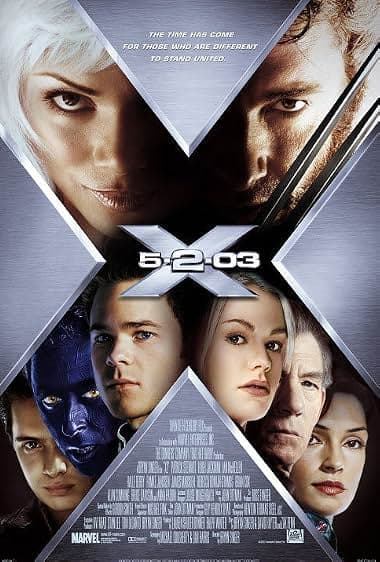
X2
A school under siege, a reluctant alliance, and Professor Xavier holding the room together.
Feature presentation
X2 still feels like a blockbuster that wanted to be taken seriously. Bryan Singer's follow-up widens the stakes — an assault on Xavier's school, a militarised plot to hunt mutants, and enough moral friction to make the action mean something. Rewatch it for the ideas as much as the set-pieces.
THE MOVIE
Professor Charles Xavier is still the reason this movie works
The thing that makes X2 hang together — the detail you notice the second the music swells — is that it cares about what it’s defending. The studio synopsis pitches the film around Colonel William Stryker’s assault on Professor Xavier’s school and his plan to use Xavier and Cerebro to target mutants, and that siege gives the whole movie a moral centre to push against.
That assault isn’t an isolated stunt. A series of attacks forces the X-Men into a reluctant alliance with Magneto, which gives the plot the sort of uneasy teamwork that raises stakes without turning the story into a simple good-vs-evil punch-up. The screenplay threads multiple strands — Xavier’s school, Stryker’s black-ops program, and the Brotherhood’s response — so the film feels busy in a productive way.
At the middle of all that is Professor Charles Xavier, who leads a private school for young mutants and acts as the X-Men’s moral and strategic anchor. Bryan Singer directs with an eye for weight: this is the second theatrical chapter in the franchise, released in 2003, and it wants us to believe these are lives worth protecting, not just powers worth displaying.
THE SETUP
The idea that sets X2 in motion
X2 begins with a simple, combustible premise: the state treats mutants as a controllable threat, and the military decides to treat control as its job. Studio materials frame the plot around Stryker’s assault on Xavier’s school and his plan to use Cerebro and Professor Xavier himself as a weapon.
That gives the film a clear moral geometry. On one side: mutant survival and civil liberties. On the other: a military-led campaign that sees fear and containment as the answer. It’s a tidy conflict, and it makes the action feel like a symptom of a political problem rather than an excuse for spectacle.
The screenplay keeps several balls in the air. It intercuts the life at Xavier’s school, Stryker’s black-ops program, and the frictions between the X-Men and the Brotherhood. That parallel structure turns the movie into a shuffle of set-pieces and philosophies, rather than a single straightforward chase.
X2 leans on the comics for ballast; elements come from the graphic novel God Loves, Man Kills, which helps the film carry a darker, more ideologically charged tone than a standard sequel.
THE CHARACTER
Why Professor Charles Xavier matters
Professor Xavier isn’t just a wise elder for the sake of cinematic shorthand. In X2 he runs a private school for young mutants and acts as the moral and strategic centre for the team, which means the film’s crises are personal, not abstract.
Because the story literally begins with an attack on his school, Xavier’s role translates into stakes that feel domestic. It’s easier to care about a threatened community than a threatened ideology; the movie uses the school to keep its big themes grounded in people’s safety and futures.
Singer and production commentary compared X2 to The Empire Strikes Back — a darker middle chapter that splits and deepens characters — and that comparison lands mostly because Xavier’s leadership gets tested. When tactics and ethics pull in different directions, the film asks who we are willing to defend and how far we’ll bend to do it.
Even small structural choices — making Xavier the film’s axis — shape every ensemble beat. The introduction of new characters (Nightcrawler, for one) is measured by how they change the school’s balance, so Xavier remains the reference point for the movie’s choices.
THE PERFORMANCE
Why Alan Cumming's performance matters
Nightcrawler arrives in X2 as a fresh, unmistakable element. Contemporary reviews and publicity singled out Alan Cumming’s casting as notable, and that attention was about more than a novelty cameo.
The commentary at the time highlighted a combination of make-up work and the actor’s physical performance as the reason the character registered on-screen. In short: Nightcrawler felt like a new texture added to the ensemble.
That texture matters because the movie balances several tonal registers — political thriller, superhero action, intimate school scenes — and a single standout new presence helps the film widen its palette without unbalancing it.
The introduction of Nightcrawler also performs a structural job: he’s a new face in the continuity who tips the team dynamic into unfamiliar territory, and contemporary coverage made clear audiences noticed the casting choice as a memorable element.
UNDER THE SURFACE
X2 has more on its mind than the plot suggests
On the surface X2 is an action-heavy superhero movie. Underneath, it’s repeatedly about othering: the film frames mutants as a persecuted minority and probes how legislation, public fear and state reaction escalate from discomfort to containment.
That anxiety about difference dovetails with surveillance and militarisation. Stryker’s program and the way Cerebro is weaponised point the film at questions about government power when it faces an allegedly existential threat.
The movie also enjoys moral slipperiness. When survival is on the line the X-Men and Magneto form an uneasy alliance — tactical agreement that raises the question of whether shared threats can blur deeper ideological divides.
Finally, identity and belonging thread through the ensemble. The school is where mutants belong and are taught to be more than their powers; the outside world treats them as a problem. That tension — belonging vs. exclusion — is the film’s emotional lever.
THE FILMMAKING
How X2 was put together
X2’s shape owes a lot to the people behind the camera. Guy Hendrix Dyas took over as production designer for this chapter, which subtly changes the film’s look and the way sets read compared with the first movie.
John Ottman doubled up in a way you don’t see every day: he edited the film and also composed the score. Press coverage at the time noted that he edited on location and recorded the music with a large orchestra and choir, which explains why the film’s sound and cut often feel tightly coordinated.
Technically the production didn’t shy away from scale: production notes list the use of multiple 35mm cameras and VistaVision processes for effects work and anamorphic release prints, choices that point to a desire for a cinematic finish rather than a television-derived gloss.
Those behind-the-scenes choices don’t make the themes for you, but they give the film a craft sheen that helps serious ideas land inside a studio-sized spectacle.
PRACTICAL EFFECTS
The effects work that gives X2 its physical personality
X2 blends physical and visual techniques in ways the production materials like to talk about. Nightcrawler’s on-screen appearance combined several hours of prosthetic make-up for the actor with visual effects for teleportation sequences, a hybrid approach emphasised in home-video extras.
The film’s costume and make-up departments are specifically discussed in production featurettes about creating character looks, which suggests a deliberate investment in physical craft rather than relying purely on digital fixes.
Making Nightcrawler feel like a concrete presence required time in the make-up chair; production notes document extended prosthetic application, which in turn gives the character a tactile life on camera.
That practical attention matters for ensemble movies: when characters occupy a physical world the stakes of danger and protection read as more immediate, and the creature-of-the-week problem is less likely to register as purely CGI.
PURE 00s
X2 could not belong to any other decade
X2 arrived in May 2003, smack in the early-2000s surge of studio comic-book adaptations. It’s the second theatrical X-Men film and part of the moment when Hollywood was figuring out how to make serialized superhero stories feel like event cinema.
Being a direct follow-up to X-Men (2000) gave it responsibilities: to deepen character threads and expand scope without losing the central premise. The film’s positioning as a sequel is part of its personality — it acts like the middle chapter of a larger conversation.
The production and release strategy treated X2 as a major tentpole: it opened wide in May 2003 and went on to gross over $400 million worldwide, which kept the franchise alive as a visible studio property.
All of which is a polite way of saying X2 is very much a product of its era: big, serious enough to court opinions, and built to be the sort of sequel that insists the plot means something.
WATCHING IT NOW
What has aged — and what hasn't
Some aspects of X2 wear their era on their sleeve. Modern commentators point out that certain teen-subplot beats and some visual-effects shots show early-2000s pacing and VFX techniques, which can make parts of the film feel of its moment.
But other parts travel better. The film’s concern with identity and belonging — the school as a place of refuge, the outside world as a place of threat — remains an accessible emotional motif even now.
Singer and production notes framed X2 as a darker middle chapter in the trilogy, a comparison to The Empire Strikes Back that matters when you watch: the film takes time to split and deepen characters rather than rush to tidy conclusions, and that narrative patience helps it age more gracefully than an effects-only thriller.
The introduction of Nightcrawler, and the documented make-up work that made him feel concrete, is an example of a production investment that still reads well. Practical choices like that give the movie tactile detail viewers can still appreciate.
THE LEGACY
Why X2 still matters
X2’s straightforward legacy is institutional: it was the second feature in the original X-Men series and directly led to a third film and further franchise entries. It kept the story moving rather than letting the series stall.
Commercially it was also significant. The film grossed over $400 million worldwide, which underwrote the idea that X-Men could be a longstanding studio property rather than a one-off experiment.
That combination — carrying the narrative forward and performing strongly at the box office — is why X2 is still part of franchise conversations: it didn’t just fill a slot, it helped sustain the series’ future.
More to the point, it showed that a mainstream superhero movie could treat political anxiety and community protection as central concerns without losing spectacle, and that balance helped the series stay relevant enough to spawn sequels and spin-offs.
THE VERDICT
Does X2 still hold up?
Short answer: yes — but with reservations. X2’s setup is sturdily plotted (Stryker’s assault on Xavier’s school and the ensuing string of attacks that force an alliance with Magneto give the film urgent stakes), and the central conflict — mutant survival and civil liberties versus a militarised campaign — still reads clearly.
The screenplay’s choice to intercut multiple strands keeps the film busy but purposeful; it’s a 134-minute picture that wants to juggle politics, character work and action, and it mostly succeeds because the school at its heart ties the threads together.
Patrick Stewart’s Professor Xavier anchors those threads; he’s the figure around which tactical choices and moral arguments rotate, and Magneto remains the necessary foil who will cooperate tactically when survival demands it. That ideological tension gives the movie bite beyond the explosions.
If you’re watching now, expect some early-2000s flourishes — a few VFX shots and teen subplot beats show their era — but expect themes that travel: discrimination, surveillance, identity and the costs of protection. Watch it for the ideas and the ensemble work; treat the dated moments with charity. X2 still wants to be more than a popcorn ride, and usually it is.
Share this movie
Keep watching
More movies from the 00s

2002
The Pianist
A quiet life unmade by war — and a pianist who refuses to stop listening.
Read the retrospective
→
2006
Blood Diamond
A mercenary, a fisherman and a pink diamond — and a film that still asks who pays for our jewellery.
Read the retrospective
→
2003
Kill Bill: Volume 1
A yellow jumpsuit, a long list of enemies and one woman who refuses to be finished.
Read the retrospective
→