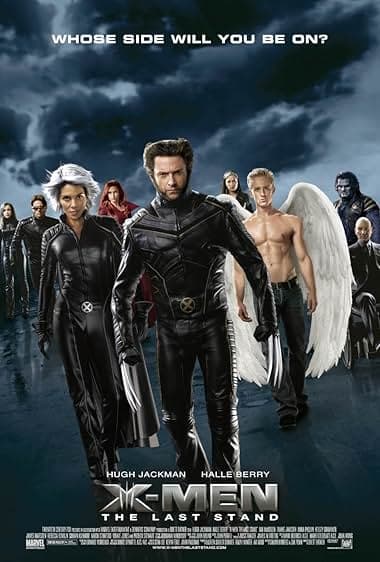
X-Men: The Last Stand
Mutant cure, Phoenix meltdown and one adamantium-clawed reason to keep watching.
Feature presentation
X-Men: The Last Stand is the loud, crowded final of Fox’s first X-Men trilogy — a film that insists on being both a political parable and an action movie. It juggles a publicly marketed 'mutant cure' and the explosive return of Jean Grey, and through it all there’s one familiar hinge: Logan, Wolverine, who keeps the story moving when everything else tries to shout over itself.
THE MOVIE
Logan / Wolverine is still the reason this movie works
If you remember one image from X-Men: The Last Stand it’s not the cure or the CGI inferno; it’s someone who simply walks into trouble and fixes the immediate problem. That person is Logan — the film’s practical centre when the script is trying to be many things at once.
The movie throws two big comic-book set-pieces into a single 104-minute package: a loudly publicised 'mutant cure' and the resurrection of Jean Grey as the Phoenix, an amplified psychic threat that shifts the film from public debate to an urgent personal crisis. On paper it’s an ambitiously packed premise; on screen it needs a character who can move between argument and action.
Brett Ratner steers that ship. The director’s job here is to keep the gears turning: staging the argument over assimilation versus resistance (what happens to difference when a cure is offered?) while still delivering the kind of island assaults and personal moments the trilogy has built toward. It’s messy, occasionally rushed — and, crucially, it keeps Logan center stage as the thing the movie pivots around.
THE SETUP
The idea that sets X-Men: The Last Stand in motion
At its most straightforward, the film is driven by two hooks that collide. One is a scientific-political story: a publicly touted 'mutant cure' that promises to remove mutation from those who choose it. The other is mythic and personal — Jean Grey returns, but not as herself: as a vastly amplified psychic force that quickly becomes a dangerous, internal threat.
The cure doesn’t arrive as philosophy alone. The film introduces a child mutant whose proximity suppresses powers and who becomes the literal key to developing an antibody-style treatment. That small piece of biology turns a political idea into a deployable weapon and forces characters to take practical positions rather than only argue in the abstract.
Those two threads push the film into a binary conflict. Charles Xavier remains the integrationist, the leader investing in coexistence; Magneto continues as the militant counterpoint who prioritises mutant survival over compromise. The clash between those approaches escalates, and the story shifts between public, ethical argument and private emergency.
All of this is folded into a relatively tight runtime by alternating set pieces and brief character vignettes — including a large-scale assault on an island research facility — so the movie has to be economical about where it lingers and where it sprints.
THE CHARACTER
Why Logan / Wolverine matters
Hugh Jackman’s Logan has been the trilogy’s through-line from the start, and in The Last Stand he performs the story’s heavy lifting without needing a second act of philosophy. The film expects him to be the guy who makes things happen when arguments stall.
The movie is tightly packed and multi-headed — political choices, ethical dilemmas, resurrected cosmic threat — so it relies on a character who is straightforward in function: practical, action-focused and willing to bridge the X-Men’s institutional aims and the immediate tactical problems the team faces.
That’s why Logan feels memorable here. When the screenplay is juggling public debate and private chaos, Wolverine is the human-sized instrument the plot uses to pivot from conversation to consequence.
Put another way: the film throws a lot at the ensemble, but Logan is where those pieces reconnect. He’s the leash that keeps the escalating stakes from flying apart entirely.
UNDER THE SURFACE
X-Men: The Last Stand has more on its mind than the plot suggests
On the surface it’s spectacle and punches. Underneath, the film is asking a question that’s simple enough to grasp: if you could erase the thing that makes you different, should you? The mutant cure forces that question into the open and drags the X-Men into a real-world debate about assimilation versus resistance.
That debate sits beside a darker worry: what happens when power outgrows control? Jean Grey’s return raises the problem in the raw. Her resurrection isn’t just another villain; it’s an instance of ungoverned power that tests the X-Men’s ability to respond when rules and reason are swallowed by force.
There’s also a medical-ethical angle built into the cure storyline. It’s not an abstract thought experiment: it becomes a problem with patients, a research programme and a choice that can be marketed and distributed. The film uses that concreteness to make the ethical questions feel immediate rather than hypothetical.
Finally, the film frames all these debates as an ideological conflict. Xavier’s integrationist stance and Magneto’s militancy look like two sides of a coin, and the movie keeps circling those positions even as it tries to resolve the Phoenix crisis.
THE FILMMAKING
How X-Men: The Last Stand was put together
The Last Stand isn’t a stripped-back, low-key production; it’s constructed. Edward Verreaux is credited as production designer and the film built large practical sets that were later extended digitally. That combination gives the movie a physical backbone even when the action expands beyond what was built on stage.
Dante Spinotti is listed as director of photography, and John Powell supplied the score, which together help shape the film’s tone: part blockbuster, part urgent thriller. Those collaborators give Ratner the raw materials to move quickly between human scenes and the larger, noisier set pieces.
The result is a film that clearly wants to be immediate — you can feel the practical weight of built sets in several scenes — while also leaning on post-production to open up the canvas when the story requires scale.
Put simply: production choices here favour solidity first and spectacle second, then use digital tools to enlarge what’s already tangible.
PRACTICAL EFFECTS
The effects work that gives X-Men: The Last Stand its physical personality
Practical work anchors much of the film. The production combined built sets and miniatures with digital visual effects, and a section of Alcatraz was physically constructed before being digitally extended for the sequences set there. That hybrid approach keeps some moments feeling tactile rather than purely synthetic.
There’s also an early example of digital cosmetic work on show: Patrick Stewart and Ian McKellen received digital de‑aging/retouching for a particular sequence, which in the mid‑2000s was still a relatively new tool in the effects toolbox.
For character effects the film used prosthetic make-up, full-body suits and physical rigging on several figures — including Beast and the winged Angel — with wirework and rigging enabling in‑camera flight before digital clean-up. That mix of techniques helps preserve a sense that the characters occupy real, physical spaces.
All of this underlines how the production aimed to balance hands-on methods with digital finishing, rather than relying solely on either practical or entirely virtual solutions.
PURE 00s
X-Men: The Last Stand could not belong to any other decade
This is a mid-2000s blockbuster in the literal sense: it’s the third instalment in Fox’s original X-Men trilogy and was released during the period when studio superhero cinema was expanding rapidly. The film carries that era’s appetite for spectacle wrapped around comic-book ideas.
It arrived in 2006 at a moment when franchises were expected to deliver closure and escalation in the same breath — a final chapter that resolves arcs while raising the stakes for what comes next. That explains the film’s compressed storytelling and its willingness to pile on concepts.
The movie even premiered out of competition at Cannes before going wide, a reminder that studios were positioning superhero pictures as major tentpoles, not just popcorn entertainment.
So yes: its structure, timing and the fact that it was the trilogy’s capstone are all things that firmly mark it as a product of the 2000s studio system.
THE LEGACY
Why X-Men: The Last Stand still matters
Part of the film’s afterlife is simple: it closed Fox’s original X-Men trilogy. That makes it a reference point whenever the franchise’s earlier continuity is discussed or revisited.
Its decision to condense Dark Phoenix material alongside a separate cure storyline left a specific mark on how that comic arc was handled on screen, and it’s a thread you can trace through later franchise attempts to re-adapt the same source material.
On the technical side, some of the production approaches — blending miniatures and CG, and early de‑aging work — are cited in trade and VFX discussions as representative of mid-2000s effects practice, so the film registers in industry conversations as much as in fan ones.
THE VERDICT
Does X-Men: The Last Stand still hold up?
Yes — but with a clear caveat. The Last Stand still works when you watch it as an action-packed, idea-heavy trilogy cap; it’s less successful when treated as a neat, fully resolved adaptation of the Dark Phoenix Saga. The film’s twin premises — the mutant cure and Jean Grey’s resurrection — create a lot of drama, and the choice to run both together is the source of both the movie’s energy and its clutter.
If you want large-scale confrontations and a film that moves quickly from political argument to personal crisis, this will deliver. The story leans on a series of set pieces (including a big assault on an island research facility) and short character beats to tie the threads together inside a 104-minute runtime, which both sharpens and shortchanges the material in places.
Crucially, Logan remains the glue. Hugh Jackman’s character functions as the practical protagonist who bridges the X-Men’s institutional aims and the immediate tactical problems, and that keeps many of the film’s more scattershot choices grounded enough to feel coherent.
So should you watch it today? Watch it if you want a brisk, occasionally frustrating but still entertaining conclusion to the original trilogy that wrestles with identity, responsibility and the ethics of intervention. It’s an uneven film — sometimes too busy for its own good — but when it lands it reminds you why this particular group of characters mattered in the first place.
Share this movie
Keep watching
More movies from the 00s

2002
The Pianist
A quiet life unmade by war — and a pianist who refuses to stop listening.
Read the retrospective
→
2006
Blood Diamond
A mercenary, a fisherman and a pink diamond — and a film that still asks who pays for our jewellery.
Read the retrospective
→
2003
Kill Bill: Volume 1
A yellow jumpsuit, a long list of enemies and one woman who refuses to be finished.
Read the retrospective
→