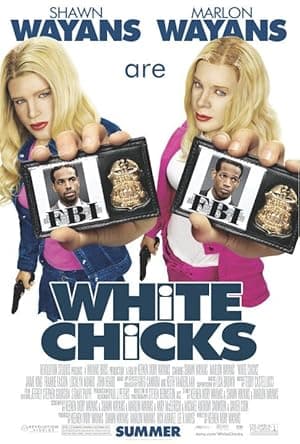
White Chicks
Brothers, prosthetics and a very particular kind of undercover: it’s chaotic, rude fun — and still oddly watchable.
Feature presentation
White Chicks is the kind of comedy that announces itself in the first five minutes and never apologises. Keenen Ivory Wayans hands his brothers a ludicrous premise — disgraced FBI agents pretending to be wealthy white heiresses — and the film spends the next 109 minutes watching them wobble, improvise and occasionally land a joke that actually sticks.
THE MOVIE
Kevin Copeland (disguised as Brittany Wilson) is still the reason this movie works
People still talk about White Chicks because it puts a very simple gag — two down‑on‑their‑luck brothers going undercover as rich socialites — through every possible comedic filter. The setup is straightforward: disgraced FBI agents are given one last chance to save their careers by stepping into the shoes of two heiresses and faking it at a high‑profile Hamptons event.
That car accident that sidelines the real sisters is the single piece of paperwork that allows the whole charade to exist. It’s a silly, practical premise and the film treats it like a dare: if the agents can pass for these women, how far will the joke stretch? Keenen Ivory Wayans, who directed the film, leans into that dare with full force.
At the centre of the dare is Kevin Copeland — played by Shawn Wayans — and the movie’s personality spins off him. He’s one half of the brother act (Marlon Wayans plays the other), and the film’s best moments come when the plot forces those brothers to keep pretending, to improvise and, occasionally, to expose how performative the social world around them already is.
THE SETUP
The idea that sets White Chicks in motion
The movie moves on a single practical idea: two FBI brothers adopt an elaborate disguise to investigate who’s targeting wealthy young women. That conceit keeps things neat — it explains the prosthetics, the sartorial immersion and the endless opportunities for fish‑out‑of‑water comedy.
What the plot asks of the audience is charmingly theatrical. You know these men are not who they claim to be; the film delights in the dramatic irony of watching other characters accept the masquerade without question. Much of the comedy is built on that gap between what we see and what the on‑screen world believes.
The stakes are simple and serviceable. The agents must balance keeping up their personas in a world of entitled socialites while also continuing a proper FBI investigation into the threat against those same socialites.
And because the story depends on that physical passing, the film repeatedly plays with how believable the disguise is within its own terms — a running game of ‘how long will they keep this up?’ that carries most of the momentum.
THE CHARACTER
Why Kevin Copeland (disguised as Brittany Wilson) matters
Kevin isn’t merely a punchline; he’s the engine that makes the joke stick. Shawn Wayans plays him, and the character’s choices — flustered, improvisatory, often combusting into bravado — keep the film moving through its more outlandish beats.
The personal pressure is clear: both brothers are on thin ice after a failed sting, and this undercover job is their last shot at redemption. That ‘do‑or‑die’ energy gives the comedy a forward drive. It’s not just about how ridiculous they look; it’s about what they’ll do to keep the act alive.
Crucially, Kevin’s purpose is shared. The brotherhood at the heart of the picture is real within the story: they’re forced together, negotiating embarrassment and danger, and that pressure occasionally produces a kind of loyalty that’s surprisingly warm.
Keenen Ivory Wayans wrote, produced and directed the brothers into this situation, and the film is very much a Wayans family project — that sense of troupe, of inside jokes and escalations, is baked into how Kevin operates on screen.
UNDER THE SURFACE
White Chicks has more on its mind than the plot suggests
Beneath the pratfalls and the nightclub dances, the movie is constantly nudging at performance. Gender is performed as costume; whiteness is, awkwardly and deliberately, performed as well. The film uses disguise to lay bare how much social identity depends on surface signals and mannered behaviour.
There’s also a satirical itch about class: the Hamptons set are presented as a cluster of entitled routines, and the agents’ impersonation becomes a way of lampooning that entitlement. The joke often lands not on the impostors but on the world that accepts them.
Those overlapping concerns — race, gender and class as performances you can put on and take off — give the film a thematic backbone that’s messier than the broad comedy would suggest. It’s not subtle, but it’s aware.
And finally, there’s the relational layer. The brothers’ friendship, the way they protect and occasionally betray each other under pressure, gives the satire something human to cling to; the disguise gag is easier to forgive because there’s an emotional throughline holding the chaos together.
THE FILMMAKING
How White Chicks was put together
White Chicks is very much a studio comedy in its mechanics: it’s built to show the joke clearly and keep the pacing brisk. The film credits name Steven Bernstein for cinematography and Jeff Gourson and Stuart Pappé on editing — job titles that point to a straightforward crew assembled to serve comic rhythm.
That crew’s work is practical: scenes are set up to land visual surprises and reaction shots, and the editing carries the film through its set‑piece beats. The filmmaking choices are not coy; they are functional, designed to keep the premise visible and the energy high.
Keenen Ivory Wayans directs with a theatre‑of‑escalation sensibility — ratchet up a situation, push the embarrassment further, then cut for the reaction. It’s not arty. It’s a particular kind of studio confidence: show the gag, milk it, then move on.
If you want subtle camera poetry, this isn’t the place. If you want a comedy assembled with the single aim of letting the players and the prosthetics do the work, it is.
PRACTICAL EFFECTS
The effects work that gives White Chicks its physical personality
The movie sells its joke largely through physical transformation. Greg Cannom and his team made that deception possible by creating sculpted facial appliances — foam‑latex and silicone pieces built from plaster casts of the actors’ heads — to alter jawlines, cheeks and brows.
That work didn’t stop at faces. The team layered body paint and airbrushed foundation, added wigs and used coloured contact lenses to finish the look. Each day’s shooting required hours in the chair to assemble the disguise.
The practical approach matters because the film asks you to accept the characters at a glance. The prosthetics provide the shorthand the comedy needs: they make the masquerade legible, even when the premise is absurd.
Whether you love that choice or find it jarring, it’s impossible to imagine the film working the same way without the physical commitment of the makeup team.
PURE 00s
White Chicks could not belong to any other decade
White Chicks sits squarely in the early‑2000s moment of big‑idea, star‑driven comedies. Released in the summer of 2004, it’s the sort of studio comedy designed for wide audiences and a loud box‑office window.
It’s also a Wayans family film: Keenen Ivory Wayans had directed Scary Movie a few years earlier, and White Chicks continues that approach of mainstream broad comedy from a familiar troupe. The film’s energy — broad, immediate and unabashedly commercial — matches what studios were programming for the 2004 season.
That context matters because the movie’s choices feel like product as much as art: it has the confidence of a film made to be consumed in a multiplex, to land jokes fast and keep an audience moving through a long runtime.
Put simply: the movie’s scale, style and release strategy are of their era. It wouldn’t quite read the same way outside that 00s studio comedy ecosystem.
WATCHING IT NOW
What has aged — and what hasn't
What holds up is the basic brotherly dynamic. The plot is a vehicle for the siblings to test each other, and those beats of loyalty, embarrassment and improvisation still land because they’re human actions underneath the makeup.
What feels more brittle is the film’s blunt approach to race and gender as comedic tools. The movie leans hard into whiteface and gender disguise as a route to jokes, and that bluntness can feel uncomfortable now in ways it didn’t for all viewers in 2004.
The way the film trades in entitlement satire still has punch — privileged behaviour is an easy target — but the methods the film uses to land that satire are of their time, and they don’t always translate to a modern audience without friction.
Ultimately, some of the emotional throughline — the brothers trying to redeem themselves and stick together — keeps the film watchable even when other elements creak.
THE LEGACY
Why White Chicks still matters
There’s no denying the film left traces. It was commercially successful on release and later developed a cult following around a handful of memorable scenes and quotable moments — the kinds of beats that get clipped and shared for years.
At the same time, the film collected Razzie nominations and attracted sustained discussion about how it handled race and gender. Those conversations are part of why people keep returning to it: it’s entertaining, but it’s also disputable.
The movie’s presence in pop culture isn’t theoretical. Cast members have revisited its most famous moments — for example, a 2019 recreation of the club dance scene — which shows the film has an afterlife in the public imagination.
So White Chicks matters because it’s both a guilty‑pleasure comic artefact and a provocation: people remember it for laughs, and they keep talking about it because parts of it don’t sit cleanly with later sensibilities.
THE VERDICT
Does White Chicks still hold up?
Yes and no. If you come for broad, high‑concept silliness and the particular chemistry of a Wayans brother act, there’s still genuine amusement to be found. The premise — two disgraced FBI agents stepping into the lives of heiresses after a car accident benches the real sisters — still supplies reliable comic set‑ups and awkward, loud payoffs.
If you’re returning to the movie with a sharper eye on how comedy treats race and gender, the view is bumpier. The film explicitly makes whiteness and femininity into costumes, and some critics at the time — Roger Ebert among them — pointed out that the brothers mostly play the same persona inside and outside their disguises, which undercuts any subtle reading of race or gender.
Technically, the film sells itself through its practical work: prosthetic makeup and layered body painting let the joke be visible, and the plot continually plays the dramatic irony between what we see and what the characters accept. That conceit keeps the central conflict — maintaining undercover personas while pursuing an FBI investigation — lively enough for most of the runtime.
So if you want a piece of unapologetic 00s studio comedy and a lot of outrageous moments, it’s worth a watch. If you expect the film to offer a nuanced critique of race or gender, it won’t satisfy. Watch it as a flawed, occasionally brilliant, very deliberate comedy of disguise — and judge the rest for yourself.
Share this movie
Keep watching
More movies from the 00s

2002
The Pianist
A quiet life unmade by war — and a pianist who refuses to stop listening.
Read the retrospective
→
2006
Blood Diamond
A mercenary, a fisherman and a pink diamond — and a film that still asks who pays for our jewellery.
Read the retrospective
→
2003
Kill Bill: Volume 1
A yellow jumpsuit, a long list of enemies and one woman who refuses to be finished.
Read the retrospective
→