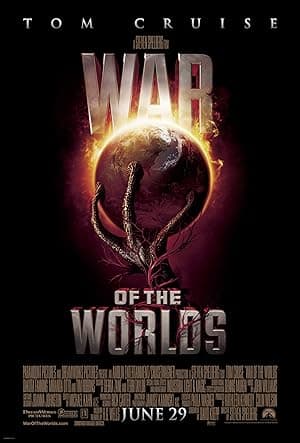
War of the Worlds
A father, two kids and a city falling apart — Spielberg turns an alien invasion into a family road movie.
Feature presentation
War of the Worlds isn't a catalogue of spectacles so much as a series of urgent, terrified family decisions. Steven Spielberg frames H.G. Wells's invasion through the eyes of one imperfect dad trying to keep his visiting children alive, which gives the giant set-pieces an oddly intimate heartbeat. That smallness is exactly why the film still rewards a rewatch.
THE MOVIE
Ray Ferrier is still the reason this movie works
Most summer blockbusters sell themselves on scale; War of the Worlds quietly does the opposite. Spielberg adapts H.G. Wells not as an exercise in catalogue destruction but by plumbing the panic, choices and loyalties inside one American family — and that focus makes the chaos readable.
At the centre is Ray Ferrier, a New Jersey dockworker whose job suddenly becomes painfully simple: keep his visiting children alive. The film writes him as an imperfect, working-class father, and it is his worry, guilt and stubborn single-mindedness to reunite his family that give the invasion sequence real emotional stakes.
That personal viewpoint — parental responsibility under catastrophic strain — is the film’s organising idea. You go for the robots and the siege, and you stay because Ray is the human map through the wreckage.
THE SETUP
The idea that sets War of the Worlds in motion
The engine of the film is straightforward: Ray Ferrier must protect his two visiting children once the invasion begins. That single duty keeps the camera close and the drama personal rather than grandly philosophical.
Where many adaptations spread their attention wide, Spielberg keeps us travelling with one family. The central conflict is a survival-and-protection journey — a road and refugee structure where each new location tests Ray’s nerve and resources.
Those tests arrive as set-pieces: a chaotic subway, a ferry evacuation, clogged highways and suburban standoffs. They’re not there to list disasters so much as to puncture the family’s path toward reunification with the children’s mother.
On a production level, the film used extensive digital previsualization to plan those complex sequences during a tight schedule, which explains how the movie maintains narrative momentum through its many large, moving scenes.
THE CHARACTER
Why Ray Ferrier matters
Ray Ferrier matters because he’s not a heroic blank slate; he’s specific. Written and filmed as an imperfect, working-class father, his arc is essentially practical: get the kids to safety and try to stitch the family back together. That keeps the movie honest.
The story asks a simple question of him repeatedly — can this man, with whatever faults he carries, do the one thing that now matters? It’s a domestic test dressed up as catastrophe, and it’s oddly compelling to watch someone improvise their way toward responsibility.
The presence of older family members in the background reminds us this is still a family story even when the world is falling apart. Ray’s decisions ripple out, shaping the survival options for everyone around him.
So while the film has spectacle, it’s Ray’s insistence on protection and reunification that gives the chaos a human direction.
THE PERFORMANCE
Why Dakota Fanning's performance matters
Contemporary coverage singled Dakota Fanning out as a standout among the film’s emotional anchors, and that attention is part of how the family story carries weight. Critics repeatedly highlighted her work, and industry groups later recognised her performance.
That recognition isn’t just trivia; it’s a signal that the film’s smaller, quieter moments registered at the time. When the child at the centre of the story is consistently noted, it helps explain why scenes of fear, pleading and hope cut through the spectacle.
Alongside the notice Fanning received, reviewers also pointed to Tom Cruise’s intense, physical contribution to the film’s emotional core — a pairing that kept the family’s survival feel urgent.
In short: the performances that were singled out by reviewers and critics’ groups helped people care about the family amid the ruin, and that was essential to the movie’s immediate impact.
UNDER THE SURFACE
War of the Worlds has more on its mind than the plot suggests
Beneath the falling girders and flaming streets the film is consistently occupied with parental responsibility — what it forces parents to become and what it reveals about their priorities under pressure.
Closely tied to that is a focus on societal collapse. The movie repeatedly stages how infrastructure and civil order fail, and the family’s decisions become small survival acts inside a larger breakdown.
Survival under catastrophe is not romanticised. The film treats it as messy, improvisational and morally complicated, which keeps sympathy focused on human choices rather than on spectacle alone.
Finally, contemporary commentators saw the film through the lens of post-9/11 cultural anxiety. The imagery and narrative resonated with early-2000s concerns about vulnerability, public threat and the suddenness of disaster.
THE FILMMAKING
How War of the Worlds was put together
One way the film holds its nerve through enormous set-pieces is in the crew list: cinematography was by Janusz Kamiński and the film was edited by Michael Kahn — collaborators Spielberg had long worked with.
That continuing collaboration matters because the people shaping images and pace were familiar with Spielberg’s rhythms, which helped the movie move confidently between intimate family beats and large-scale chaos.
You can see the result in how the film keeps the story legible despite constant upheaval: tighter cuts in tense moments, longer breathing shots when the family needs to regroup.
So while the movie is often discussed for its effects, its cinematic identity also rests on a small group of trusted craftspeople doing steady, shaping work.
PRACTICAL EFFECTS
The effects work that gives War of the Worlds its physical personality
The film’s physical personality comes from a mixture of staged on-set stunts and pyrotechnics blended with extensive digital visual effects. That combination keeps much of the action feeling immediate.
Industrial Light & Magic supplied the primary digital work, but the production didn’t rely on computer imagery alone; stunts and practical set elements were part of the plan from the start.
Crucially, the production used previsualization — computer-animated storyboards — to coordinate cameras, practical elements and the later digital augmentation. It was a way of planning complicated destruction without losing the actors’ spatial reality.
The result is a movie where digital and practical techniques serve the same aim: making the family’s journey through disaster feel lived-in and dangerously close.
PURE 00s
War of the Worlds could not belong to any other decade
The film sits squarely in the mid-2000s moment. Released in 2005 and completed quickly after photography in late 2004 and early 2005, it arrived as a major summer studio picture designed to play large and fast.
But it’s not just a blockbuster in scale; contemporary reviewers frequently read its images and story through early-2000s American anxieties. The film’s sense of sudden vulnerability and public catastrophe echo conversations happening at the time.
That context matters because Spielberg chose to make an H.G. Wells tale feel immediate and domestic rather than nostalgic. It’s an adaptation filtered through a particular historical nervousness — the early 00s — rather than a period piece.
Seen this way, War of the Worlds is very much a product of its release moment: a wide summer film that used the tools of modern effects and production planning to speak to contemporary fears.
THE LEGACY
Why War of the Worlds still matters
For starters, it was a major commercial release for Spielberg and Tom Cruise, and it became one of 2005’s highest-grossing films worldwide — a reminder that big ideas married to a personal story can still play to mass audiences.
Technically, the film earned recognition at the 78th Academy Awards with nominations in sound and visual-effects categories, which underlines how the industry acknowledged its technical craft.
On the human side, Dakota Fanning received notice from critics’ groups for her work, and that attention helped the film be remembered not only for spectacle but for its performances anchoring the family drama.
Taken together, the commercial reach, the technical nominations and the performance recognition explain why War of the Worlds remains a frequently mentioned Spielberg title from the 00s.
THE VERDICT
Does War of the Worlds still hold up?
Yes — if you want a spectacle that never forgets it’s about people. The film frames the invasion from the viewpoint of a single family, and that keeps every large set-piece tethered to Ray’s goal: protect and reunite his children.
The central conflict is a survival-and-protection journey across collapsing infrastructure — a road/refugee structure punctuated by subway, ferry, highway and suburban stand-offs — and that focus gives the movie emotional forward motion as well as spectacle.
Crucially, Ray is written as an imperfect, working-class father whose need to protect becomes the watchword for the film. Rachel functions as a catalyst and an emotional anchor, while Robbie’s adolescent restlessness and other figures’ post-traumatic behaviour complicate the moral choices on screen.
If you care whether a disaster movie has a human engine, this one does. Watch it for the family at its core first, and for the destruction second — you’ll find that the personal through-line is what makes it stick.
Share this movie
Keep watching
More movies from the 00s

2002
The Pianist
A quiet life unmade by war — and a pianist who refuses to stop listening.
Read the retrospective
→
2006
Blood Diamond
A mercenary, a fisherman and a pink diamond — and a film that still asks who pays for our jewellery.
Read the retrospective
→
2003
Kill Bill: Volume 1
A yellow jumpsuit, a long list of enemies and one woman who refuses to be finished.
Read the retrospective
→