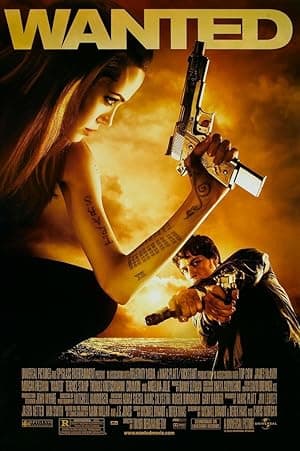
Wanted
A comic-book action engine with a very human centre: agency, fate and a bloke trying to stop being nobody.
Feature presentation
Wanted often gets remembered for curving bullets and ludicrous set pieces. But what keeps it watchable is a simple engine: Wesley Allan Gibson’s jump from anonymous cubicle drone into someone with choices to make. That turn — and the film’s blunt argument about destiny, mentors and institutions — is why the movie still deserves a revisit.
THE MOVIE
Wesley Allan Gibson is still the reason this movie works
Say the name Wesley Allan Gibson and most people picture an ordinary bloke who gets yanked out of a dead-end life and shoved into something outrageously violent. That’s the premise: a meek, 24-year-old office worker discovers his recently murdered father was an assassin and, via a dramatic interruption by Fox, is pulled into the Fraternity's world.
Wanted is noisy and confident and unapologetically stylised — qualities Timur Bekmambetov brought with him from his earlier Russian-language work — but it’s Wesley’s tilt from anonymity to autonomy that gives the spectacle a spine. The film runs briskly (110 minutes) and keeps returning to one blunt question: who’s making your choices, you or a machine called the Loom?
All of that is served up with a cast that points the story where it needs to go: James McAvoy as the reluctant recruit, Angelina Jolie as the recruiter and trainer, and Morgan Freeman as the leader who keeps the Fraternity’s certainties in place. The result is a mid-2000s action thriller that still feels like a conversation about fate — shouted over the sound of curved bullets.
THE SETUP
The idea that sets Wanted in motion
At its simplest, Wanted begins as an origin story. Wesley Gibson is stalled — an apathetic office worker whose life is defined by small humiliations — until the revelation about his father forces a re-evaluation of who he might be.
Fox’s arrival is the inciting spark. She interrupts Wesley’s collapse after his father’s murder, explains the Fraternity, and drags him into a training and initiation process that’s shown through montages, assassinations and staged set pieces.
The Fraternity runs by odd mechanics: a Loom that issues contracts via woven names, a system that treats heightened physical ability as something you can trigger, and a code that prizes discipline. Those mechanics turn training sequences and assassinations into the film’s forward gears, pushing Wesley from confused recruit to someone who can act.
Crucially, the story teases a deeper problem: not everyone in the Fraternity is who they seem to be. That ambiguity — about leadership, motives and loyalties — supplies the moral and personal friction that drives Wesley’s confrontation with the past and with the group that reshaped his life.
THE CHARACTER
Why Wesley Allan Gibson matters
Wesley is the movie’s emotional stake. You can watch bullet physics and spectacle all day, but the whole thing collapses if the audience doesn’t believe someone actually wants something. Wesley’s want is basic and recognisable: to stop being invisible and to reclaim an identity after the revelation about his father.
That makes his arc tidy and satisfying in a way spectacle alone can’t achieve. The film sets up a straightforward personal quest — training, tests, the hunt for the person who set him on this path — and positions Wesley’s need for agency at the centre of the action.
There’s also a useful moral tilt to his journey. The discovery that Fraternity members and leaders aren’t simply benevolent guardians forces Wesley to ask whether joining an institution that claims to follow destiny is any different from living a life where choices are made for you.
In short: Wesley matters because he’s the human problem the movie keeps returning to. All the special moves and visual tricks exist to dramatise what he’s becoming: someone who can make decisions that aren’t just handed to him.
UNDER THE SURFACE
Wanted has more on its mind than the plot suggests
Three ideas quietly steer the film: free will versus determinism, identity and agency, and the tension between mentorship and institutional corruption. They’re not always spoken about delicately — this is a comic-book film, after all — but they’re never absent.
The Loom of Fate and the Fraternity’s rituals turn destiny into a literal machine. That’s a neat shorthand for a movie that wants to ask whether our lives are authored by our decisions or by systems that arrange outcomes for us.
Identity and agency show up in Wesley’s transformation: he’s not just acquiring skills; he’s learning to claim himself. Which is why the mentorship element matters — Fox isn’t merely an instructor, she’s the visible face of an institution that can both make you formidable and ask you to surrender your moral bearings.
Once the film suggests leadership may be compromised, the themes link together. A mentor can teach you to be someone — but the question remains whether that someone answers to the mentor, the institution, or to themselves.
THE FILMMAKING
How Wanted was put together
Wanted’s feel comes from how it stitches techniques together. The film leans on rapid-cut editing, manipulated time-flow and heavy post-production compositing to make ordinary moves look comic-book grand. The result is action that reads less like filmed reality and more like a sequence from a graphic novel given motion.
That approach is part of Timur Bekmambetov’s fingerprint — he brought a stylised visual language that had been visible in his earlier work and amplified it for a Hollywood-sized canvas. The compositing and editing choices turn stunts into set pieces that play like visual riffs rather than straightforward fights.
It also helped the movie be precise about what it wanted to show: slowed moments, exaggerated arcs and tightly controlled choreography of bullets and bodies. Those choices make the film distinctive; they’re not always subtle, but they are coherent.
On a technical level the movie’s craft was noticed where it counts: its sound work was singled out at awards season, earning two Academy Award nominations in technical sound categories.
PRACTICAL EFFECTS
The effects work that gives Wanted its physical personality
Even at its most digital, Wanted keeps one foot in the physical. The production built a full-size train car and mounted it on hydraulics and gimbals to stage a derailment sequence — a clear example of practical work being used to anchor a set piece.
That practical underpinning didn’t stand alone. The production combined on-set elements with extensive computer-generated work — from digital doubles to creature and bullet effects — rather than pretending the whole thing was one or the other.
Delivering those blended sequences required a broad visual-effects pipeline. Dozens of vendors contributed, and the final cut included several hundred VFX shots (reports cited totals around 800) to realise bullet-curving, speed-ramping and creature moments.
Put simply: the film’s physical tricks gave the weight, the VFX supplied the fantasy, and both were necessary to make the action read as both visceral and unreal.
PURE 00s
Wanted could not belong to any other decade
Wanted is very much of its moment: a mid-2000s big-studio, R-rated comic-book adaptation that prioritised stylised visuals and spectacle over slavish fidelity to the source material’s exact costumes or tone.
It’s also a good example of how the decade’s productions plugged into global talent. A non-U.S. director — Timur Bekmambetov — and his Moscow-based effects company played central roles in a Hollywood release, showing how transnational cinema was already shaping blockbusters.
Released in 2008 and adapted from a 2003–2005 comic-book miniseries, the film sits with other 00s experiments that treated source comics as raw material for big, noisy movies rather than as manuals to be followed line by line.
The era’s appetite for spectacle, digital craft and a slightly gleeful approach to violence made Wanted feel like a natural fit for 2008 — loud, kinetic and willing to bend physics for the sake of a memorable image.
THE LEGACY
Why Wanted still matters
Wanted’s afterlife is pragmatic rather than mythic. On the awards front it landed two Academy Award nominations in sound categories, a formal nod to the film’s technical ambitions.
Narratively, the story continued in licensed media: a video-game tie-in, Wanted: Weapons of Fate, was released in 2009 and acts as the primary narrative spin-off that extended the film’s events.
There were conversations about a cinematic sequel — development talk happened several times — but those plans stalled and no second film materialised.
Between the technical recognition and the licensed continuation, Wanted’s legacy is one of a mid-00s action picture that left a tangible, if contained, footprint rather than a sweeping cultural takeover.
THE VERDICT
Does Wanted still hold up?
Short answer: yes — if you turn up for its strengths and accept its bluntness. Wanted is at its best when Wesley’s personal question — who gets to make the choices in my life? — is front and centre. That basic motor still feels immediate.
The film pairs that human beat with a clear set of mechanics: Fox pulling Wesley into the Fraternity, training sequences and the Loom that hands out contracts, and the revelation that leadership isn’t what it appears. Those elements give the action a reason to exist beyond spectacle.
Technically the movie still reads as a 00s action film: Bekmambetov’s stylised approach, the heavy VFX pipeline and built practical moments like the hydraulics-mounted train car all combine to create a distinctive look and feel. The production’s craft was even recognised in sound categories at the Oscars.
So watch Wanted if you want kinetic, idea-driven action where questions about fate and agency are asked loudly and without apology. It isn’t subtle, but it knows its questions and it makes them matter by putting a real person — Wesley — in the middle of them.
Share this movie
Keep watching
More movies from the 00s

2002
The Pianist
A quiet life unmade by war — and a pianist who refuses to stop listening.
Read the retrospective
→
2006
Blood Diamond
A mercenary, a fisherman and a pink diamond — and a film that still asks who pays for our jewellery.
Read the retrospective
→
2003
Kill Bill: Volume 1
A yellow jumpsuit, a long list of enemies and one woman who refuses to be finished.
Read the retrospective
→