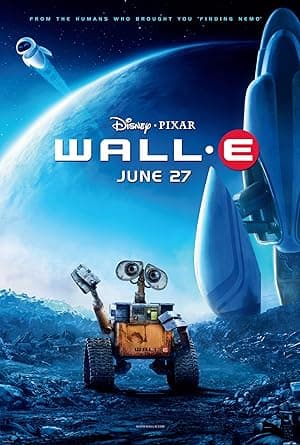
WALL-E
A tiny robot, a stubborn plant and a lot of things we probably recognise in the mirror.
Feature presentation
WALL•E still grabs you by the chest not because of spectacle but because of two things: a machine that behaves like a person, and sound that makes you feel it. Andrew Stanton built a movie that asks big questions — trash, habits, love — and lets a curious little collector do the convincing.
THE MOVIE
WALL•E (and M-O; primary robot vocalizations/sound design) is still the reason this movie works
People still talk about WALL•E because the film is arranged around a personality you can actually live inside for ninety-odd minutes: a robot whose curiosity, hoarding of human things and appetite for play make him unexpectedly, stubbornly human. That’s the sensible trick — give the movie a small, specific centre and let everything else orbit it.
The plot’s engine is simple and stubbornly effective. WALL•E is a lone waste-compacting robot on a ruined Earth who finds a small living plant while doing his rounds; that discovery — and the appearance of the probe droid EVE — is the peg that drags corporate systems, a starship and a whole complacent human civilisation into the story.
Andrew Stanton set the film up to do that without relying on chatter. Ben Burtt’s work on the robots’ sounds and Elissa Knight’s vocal material for EVE let the movie say complicated things about loneliness, consumption and companionship without explaining every feeling in words. It’s bold, and it’s why, even now, the film feels like it was written around its central soul rather than its effects budget.
THE SETUP
The idea that sets WALL-E in motion
At its most basic: a single waste-compacting robot is left behind on a trash-strewn Earth and discovers a living plant. That small discovery gives the robot purpose beyond daily routine and pulls the rest of the film along with him.
Stanton trusted images and sounds to do the heavy lifting early on. A substantial portion of the film’s opening Earth scenes use little conventional dialogue, relying instead on visual storytelling, sound design and music cues to show us who WALL•E is and why we should care.
The wider world is sketched with a neat shorthand. Buy n’ Large functions as a global corporate presence — its branding and prerecorded messages are threaded into the film as a way to explain how consumer culture and corporate centralisation contributed to Earth’s abandonment.
Behind those choices is a tightly credited creative team: the screenplay and story come from Andrew Stanton alongside Jim Reardon and Pete Docter, and the whole structure deliberately lets images carry exposition where most films would reach for lines.
THE CHARACTER
Why WALL•E (and M-O; primary robot vocalizations/sound design) matters
WALL•E matters because he’s written as an assembler of small human things and small human pleasures: curiosity, collecting, play. Those traits are the movie’s primary access point — we understand the world through what he notices and keeps.
That makes his pursuit of EVE feel logical rather than plot-forced. The film sets up a useful contrast: WALL•E is driven by curiosity and attachment, while EVE arrives as a directive-driven probe with a mission. That mismatch is the engine of their interaction.
Ben Burtt is credited both as the performer for WALL•E and as the film’s sound-and-character voice designer; the movie depends on those vocal and signal choices to carry expression where dialogue is scarce. The sounds are not a bonus; they are the grammar the story uses.
Put simply: the character’s memorable because the film built a whole speaking system around him when it could have given him a script. That decision makes him feel like a presence rather than a prop.
THE PERFORMANCE
Why Sigourney Weaver's performance matters
Sigourney Weaver appears in WALL•E as the voice of the ship’s computer. Her role is a vocal presence rather than an on-screen character.
As the ship’s interface, that voice sits at the top of the Axiom’s hierarchy: it’s part of how the film constructs the starship’s authority and systems without lengthy exposition.
Because the part is a voice role, its value is functional and structural — it helps make the ship feel alive and administratively coherent within the story.
In short: Weaver’s contribution is one of those small but necessary beams that props up the film’s bigger set pieces.
UNDER THE SURFACE
WALL-E has more on its mind than the plot suggests
The movie is built around a set of ideas you can talk about in a kitchen rather than a lecture theatre. One obvious strand is environmental collapse and consumerism: the world WALL•E tidies and the corporate messaging of Buy n’ Large explain the scale of the problem without a single long speech.
Closely tied to that is loneliness and companionship. A solitary robot that collects human flotsam is, in cartoon terms, an empty life filling itself up with objects and memories — and when companionship arrives, the film lets that shift everything that follows.
There’s also a frank note about technological dependence and bodily atrophy. The Axiom’s humans are themselves evidence of a society that outsourced living; the story invites the idea that habit and comfort can calcify into something dangerous.
Finally, the film keeps a thread of redemption and human renewal — the plant that WALL•E finds and the choices made aboard the ship push the narrative toward the possibility of repair rather than mere collapse.
THE FILMMAKING
How WALL-E was put together
WALL•E’s look and organisation are products of a tightly credited team: Ralph Eggleston is listed as production designer and Stephen Schaffer as editor. Those credits point to a film that spent time shaping world and rhythm rather than treating design and cutting as afterthoughts.
One of the film’s neat formal moves is the way it folds short live-action corporate advertisement sequences — Buy n’ Large messages — into the animated world. Those prerecorded segments are a deliberate piece of worldbuilding that explain backstory economically and ironically.
The film’s awards season presence also speaks to how those choices landed: WALL•E won the Academy Award for Best Animated Feature and picked up nominations in several major categories, signalling industry recognition for its craft.
Put together: production design, editing and the insertion of those corporate vignettes give the movie a specific identity — a family-friendly science fiction film that doesn’t flinch from constructing its satire within the fabric of its visuals and sound.
PRACTICAL EFFECTS
The effects work that gives WALL-E its physical personality
Sound and the shaping of vocal identity are the film’s practical personality tools. Ben Burtt’s design combined recorded human sources and mechanical recordings to create the robots’ voices and signals, which become the film’s emotional vocabulary.
That attention to sound makes the robots feel tactile even when they’re rendered digitally: the noises act like textures you can almost touch.
Outside the film itself, Pixar and Walt Disney Imagineering produced full-scale WALL•E animatronic units for museums and theme-park displays as part of the release campaign. Those real-world constructions underline how the character was conceived to exist physically, not just as pixels.
The upshot: WALL•E’s apparent ‘physicality’ is a mixture of careful in-film sound design and promotional real-world objects that treated the character as something people could meet in the flesh.
PURE 00s
WALL-E could not belong to any other decade
Released in 2008, WALL•E sits inside Pixar’s mid-2000s run of original features and was widely noted at the time for being formally bold for the studio. That willingness to let images and sound carry an extended, largely wordless stretch feels like a confidence the studio developed in that period.
The film also arrived after Pixar’s acquisition by Disney, and it was made at a moment when mainstream animation was experimenting with genre blending — family films that could also nudge at adult concerns without losing their younger audience.
WALL•E’s awards-season visibility — a Best Animated Feature win and several other nominations — shows how that experiment with tone and form was read by the industry as noteworthy.
All of which means the film is of its moment: ambitious studio animation that trusted quiet, visual storytelling as much as spectacle.
WATCHING IT NOW
What has aged — and what hasn't
A lot of the film’s strengths age like good engineering: the visual storytelling, the production design and the sound work are still frequently singled out in contemporary retrospectives and preservation notes as examples of animation that can speak to adults and families alike.
That matters because the movie’s family label doesn’t capture how it layers meaning. Its decision to use sound and silence as narrative tools gives it a clarity that still plays for viewers who want a thoughtful half-term film and for those who simply want a charming robot romance.
Ben Burtt’s role as sound-and-character voice designer continues to be one of the film’s durable technical achievements; the way the robots ‘speak’ remains central to the emotional payoff.
So when you watch it now, expect the silence to be purposeful and the noises to be doing quite a lot of the conversational work — and expect that move to feel fresh rather than quaint.
THE LEGACY
Why WALL-E still matters
WALL•E’s industry recognition is concrete: it won the Academy Award for Best Animated Feature and gathered nominations in several major categories, including Original Screenplay, Original Score and both sound categories.
Its end-credits song was acknowledged with an Academy Award nomination as well, which underlines how the film’s music and sound design were part of its public reception.
The film’s preservation in the U.S. Library of Congress National Film Registry in 2021 is a formal instance of institutional recognition that the movie holds cultural, historical or aesthetic significance.
Those are tidy ways of saying the film’s craft and ideas continued to matter enough to be formally recorded and preserved.
THE VERDICT
Does WALL-E still hold up?
Yes. WALL•E holds up because it’s built from choices that remain persuasive rather than fashionable: a tiny robot with an appetite for human objects, a simple ecological hook (the little plant), and a narrative that trusts silence, sound and small gestures to do the heavy emotional work.
The film moves from a close, largely wordless encounter on Earth into larger set pieces aboard the Axiom, and that shift still feels purposeful — it turns a private discovery into a question about habit, corporate structure and whether a whole society can wake up.
Technically and narratively, the film’s reliance on carefully designed robot vocalisations (Ben Burtt) and EVE’s tonal material (Elissa Knight) means the emotional beats are earned without expository monologue — and that economy still rewards attentive viewing.
If you’ve never seen it, watch it. If you’re returning, watch it with an ear as much as an eye: the film’s small mechanical sounds are where it keeps its big feelings.
Share this movie
Keep watching
More movies from the 00s

2002
The Pianist
A quiet life unmade by war — and a pianist who refuses to stop listening.
Read the retrospective
→
2006
Blood Diamond
A mercenary, a fisherman and a pink diamond — and a film that still asks who pays for our jewellery.
Read the retrospective
→
2003
Kill Bill: Volume 1
A yellow jumpsuit, a long list of enemies and one woman who refuses to be finished.
Read the retrospective
→