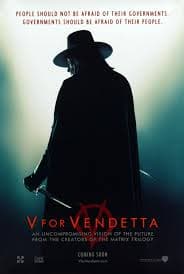
V for Vendetta
A masked revenge play about ideas, identity and whether a single symbol can topple a regime.
Feature presentation
V for Vendetta still turns heads because it dresses a political thriller in a showman's costume. At its centre is a theatrical, anonymous operative who uses spectacle to make the public look at itself—and, crucially, to make a frightened woman into someone who acts. Directed by James McTeigue and released in 2005, it’s the kind of mid-00s dystopia that keeps people arguing about protest, secrecy and the price of political violence.
THE MOVIE
V / William Rookwood is still the reason this movie works
The simplest way to say why V for Vendetta still lands is this: the film gives you a character who is both an idea and a performance. Set in a near-future Britain ruled by an authoritarian party, the story hands one person the stage and lets him use spectacle—bombings, hijacked broadcasts, even the deliberate spread of a mask—as a political argument rather than mere property damage.
That operative is V, a masked, theatrical figure driven by revenge for past experiments and committed to making resistance anonymous and contagious instead of self-serving. His rescue of Evey Hammond from the secret police isn’t just an action beat; it’s the shove that turns a terrified citizen into someone dragged, willingly or not, through a political education.
James McTeigue directs a two-hour-plus piece that stitches together thriller mechanics with big, public gestures. The result is a film that still feels like a debate you can watch: are spectacular acts of sabotage legitimate political speech, or something darker? The movie asks the question out loud and makes V the person you keep listening to while you decide.
THE SETUP
The idea that sets V for Vendetta in motion
At its core the film hands you a clear premise: a masked vigilante stages a campaign of sabotage and symbolic violence against an authoritarian government in order to catalyse popular resistance. It’s neat and direct, which helps; you never have to wonder what the film is trying to do.
Those actions are deliberately theatrical. V doesn't hide in the shadows so much as stage-manage the public’s attention—public bombings, a hijacked television address, and the spread of a single mask are all chosen because they make people look up from their lives and ask questions.
The setup works because the story treats spectacle as strategy. By making the means of rebellion visible and repeatable, the movie turns an individual’s vendetta into a potential mass movement—at least in idea if not instant reality.
THE CHARACTER
Why V / William Rookwood matters
V matters because he is both deliberately theatrical and deliberately anonymous. The film presents him as someone shaped by past experimentation and channelled into a campaign that prizes idea over personal fame.
Hugo Weaving plays the role that emerges from the script as less a conventional hero and more a walking manifesto: a figure whose methods and symbolism are the point, rather than his backstory. That shape—revenge fused with ideology—gives the rest of the cast something to react to.
There’s also a production story in the casting: James Purefoy began as V but left during filming, and Hugo Weaving stepped in to provide the masked presence that anchors the film. That change matters because the movie asks you to read the mask as character, and the role depends on having someone who can make the mask feel like a force in the scene.
THE PERFORMANCE
Why Hugo Weaving's performance matters
Contemporary critics noticed something specific about the leads: Hugo Weaving’s presence when masked became a focal point. Reviews singled out that the physicality of the masked role and the way it reads on screen give the character a force beyond any single speech.
That’s the performance the film asks for—less a tour-de-force of unmasked interiority and more a disciplined physicality that lets the mask argue. It’s the kind of casting and delivery that keeps the audience attentive to the mask's rhetoric rather than just its mystery.
It’s also worth remembering the practical: Weaving wasn’t the original V. James Purefoy left partway through production and Weaving stepped in to complete the masked performance, which is the version most viewers now recognise.
UNDER THE SURFACE
V for Vendetta has more on its mind than the plot suggests
Underneath the action the film is a conversation about how power is made. It looks at totalitarianism and the mechanics by which a regime builds legitimacy—fear, staged stability and control of information.
Related to that is a worry about propaganda and information control. The movie stages how broadcasted messages and manipulated facts can shape public belief, and how spectacle can be used to break or reinforce that control.
There’s also an argument about identity and anonymity: masks allow ideas to spread without being tied to a single personality, and the film leans into the question of whether a symbol can mean more than the person behind it.
Finally, it’s interested in the ethical limits of political violence and personal change. The story places the moral ambiguity of V’s tactics alongside Evey’s transformation, asking the viewer to decide whether ends, spectacle and revenge can be disentangled.
THE FILMMAKING
How V for Vendetta was put together
The movie’s look and feel come from a clear production mix: experienced collaborators built a controlled, theatrical production design around retrofitted historic locations. That balance keeps the film feeling staged on purpose, which suits a story about public performance.
Adrian Biddle served as director of photography while Owen Paterson handled production design—names you can point to when you want to explain why the film often reads like a series of tableaux as much as a sequence of chases.
Those choices matter because the material asks to be partly theatrical. When your protagonist uses spectacle as a tactic, you want the world to look like it could be set-piece-friendly without collapsing into pastiche. This film aims for that middle ground.
PURE 00s
V for Vendetta could not belong to any other decade
V for Vendetta wears its era on its sleeve. Developed and released in the mid-2000s, it reframes the graphic novel’s original political context for a world already talking about post-9/11 security policy and the trade-offs between safety and liberty.
The film’s imagery and its concern with media spin and the manipulation of public opinion are very much responses to 00s debates about the war on terror and civil liberties. That gives the film a specificity: it’s arguing with the anxieties of its moment, not reciting a generic dystopian checklist.
The timing matters. Premiered in late 2005 and widely released in March 2006, it arrived in a moment when those questions were being argued loudly in newsrooms and parliaments, which helps explain why it felt urgent to contemporary audiences.
THE LEGACY
Why V for Vendetta still matters
The film continues to be invoked in discussions about how cinema represents modern authoritarianism and the visuals of protest—most notably the image of a single mask that carries political meaning beyond any one character. That visual shorthand gives the movie an afterlife in debates and commentary.
It also remains associated with the Wachowskis’ post-Matrix work and with James McTeigue’s emergence from assistant director to leading a major studio feature. For those tracking careers and creative networks, V for Vendetta is a clear waypoint.
THE VERDICT
Does V for Vendetta still hold up?
Yes—with a rider. If you go back for the central argument—about spectacle, anonymity and how resistance is performed—the film still cuts cleanly. It gives you a vivid conceit (a masked operative staging public theatre to provoke a populace), a clear inciting moment that drags Evey into the political fray, and a recurring set of tactics that the story uses to keep the stakes legible.
The movie also asks uncomfortable questions it doesn't neatly resolve: V’s methods sit in moral grey areas, and the film stages that ambiguity through Evey’s changing response and a parallel investigation by Chief Inspector Finch. That uncertainty is a strength; it refuses the easy moral answer of cheering on every blast of sabotage.
On the practical side, Hugo Weaving’s masked presence and the way contemporary critics singled out the leads for carrying the film mean the picture still has an emotional anchor. It’s a political thriller, a drama and an action movie in one package—and those genres help it keep an audience’s attention even when the arguments get thorny.
So watch it if you want a film that will make you think and argue. It isn’t a flawless handbook for protest, nor does it pretend to be; it’s a staged, theatrical case study about how ideas travel when someone gives them a face—or, crucially, a mask.
Share this movie
Keep watching
More movies from the 00s
2002
The Pianist
A quiet life unmade by war — and a pianist who refuses to stop listening.
Read the retrospective
→
2006
Blood Diamond
A mercenary, a fisherman and a pink diamond — and a film that still asks who pays for our jewellery.
Read the retrospective
→
2003
Kill Bill: Volume 1
A yellow jumpsuit, a long list of enemies and one woman who refuses to be finished.
Read the retrospective
→