Feature presentation
There are films that make you laugh, films that make you cry, and then there’s the fifteen-minute sequence that teaches the rest of the movie how to do both. Up begins with a life lived — not by telling you, but by showing it: a house, a promise, and a man who refuses to let go. From there Pete Docter turns a daft visual gag into something quietly devastating and strangely hopeful.
THE MOVIE
Carl Fredricksen is still the reason this movie works
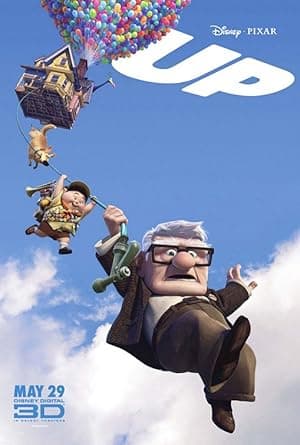
If you remember one image from Up, it’s probably a modest house climbing into the sky on a ridiculous fleet of balloons. That absurd sight is the film’s engine: Carl Fredricksen literally lifts his suburban home into the air to keep a promise he made to his late wife and to escape a life he feels has been taken from him.
The trip doesn’t stay private for long. Seconds after takeoff a keen little Wilderness Explorer called Russell turns up as an accidental passenger, and the pair — a crusty widower and a relentlessly helpful eight-year-old — become the story’s central odd couple.
Under Pete Docter’s direction, Up treats grief and memory seriously without shrinking from its comedy. The ‘Married Life’ montage sets everything up in under five minutes, and Pixar’s design choices — even the way the house was researched and animated — make Carl’s loss feel lived-in rather than staged.
THE SETUP
The idea that sets Up in motion
Up’s premise is gloriously literal: Carl lifts his entire house with thousands of helium balloons and heads for South America to honour a promise to his late wife. It’s a whimsical conceit, but one that immediately tells you who Carl is — stubborn, devoted and a little stubbornly stuck in the past.
Almost at once the plan becomes complicated. Russell, the enthusiastic Wilderness Explorer, has stowed away to earn a badge for assisting the elderly, and his presence forces Carl out of the solitude he’s been protecting.
As they travel the pair encounter more than scenery: an enormous flightless bird named Kevin and a pack of dogs under the control of Charles Muntz turn Carl’s private pilgrimage into a wider conflict. The voyage shifts from personal escape to something that asks Carl what kind of life he still wants.
Pixar plays with the idea of the house as a character in its own right — a burden that also carries Carl toward closure — and even the casting choices (Jordan Nagai’s physical direction during recording) underline how the film balances the ridiculous with the intimate.
THE CHARACTER
Why Carl Fredricksen matters
Carl could have been a stock curmudgeon; instead he’s written as someone whose hard edges are shaped by a long, private tenderness. His life is organised around a promise to his late wife, and that promise explains why he clings to his house — and to solitude — with such fierce logic.
That single motivation keeps the film honest. Carl isn’t grumpy for comedy’s sake; he’s protecting memory, and the movie asks whether preservation is the same thing as living.
Treating the house as a cinematic character matters here. It’s not just a vehicle for jokes; it’s Carl’s stubborn archive — the place where his life with Ellie is physically stored — and moving it becomes a literal and emotional journey.
Because the story pairs him with Russell the film invites a softer register: friendship across generations is a deliberate counterweight to Carl’s isolation, and the contrast between them lets both characters say things they couldn’t alone.
THE PERFORMANCE
Why Ed Asner's performance matters
Contemporary reviewers singled out Ed Asner’s voice work for giving Carl a particular texture: weary, gravelly and believable as someone who’s carried years of life behind him.
That vocal quality anchors a lot of the film’s emotional shifts. When the picture asks the audience to follow Carl from bitterness toward something like acceptance, the voice gives those beats weight without ever needing to spell them out.
Because much of the character’s interiority is suggested rather than explained, a reliable vocal presence matters — and the commentary that surrounded the film at release made that clear.
Put simply: the voice lets you hear the age and history that the script describes, and that audible history is part of why Carl reads as a person you can invest in.
UNDER THE SURFACE
Up has more on its mind than the plot suggests
On the surface Up is an odd-couple adventure with a gag built from balloons. Underneath, it’s tracking grief and the slow arithmetic of mourning: how memory grows and what it costs to keep it pristine.
The story pushes toward renewal. Carl’s flight is initially an act of preservation, but the journey forces a choice between living in a shrine and living a life that still accepts change.
Friendship across generations is one of the film’s steady comforts. Russell’s forward, baffling kindness reframes Carl’s loneliness as something that can be challenged gently rather than punished.
Memory and nostalgia are present without sentimentality; they’re treated as materials you can either hoard or use, and the movie’s adventure is its argument that the latter is braver.
THE FILMMAKING
How Up was put together
The industry took notice when Up arrived. The film’s awards and nominations — including the Oscar for Best Animated Feature and nominations in major categories — signalled that its craft and storytelling were being taken seriously beyond the usual family-film chatter.
That recognition isn’t just window-dressing; it’s a practical acknowledgement that the film blended technical accomplishment with the kind of storytelling that reaches reviewers who don’t always warm to cartoons.
Pete Docter’s direction keeps the picture compact — ninety-six minutes — and focused on character beats that justify the more fantastical elements.
So while the technical achievements matter, they exist to serve an emotional architecture that made critics and awards bodies pay attention.
PRACTICAL EFFECTS
The effects work that gives Up its physical personality
Up’s visuals required new animation and rigging approaches to manage elements the studio hadn’t tackled at scale before — large swarms of balloons and the iridescent plumage of its creatures needed fresh technical solutions.
Those technical steps were practical in the sense that they solved concrete problems: how to make hundreds or thousands of separate objects behave believably without slowing the movie’s momentum.
Pixar also released the film in digital 3-D and consciously used the format to separate the cramped, everyday world from the open vistas the characters seek — a small but deliberate use of depth to underline the story’s themes.
The effects are there to make the oddness feel lived-in, not to distract from the human moments at the centre of the film.
PURE 00s
Up could not belong to any other decade
Up landed in 2009 at a particular moment for mainstream animation: Pixar was pushing stories that trusted audiences with grown-up feelings, and Up continued that late-2000s turn toward emotional maturity in family films.
It also rode the wave of big 3-D releases that marked the era: the studio leaned into digital 3-D theatrically, using depth as another storytelling tool rather than a mere gimmick.
Opening the Cannes Film Festival that year was a statement too — one of the early examples of an animated, 3-D feature carrying a prestigious festival slot and underline Pixar’s cultural standing in the decade.
That mix of technical showmanship and emotional ambition feels very of its time: a mainstream studio comfortable taking risks with tone and form.
WATCHING IT NOW
What has aged — and what hasn't
One of Up’s strengths is the simplicity of its central relationships; the friendship between an older man and a child still reads easily to modern viewers because it’s built on concrete actions rather than tired clichés.
Treating the house as a cinematic character — informed by research into actual vintage architecture — gives the film a tactile anchor that hasn’t dated. The house feels specific, not just symbolic, and that specific detail keeps the film rooted.
Because the emotional stakes are personal and clear, the film’s heart doesn’t rely on passing trends. The questions it asks about holding on and letting go are still recognisable.
In short: the film’s human material ages better than any novelty in its effects or release format.
THE LEGACY
Why Up still matters
Awards underline how Up was received: it won Best Animated Feature and its score by Michael Giacchino took home the Oscar for Best Original Score, while the film also earned unusually broad nominations including Best Picture and Best Original Screenplay.
Those nods reflect more than industry politeness; they recognised a film that asked mature questions inside a form usually reserved for younger viewers and proved that animation could carry serious storytelling weight.
Even years on, Up is brought into conversations when animation and mature themes intersect — not because it’s a spectacle, but because it laid out a compact, humane story that critics and audiences noticed at the time.
THE VERDICT
Does Up still hold up?
Yes — but not because the balloons are charming. Up holds up because its centre is small and stubbornly specific: an elderly man who insists on preserving a life for reasons that make sense to him, and a child who insists that life can be bigger than a shrine.
The movie’s set pieces — the house-as-vehicle, the South American wilderness, the oddball encounters with Kevin and Muntz’s dogs — are enjoyable, but they matter because they force Carl to choose between memory and engagement.
Ed Asner’s vocal presence and the lively counterpoint provided by Russell were part of what reviewers noticed on release, and those performances still give the emotional beats something concrete to hang on. The film’s awards and nominations from the period are a reminder that its mixture of humour and grief landed widely.
If you’re deciding whether to watch it now: treat Up as a short, perfectly formed fable about how people move through loss. It’s heartfelt without being mawkish, and it still finds a way to make the idea of letting go feel like an adventure.
Share this movie
Keep watching
More movies from the 00s
2002
The Pianist
A quiet life unmade by war — and a pianist who refuses to stop listening.
Read the retrospective
→
2006
Blood Diamond
A mercenary, a fisherman and a pink diamond — and a film that still asks who pays for our jewellery.
Read the retrospective
→
2003
Kill Bill: Volume 1
A yellow jumpsuit, a long list of enemies and one woman who refuses to be finished.
Read the retrospective
→