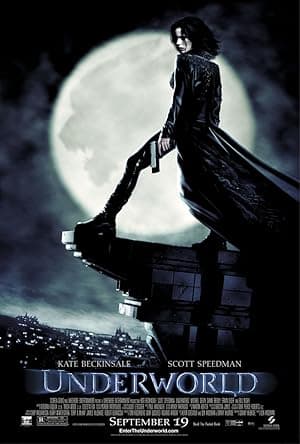
Underworld
Vengeance, forbidden bloodlines and one woman who refuses to stop hunting.
Feature presentation
Underworld is the film that married goth romance to slick 2000s action and handed the whole thing to Selene — a Death Dealer with revenge on her mind. Revisit it for the mythology, the betrayals and for how the movie deliberately wears its decade like a uniform.
THE MOVIE
Selene is still the reason this movie works
Underworld makes a simple promise and keeps it: there’s a secret, centuries-long war between vampires and Lycans hidden inside a modern, Gothic city. That hook alone is good bar-talk and solid movie fuel, but what gave the film traction in 2003 — and what still does today — is the way it centres the story on one person who refuses to be background scenery.
Selene is introduced as a Death Dealer with a vendetta. Her hunt for Lycans isn’t a hobby; it’s a life sentence shaped by the murder of her family, and the movie keeps returning to that need for revenge as its driving engine. When she chooses to investigate a human named Michael Corvin despite orders to stand down, the plot stops being only about monster-versus-monster and starts asking why loyalty and blood matter more than legend.
Len Wiseman’s first feature wraps those elements in a 121-minute package that leans into genre — action, horror, gothic romance — and trusts that a single, focused lead can carry a whole franchise’s worth of questions about secrecy, history and forbidden attachments. Put bluntly: Selene is not only the protagonist; she’s the film’s organising principle.
THE SETUP
The idea that sets Underworld in motion
At the movie’s core is a tidy, effective premise: an ancient, hidden conflict between vampires and Lycans plays out in modern times, and the audience learns the rules as the characters do. That slow reveal — the sense that history is being uncovered rather than explained in a lecture — keeps the film moving without drowning every scene in exposition.
A single plot engine supplies the stakes: Michael Corvin carries the Corvinus bloodline, a genetic thread that could produce a vampire–werewolf hybrid. That possibility turns him from an ordinary human into a symbol — the thing both sides fear and want — and gives Selene a reason to protect him that goes beyond battlefield duty.
Complicating the simple monsters-versus-monsters set-up is human political rot inside the vampire ranks. A vampire noble conspires with the Lycans, and the elders’ internal power plays push the conflict beyond natural enmity into the realm of betrayal and court-style intrigue. It’s not just brute force on display; it’s a closed society with secrets and selfish agendas.
Put together, these pieces — secret war, an inheritable contagion, and conspiracy from inside — establish a mythology ambitious enough to spin sequels and prequels, while still giving the immediate story a clear, single path to follow.
THE CHARACTER
Why Selene matters
Selene is written as a professional: a Death Dealer who exists to hunt Lycans. That job gives her a crisp spine — you always know what her priorities are — and the story makes those priorities interesting by tying them to a personal loss. Her long-term motivation is vengeance; it’s the reason she keeps moving even when the plot asks her to step back.
Because Selene’s motives are personal rather than ideological, she works as an access point into the film’s larger mythology. She’s not a neutral historian; she’s a soldier with a history, and the audience experiences the vampire world through her focused, sometimes stubborn perspective.
That single-mindedness also allows the movie to thread other themes — secrecy, forbidden attachments, and hybrid identity — through a viewpoint that feels immediate. Selene’s actions matter because they’re driven by a private ledger of wrongs, and that keeps the film intimate even while it gestures at a sprawling backstory.
Finally, the character’s centrality is practical: the film is constructed around her choices. When she decides to investigate Michael, the plot pivots; when she confronts the coven’s darker truths, the political intrigue becomes personal. Selene isn’t just memorable because of style — she’s the plot’s moral and kinetic centre.
THE PERFORMANCE
Why Kate Beckinsale's performance matters
Contemporary coverage singled out Kate Beckinsale when Underworld first arrived. Reviews and press noted her physical presence and the way she occupies the central space the movie hands her.
That focus is important because the film relies on Selene as a stabiliser: much of the plot depends on the audience trusting her motives and following her choices. Having a lead who registers as a force — not merely a poster image — helps the story land scenes that might otherwise drift into genre wallpaper.
The other frequently mentioned cast member, Bill Nighy, provides a counterweight as the elders’ voice, which matters because the film’s political betrayals need someone to represent old authority. The critical attention on both actors suggests the movie’s emotional and narrative beats were often judged by how convincingly those roles read on screen.
In short: the contemporary reception identified Beckinsale as carrying the film’s physical and star presence, and that presence is precisely what the story asks for from its protagonist.
UNDER THE SURFACE
Underworld has more on its mind than the plot suggests
On the surface Underworld is an action-horror fable about monsters. Underneath, it’s preoccupied with the mess that happens when private pain meets public power. Selene’s personal vendetta is small-scale — family versus Lycans — but it collides with coven politics and conspiracies, which turns private grief into political consequence.
Betrayal is a constant note. The film isn’t just about enemies outside the gates; it’s about rotten choices inside them. That courtly treachery — nobles conspiring with enemies — fleshes out the vampire society as hierarchical and fragile, and it gives the action stakes that aren’t solved by better weapons alone.
Identity and hybridization are another layer. The Corvinus bloodline reframes vampirism and lycanthropy as genetic inheritance rather than pure superstition. That shift matters because it turns the monster question into a question of lineage and transformation: what happens when blood renders old categories useless?
Finally, secrecy and hidden history thread through everything. The film slowly reveals its world’s past instead of dumping it at once, which makes discovery part of the pleasure: every reveal reframes a previous choice and deepens the sense that this conflict has been misremembered for generations.
THE FILMMAKING
How Underworld was put together
Underworld’s technical credits point to a production that mixed domestic craft with genre ambition. Tony Pierce-Roberts is credited as director of photography, Martin Hunter as the film editor, and Bruton Jones as production designer — names that show the film assembled a team with clear, traditional roles rather than treating visuals as an afterthought.
Saying the credits out loud matters because they hint at a production that wanted its look and pace to be deliberate. The director of photography, editor and production designer are the trio that decide how a world feels on screen — how dense or spare it reads, how action beats breathe — and Underworld’s choices about rhythm and space trace back to those departments.
Len Wiseman, directing his first feature, was working within that structure. A director’s debut often finds ways to lean on trusted collaborators; the named credits suggest Wiseman had a stable crew to realise the film’s gothic-action ambitions.
The result is a film that feels assembled with craft in mind: the mechanics — how scenes are cut together, how locations read, how production elements support mood — are credited clearly, and that matters because the story depends on atmosphere as much as it does on plot.
PRACTICAL EFFECTS
The effects work that gives Underworld its physical personality
Underworld didn’t outsource its transformations to pure CGI. Framestore-CFC supervised the digital visual effects, but the film favoured a hybrid approach: stunt performers and prosthetics were combined with digital doubles and compositing to sell the werewolf transformations.
That blend matters because it gives the movie physicality. Where a fully digital creature can float free of weight, the hybrid method keeps movement anchored to a human performer and then extends or alters it with digital tools. The visual trick is to make the change readable as both stunt work and digital augmentation.
Practical stunts played a role beyond creature work. Several scenes used stunt performers suspended on wires — for example, to achieve wall-running werewolf shots — and those moments were then boosted with digital extensions and compositing to multiply or enhance the live-action elements.
Put simply: Underworld’s effects are a mixture of hands-on craft and digital finishing. That combination gives the film a tactile quality while still allowing for the larger-than-life transformations the story requires.
PURE 00s
Underworld could not belong to any other decade
Underworld is very much a product of the early 2000s in more than just date: it fits a moment when Hollywood liked its genre lean, stylised and confident. The film sits alongside other action-horror hybrids that borrowed music-video energy and graphic-novel attitude to give genre stories a glossy surface.
Contemporary critics noticed that surface. Reviews repeatedly compared the film’s visual style to the era’s big stylised action pictures — references to The Matrix and similar films came up in coverage — which is telling: Underworld worked because it echoed a popular, recognisable cinematic grammar of the time.
The movie also plugged into the decade’s commercial logic. It launched a franchise and fed into a studio strategy of building intellectual property from high-concept genre pictures; sequels and spin-offs followed as the 2000s leaned into serial storytelling.
Finally, the film’s makers were playing a familiar 00s game: a first-time feature director taking a confident, genre-heavy idea and running with it. Len Wiseman’s debut is recognisably of its period — stylised, genre-savvy and franchise-minded.
WATCHING IT NOW
What has aged — and what hasn't
If you press reboot on Underworld today, one of the first things you notice is the emphasis on style over absolute narrative clarity. Later commentary has flagged the quick editing and stylised night cinematography as elements that age the movie in a recognisable early-2000s way — fashionable at the time, occasionally distracting now.
That said, the core mechanical choices hold up: the film’s insistence on Selene as a focused protagonist, the Corvinus bloodline as a plot pivot, and the internal betrayals that drive the conflict are story ingredients that don’t depend on visual trends to make sense. Those elements remain sturdy because they’re narrative, not merely aesthetic.
The film’s role as a mythology-establishing first chapter also affects how it reads now. A lot of Underworld’s purpose is to set out the franchise’s rules — the Corvinus strain, the vampire–Lycan history — and as the seed of a larger narrative that was expanded in later films, it still feels purposeful even if some of the execution is of its moment.
So: watch for the atmosphere if you enjoy 00s stylings, but judge the movie by the solidity of its plot mechanics and characters — the things that survive the passage of time better than surface flourishes.
THE LEGACY
Why Underworld still matters
Underworld’s clearest legacy is institutional: it established the franchise’s core mythology — the Corvinus bloodline and the vampire–Lycan political conflict — and later films kept returning to those building blocks. That origin work matters because it anchored subsequent entries with a shared set of rules and history.
The film’s world-building also proved adaptable. By setting up a secret war and a discoverable past, Underworld handed later instalments a toolbox of ideas they could unpack from different angles — sequels that moved the timeline forward, and a prequel that looked back at origins.
Beyond the narrative mechanics, the movie matters as an example of early-2000s genre filmmaking that could launch a durable franchise. It showed how a focused aesthetic and a single compelling protagonist could become the spine of a multi-film series.
In short: Underworld’s continuing importance is less about a single scene or one headline moment and more about the way it built a world that other films felt compelled to revisit.
THE VERDICT
Does Underworld still hold up?
If you’re deciding whether to watch Underworld now, it comes down to what you’re after. If you want tidy, myth-heavy world-building, a single protagonist whose motives keep the plot honest, and a franchise seed that rewards curiosity, this film delivers. Selene’s decision to investigate Michael Corvin despite orders is the inciting move that makes everything happen, and the Corvinus bloodline gives the plot a strong, simple engine.
If your patience for early-2000s stylings runs thin, there are moments where the emphasis on mood and visual attitude over razor-clear exposition feels of its time. The film also leans on internal vampire politics and a betrayal among the elders to complicate the conflict, which rewards viewers who enjoy conspiratorial, courtly twists as much as physical action.
But the things Underworld sets up — a female lead on a personal revenge mission, the possibility of hybrid identity, and a conspiracy that reframes old myths — remain interesting. Kate Beckinsale is the pivot the whole enterprise hinges on, and contemporary coverage singled her out alongside other cast members, which speaks to how the film asked audiences to invest in its central presence.
Final thought: Underworld hasn’t become a perfect movie with time, but it still works as what it set out to be — a moody, myth-making action-horror that centres a driven protagonist and leaves the door open for more. Watch it for Selene; stay for the way the story slowly untangles its hidden history.
Share this movie
Keep watching
More movies from the 00s

2002
The Pianist
A quiet life unmade by war — and a pianist who refuses to stop listening.
Read the retrospective
→
2006
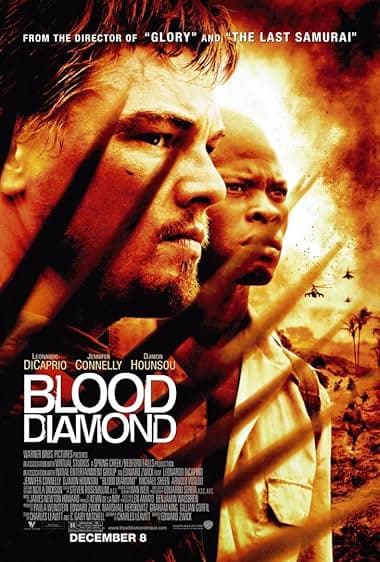
Blood Diamond
A mercenary, a fisherman and a pink diamond — and a film that still asks who pays for our jewellery.
Read the retrospective
→
2003
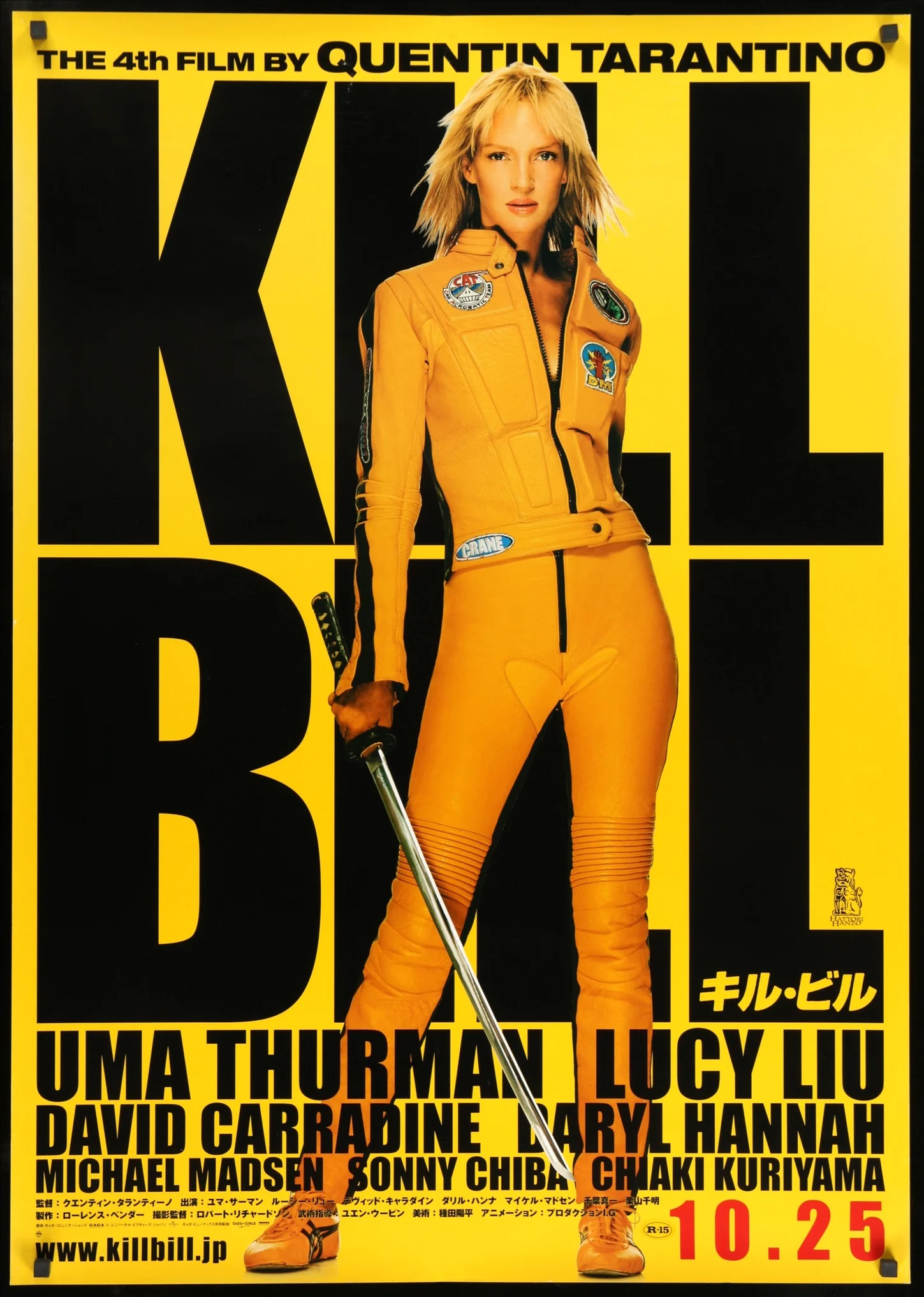
Kill Bill: Volume 1
A yellow jumpsuit, a long list of enemies and one woman who refuses to be finished.
Read the retrospective
→