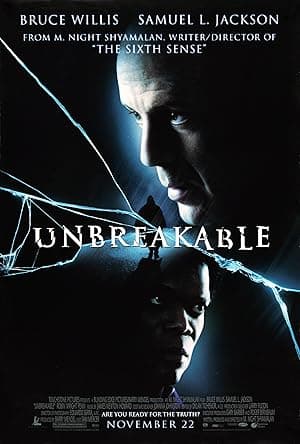
Unbreakable
A quiet superhero origin about a man who walks away from a train and then has to decide who he is.
Feature presentation
Unbreakable still feels like a private conversation with the superhero genre. M. Night Shyamalan took a smash-the-window idea — a man survives a catastrophic train wreck — and turned it into a slow-burn question about purpose, duty and family, rather than costumes and explosions.
THE MOVIE
David Dunn is still the reason this movie works
Unbreakable kicks off with a stubbornly simple premise: a Philadelphia-area security guard walks out of a devastating train derailment while everyone else is killed or hurt. That single fact — one man left untouched by catastrophe — is the movie’s engine.
From that moment David Dunn’s life is no longer just the one he knew. He’s a quiet, estranged family man who must confront the idea that his ordinary existence might have been holding something extraordinary all along. The film turns that premise into a slow test: will he accept a new identity, and what will it cost the people closest to him?
M. Night Shyamalan writes and directs the whole thing in the register of a comic-book origin story, but he deliberately avoids spectacle. The result is a mystery framed with superhero motifs: familiar signs, rearranged so they point inward to character rather than outward to action.
THE SETUP
The idea that sets Unbreakable in motion
The hook is straightforward: a catastrophic train accident leaves one man apparently unhurt. That single anomaly turns an everyday life into material for a bigger story.
Into this gap steps Elijah Price, a brittle, comic-book–obsessed outsider who reaches out to David and suggests a startling hypothesis — maybe some people are built differently, and Dunn is living proof. Elijah’s obsession with meaning and pattern becomes the plot’s driving force.
The central friction is not a fistfight; it’s an argument about how to read a life. Does David stay the anonymous husband and father he has always been, or does he accept the idea that ordinary routines conceal mythic purpose, with all the obligations that implies?
Shyamalan stages these revelations like panels in a comic: scenes get new weight as the screenplay slowly reveals biographical details that force you to look back and see them differently, which keeps the thriller elements more about discovery than spectacle.
THE CHARACTER
Why David Dunn matters
David Dunn matters because the film asks you to live inside his reluctance. He’s not set up as a chosen one who thrills at power; he’s a withdrawn, emotionally distant husband and father who has to reckon with a new idea about himself.
That domestic strain — obligation to family, the pull of normal life — is what gives the superhero framing some teeth. The choices he faces feel moral and practical, not merely cinematic. The story hinges on whether a man who has been doing the everyday can accept the extraordinary without losing the people who matter.
Bruce Willis plays that role, and the film is calibrated around the character’s interior. David’s arc is less about proving physical feats and more about whether he will shoulder responsibility once the possibility of something greater is placed in front of him.
Put bluntly: Unbreakable wouldn’t hold together without a believable centre of gravity, and David Dunn is that gravity — the film measures every mythic impulse against the weight of his home life.
THE PERFORMANCE
Why Robin Wright's performance matters
Robin Wright’s Audrey acts as the film’s tether to ordinary life. Contemporary reviewers singled out her restrained portrayal as the calm counterpoint to the story’s schematics, and for good reason.
Audrey is not written as a plot device with flash lines; she’s the everyday relationship that tests David’s choices. That restraint — holding back rather than dominating scenes — keeps the family stakes grounded when the screenplay leans into myth.
Because the film prefers subtlety to fanfare, having a steady, controlled presence opposite the more schematic elements helps everything feel lived-in. Audrey isn’t there to cheerlead; she’s the yardstick for what David could lose.
In short, her performance gives the film a reality check: whenever the story tips toward abstraction, Audrey brings it back to human terms.
UNDER THE SURFACE
Unbreakable has more on its mind than the plot suggests
On the surface it’s a mystery dressed in comic-book language. Underneath, it’s wrestling with identity: who are we when accident and chance seem to point us toward a different life?
Destiny and the temptation to read meaning into randomness is the movie’s nervous system. Elijah’s need to explain chaos — to find causality in catastrophe — drives ethical choices that ripple through other people’s lives.
There’s also a steady tug between myth and realism. The film borrows the vocabulary of superheroes but keeps asking whether those mythic categories help or distort ordinary human relationships.
Finally, family and responsibility give the abstract ideas a human face. The question isn’t only whether a man can be extraordinary; it’s what that discovery asks of the people who live with him.
THE FILMMAKING
How Unbreakable was put together
One of the film’s clearest choices is visual: the camera often composes scenes as if they were comic-book panels. That framing gives the movie a measured, deliberate cadence — it’s quieter than a typical blockbuster but very intentional.
Eduardo Serra’s credited cinematography works with that idea, organising images so that small gestures and glances carry weight in a way that would be lost in a faster-cut action picture.
Dylan Tichenor’s editing and Larry Fulton’s production design are part of the same plan: the film is built to feel like a stripped-down origin story, where every revealed detail can reconfigure what came before.
Those choices keep the focus on discovery and character rather than spectacle, which is why the film reads like a mystery dressed in superhero clothes.
PRACTICAL EFFECTS
The effects work that gives Unbreakable its physical personality
Unbreakable relies on a mix of physical and optical work to sell its moments. The make-up and prosthetic elements were handled by KNB EFX Group, whose team provided the hands-on effects that make the wreckage and injuries feel tangible.
Visual effects tasks were carried out by The Secret Lab, with special-effects coordination and practical stunts rounding out the film’s physical palette.
That combination — practical make-up work supplemented by visual effects and stunts — helps the film keep a grounded texture. It’s not about glossy spectacle so much as believable consequences.
Which is exactly what the story needs: if the world felt too polished, the moral and familial stakes would lose their bite.
PURE 00s
Unbreakable could not belong to any other decade
Released at the tail end of 2000, Unbreakable feels like a creature of its moment precisely because it refused the obvious routes. It presented a low-key, realist-minded approach to the superhero origin long before the genre became the dominant industrial force it later turned into.
That timing matters: the film uses comic-book language without feeling compelled to translate it into blockbuster mechanics. Instead it tests the language against ordinary lives, which made it an outlier at the time.
Even the decision to release the soundtrack and score in November of 2000 fits the film’s careful pacing — everything about it was measured rather than market-driven.
All of which helps explain why Unbreakable reads like a transitional movie: rooted in the 2000 moment, but looking forward to what superhero storytelling could become if you shrank the scale and raised the moral questions.
WATCHING IT NOW
What has aged — and what hasn't
What still feels fresh is the film’s restraint. Contemporary observers have noted that its focus on character and moral puzzles sets it apart from later, spectacle-first superhero films — and that quality still reads as distinctive today.
Because Unbreakable prizes intimacy over bravura, its questions about identity and responsibility still land. The family tensions and quiet moral choices haven’t turned into period curiosities; they remain central reasons to watch.
That said, the movie’s deliberate pace and schematic plotting can feel arid if you’re expecting blockbuster pacing. The film asks you to sit with ideas rather than be dazzled, which will delight some viewers and try the patience of others.
The later connections — the fact the story was folded into a three-part arc with Split and Glass — also give the film a new context now, making it possible to revisit it as the opening note of a larger experiment.
THE LEGACY
Why Unbreakable still matters
Part of Unbreakable’s afterlife comes from how it was later folded into a trilogy with Split and Glass; that decision reshaped how people revisit the first film, turning it into the origin note of a longer conversation.
Critical reappraisal has also helped. The film is often cited as an atypical example of superhero material — not because it kicked off a style sweep, but because it showed a different way to use comic-book ideas: quietly and morally.
More than anything, it matters because it made room for a superhero story that is chiefly interested in character decisions and ethical consequences. That remains a useful alternative to the era’s more muscular offerings.
Even now, Unbreakable functions as a reminder that the genre can be interrogative as well as celebratory.
THE VERDICT
Does Unbreakable still hold up?
Yes — if you watch it on its own terms. The movie begins with a nearly miraculous survival and builds a story around the question that follows: what does that survival mean for the man who lived through it, and for the people who love him?
Elijah Price’s obsessive attempt to read meaning into catastrophe is what complicates everything; his contact with David forces a choice between staying ordinary and accepting a mythic calling that will change domestic life. That moral tension is the film’s strongest currency.
Shyamalan’s origin-story structure — revealing biographical details that retroactively reshape earlier scenes — keeps the mystery alive without leaning on action set-pieces. If you prefer character-led puzzles to spectacle, Unbreakable still delivers.
So yes: watch it for David Dunn’s difficult, quiet centre, and for the way the film asks whether heroism is a public performance or a private duty. It rewards patience: not with pyrotechnics, but with a stubbornly humane question that lingers.
Share this movie
Keep watching
More movies from the 00s

2002
The Pianist
A quiet life unmade by war — and a pianist who refuses to stop listening.
Read the retrospective
→
2006
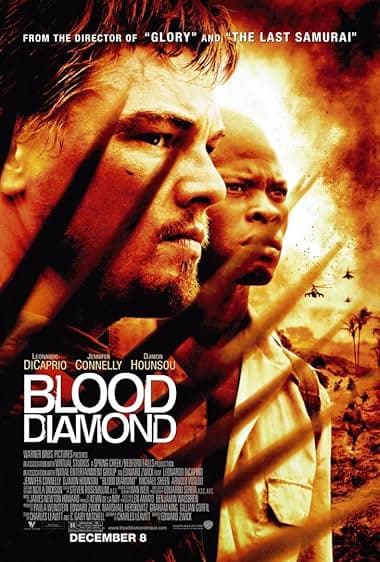
Blood Diamond
A mercenary, a fisherman and a pink diamond — and a film that still asks who pays for our jewellery.
Read the retrospective
→
2003
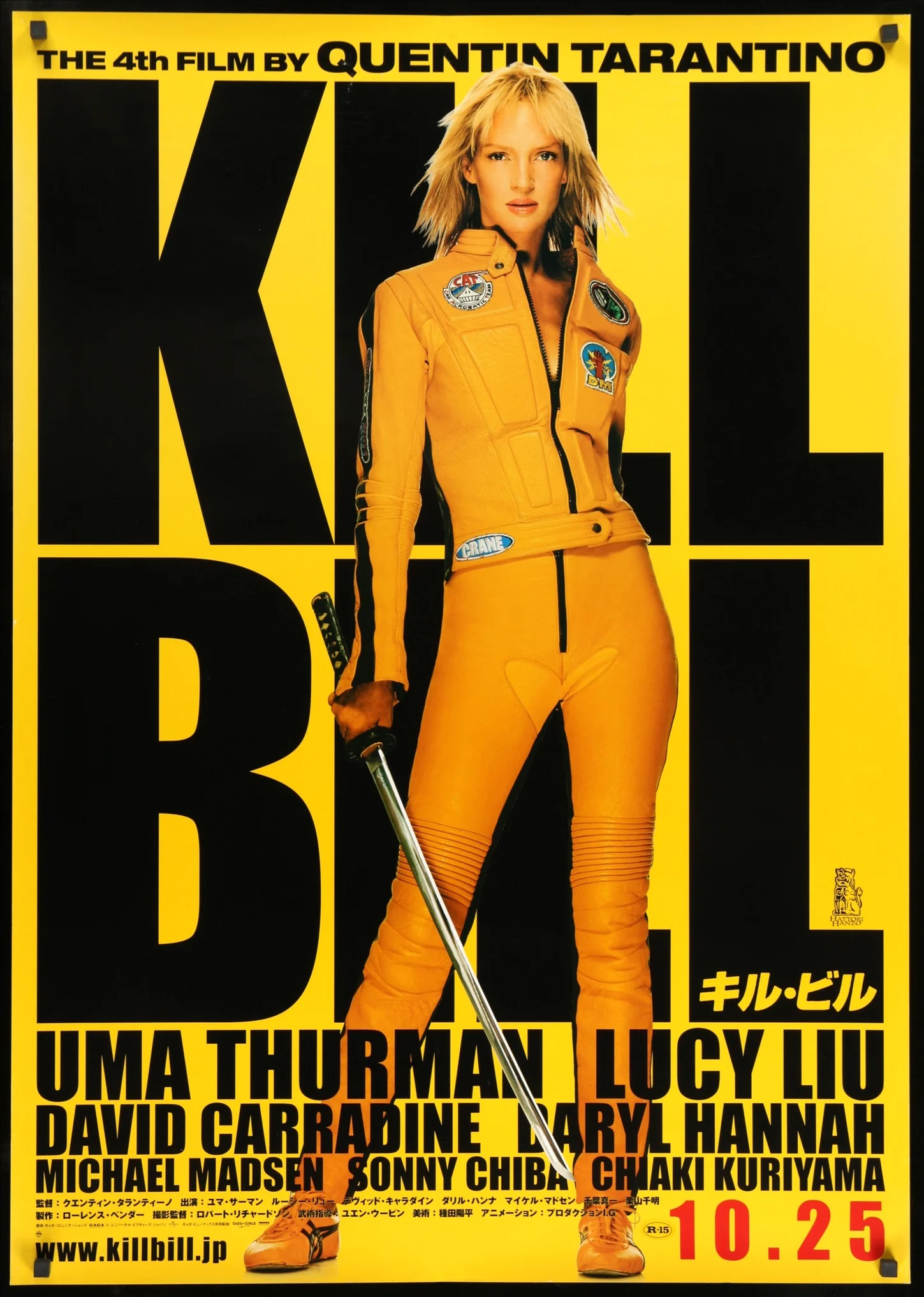
Kill Bill: Volume 1
A yellow jumpsuit, a long list of enemies and one woman who refuses to be finished.
Read the retrospective
→