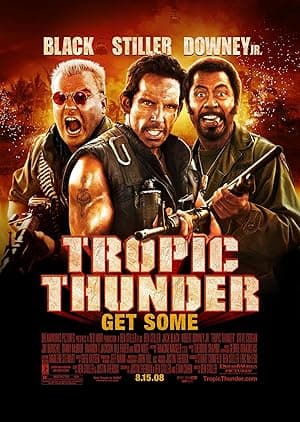
Tropic Thunder
A studio satire that keeps one foot in the jungle and the other on the awards stage.
Feature presentation
Tropic Thunder still gets talked about because it keeps wobbling between two very silly things at once: a group of utterly self-involved actors lost in a real jungle, and a savage take on how Hollywood polishes tragedy into publicity. Ben Stiller’s Tugg Speedman is the little wrecking ball at the centre of that wobble.
THE MOVIE
Tugg Speedman is still the reason this movie works
There’s a simple image that hooks Tropic Thunder: a troupe of overripe movie stars, paid to make a prestige Vietnam picture, shoved out of the comfort of their set and into an actual jungle. The conceit is neat because it immediately turns a production problem into a character test.
Behind that forced wilderness exercise is a specific production catastrophe — an expensive pyrotechnics set-piece that goes to waste — and the studio's panic that forces the film's director to stop pretending and try guerrilla filmmaking. That panic is the movie’s engine; it’s what makes the satire bite.
At the centre of the mess is Tugg Speedman, Ben Stiller’s fading action-name who’s desperate for respect and a proper dramatic turn. He’s not the only ridiculous thing on screen, but he’s the one who keeps the movie honest about why any of this theatre matters.
THE SETUP
The idea that sets Tropic Thunder in motion
You don’t need a detailed plot to appreciate Tropic Thunder’s premise: a movie-within-a-movie about a Vietnam-era production that, through a series of calamities, becomes a genuine survival story for its egotistical cast. The structure lets the film lampoon both the war picture and the machinery that makes one.
Those embedded fake trailers and behind-the-scenes bits aren’t window dressing; they’re the scaffolding. They show the actors as public personae long before the jungle forces them to reveal their private flaws.
The film leans on the contrast between performance and reality. Once the actors are outside the protection of the set, they keep slipping in and out of their screen characters — sometimes because they think it helps, sometimes because that’s all they have left.
And the practical trigger for this experiment in humiliation is delightfully mundane: the crew squanders a huge pyrotechnics sequence, the studio throws a tantrum, and the director’s solution is to drop the whole production into the real thing.
THE CHARACTER
Why Tugg Speedman matters
Tugg Speedman isn’t funny because he’s a parody of an action star. He’s interesting because he’s trying and failing to be more than that. The movie gives us a celebrity whose career is slipping and who has pinned his dignity on one ‘respectable’ role.
That desire — to be seen as an actor rather than an inflatable franchise name — is what makes Tugg human enough to hold the satire together. He’s vanity with a painful centre; you can laugh at him and still care when the façade cracks.
Ben Stiller directs from inside the character as well as outside it, so Tugg’s story doubles as the film’s joke about showbusiness: the people who make the noise are often the most afraid of being quiet and real.
Tugg also anchors the marketing and publicity machine that surrounds the film; the movie’s stunts and mock promotion give his career ambitions more teeth, and occasionally more consequences than he expects.
THE PERFORMANCE
Why Robert Downey Jr.'s performance matters
Robert Downey Jr. plays an actor whose commitment to transformation is taken to an absurd extreme, and that portrayal was noticed beyond the usual comedy chatter.
It drew serious awards-season attention, including a nomination for Best Supporting Actor at the Academy Awards — a tidy piece of evidence that the performance landed with a wide swathe of critics and industry voters.
Within the movie’s mechanics, the part functions as more than a joke about method acting; it’s a loudcase for the film’s questions about authenticity and the cost of pretending.
Mentioning the nomination isn’t an attempt to polish the satire — it’s simply a factual marker that this particular choice had impact outside the jokes.
UNDER THE SURFACE
Tropic Thunder has more on its mind than the plot suggests
Yes, it’s a parody of Vietnam War film conventions, but Tropic Thunder is also a satire of celebrity culture — the way studios and stars spin real danger into product and promote suffering as career currency.
More specifically, it’s fascinated by the gap between authenticity and performance. The film keeps asking whether anyone is actually themselves when they’re always performing, and what happens when pretending becomes the only survival skill you possess.
That obsession bleeds into the movie’s treatment of method acting: the comedy comes from taking the idea of absolute commitment and pushing it to ludicrous lengths until it stops being admirable and starts being dangerous.
So while the story gives us explosions and jungle set-pieces, the movie’s steady aim is to make the audience squint at the theatre of celebrity and wonder which bits are staged — and which are real.
THE FILMMAKING
How Tropic Thunder was put together
Tropic Thunder is cheeky, but it’s also a fairly substantial production. John Toll handled the cinematography while the shoot split between a long location schedule on Kauaʻi and interior studio work back in Los Angeles.
That blend of location and studio allowed the film to sell the jungle-turned-real-jungle conceit without abandoning the sense that this is, at heart, a film about filmmaking.
Production design — led by Jeff Mann — and the editing by Greg Hayden are the practical scaffolding that keep the comedy readable. They let the movie flip between faux-trailers, on-set chaos and real survival beats without leaving the audience behind.
All of this is the quiet discipline under the jokes: a lot of effort went into making the satire feel like it’s coming from inside the machine rather than standing outside and shouting at it.
PRACTICAL EFFECTS
The effects work that gives Tropic Thunder its physical personality
The movie needed to feel physical, so it leaned on real stunt performers and military advisors — the opening sequence alone reportedly required dozens of stunt people to stage the chaos.
Pyrotechnics are not incidental here. On-screen and in the story, explosion set-pieces are central; one costly pyrotechnics sequence is even referenced in the plot as having been wasted, which fuels the scramble that follows.
Makeup and prosthetics were also used for comic transformations. The production ran tests, including for certain characters' heavy makeup looks, in order to make those visual gags read properly on camera.
Those choices underline something obvious: the film’s gags needed physical backing. The practical work gives the satire a weight that purely digital humour would have struggled to match.
PURE 00s
Tropic Thunder could not belong to any other decade
Released in late summer 2008, Tropic Thunder wears its decade in its publicity as much as in its jokes. The studio leaned into viral marketing — faux websites and a mockumentary tie-in — which felt very of-the-moment for that period.
The film’s satire fed on then-current conversations about prestige war movies and the cult of method acting. It pulled at threads that were being discussed around Hollywood dinner tables and gossip columns at the time.
On a production level, the shoot in 2007 on Kauaʻi was unusually large for the island then; the scale of the shoot is a reminder that the film was a proper studio enterprise disguised as anarchic comedy.
So the movie is both a product of and a comment on the 00s: slick enough to be a mainstream summer release, jokey enough to deploy viral tricks, and topical enough to mock then-fashionable acting postures.
WATCHING IT NOW
What has aged — and what hasn't
Some things about Tropic Thunder remain straightforwardly serviceable: it’s a compact 107 minutes and there’s a director’s cut with extra material for anyone wanting to linger longer.
Elements tied to the film’s publicity have kept their bite. The Les Grossman character and the publicity around that part — including appearances outside the film — remain part of how people remember the release.
But the movie’s marketing also brought trouble: a faux promotional site and a mock-documentary element prompted protests and were modified after advocacy groups raised concerns. Those controversies are part of the film’s modern footprint.
Even the production scale — the lengthy Kauaʻi shoot and the studio/stunt resources behind the action — is part of what lets the film hold its tone today. It isn’t a sloppy sketch; it’s a deliberately built thing, for better and worse.
THE LEGACY
Why Tropic Thunder still matters
Tropic Thunder matters partly because it performed as a studio movie: it opened at number one in North America and held that commercial position for several weeks, so it reached a broad audience at release.
It also landed moments that outlived initial trailers — Robert Downey Jr.’s awards-season attention, signalled by an Academy Award nomination, made the film talkable in a way few comedies manage.
Then there’s Les Grossman, a character who became a public talking point beyond the film itself, with the actor reprising that persona in promotional and awards-show settings.
Those three facts — commercial reach, awards chatter, and a publicity-friendly character — explain why Tropic Thunder remains a film people bring up when talking about how Hollywood satirises itself.
THE VERDICT
Does Tropic Thunder still hold up?
Short answer: yes, with caveats. The movie’s central joke — actors dropped from a set into a real jungle and forced to confront danger with only their performative tools — still reads as a sharp premise and fuels most of the best scenes.
Tropic Thunder’s structural cleverness — the film-within-a-film and the faux-trailers — keeps the satire precise rather than scattergun. When the production implodes over a wasted pyrotechnics set-piece and the director is suddenly incapacitated, the stakes become both ridiculous and urgent.
The film also benefits from having a clear target: celebrity narcissism and the way prestige and publicity get weaponised. That focus is why moments like the Les Grossman appearances cut through publicity noise, and why Robert Downey Jr.’s awards recognition registered beyond the box-office churn.
So watch it for the bite and the set pieces, but watch it with your eyes open to its controversies and the bits of its publicity that sparked real complaints. It’s a loud, deliberately ugly satire — and most of the time that’s exactly the point.
Share this movie
Keep watching
More movies from the 00s

2002
The Pianist
A quiet life unmade by war — and a pianist who refuses to stop listening.
Read the retrospective
→
2006
Blood Diamond
A mercenary, a fisherman and a pink diamond — and a film that still asks who pays for our jewellery.
Read the retrospective
→
2003
Kill Bill: Volume 1
A yellow jumpsuit, a long list of enemies and one woman who refuses to be finished.
Read the retrospective
→