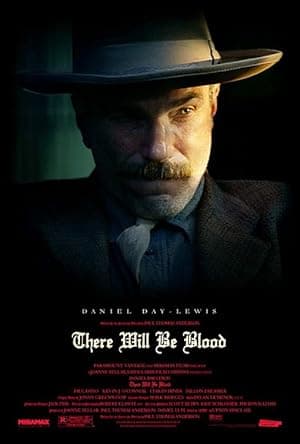
There Will Be Blood
Daniel Plainview wants everything. The film wants you to watch him try.
Feature presentation
There Will Be Blood is the sort of film you remember as much for who it watches as for what it shows. Paul Thomas Anderson hands the camera to a man building an empire and then asks us to witness the cost. Three hours of ambition, Sabbath sermons and oil-stained silence — and a central figure who keeps drawing your attention back.
THE MOVIE
Daniel Plainview is still the reason this movie works
There Will Be Blood follows Daniel Plainview, an early-20th-century prospector who turns a bit of information about oil under someone’s land into a career in commercial drilling. It’s a simple engine: a tip, a decision, and the slow accretion of power.
What makes that engine engrossing is Plainview himself — a man built around accumulation, self-reliance and a need to control the world around him. He talks about family often, but the film lets you see those family claims operating as strategy as much as feeling.
Paul Thomas Anderson directs, Daniel Day-Lewis plays the central role, and Jonny Greenwood’s modernistic score keeps the period material feeling restless rather than cosy. It was a long, deliberate movie in 2007, and it still feels like one that wants you to lean in and listen.
THE SETUP
The idea that sets There Will Be Blood in motion
The story is straightforward in its promise: a prospector finds opportunity and goes all in. An early scene — a young man named Paul Sunday telling Daniel Plainview about oil under his family’s land — is the literal spark that flips Plainview into commercial drilling.
From there the film opts for breadth over breathless plotting. It traces decades, showing the practical business of finding and pumping oil as Plainview’s small operations become something much bigger.
That passage of time does a crucial emotional job: as the business grows, Plainview’s private life frays. The movie never treats success as uncomplicated; what gets gained is measured against what is lost.
So the setup works because the plot is less about surprising twists and more about watching a personality harden under a specific set of pressures — commerce, land, and the way reputation can be used like capital.
THE CHARACTER
Why Daniel Plainview matters
Plainview matters because he’s not just chasing oil; he’s chasing what oil represents — leverage, independence, control. The film keeps returning to his rhetoric about self-reliance and family, and then quietly tests how much of that rhetoric is sincere.
That ‘family’ claim is a performance on many levels. Plainview adopts a boy, H.W., and the arrangement functions as a public signal that helps him do business. The kid becomes a living proof that Plainview is rooted, not some lone prospector without ties.
A later injury removes H.W.'s hearing, and the film uses that change to shift the texture of Plainview's private life. H.W. is both a tether and a mirror: he shows Plainview the shape of his commitments, and he also reveals their limits.
Daniel Day-Lewis plays Plainview, and the film revolves around how that character negotiates ambition, control and the idea of family as both comfort and commodity.
THE PERFORMANCE
Why Daniel Day-Lewis's performance matters
Contemporary coverage singled out Daniel Day-Lewis’s portrayal of Daniel Plainview as the film’s central achievement. That attention is part of why the movie had such a profile during awards season.
Day-Lewis’s centrality is baked into the film’s shape: it’s a long movie that repeatedly returns the camera to one man’s decisions, moods and escalations. The attention paid by critics and awards bodies underlines how the role anchors the whole piece.
In practical terms, the performance became a pivot around which the film’s reception turned, helping to make the picture a headline example of auteur-driven drama in 2007–2008.
Put simply: the movie’s conversation is often a one-on-one with Plainview, and that conversation only works if the lead convinces us to keep listening — something contemporary reaction made very clear.
UNDER THE SURFACE
There Will Be Blood has more on its mind than the plot suggests
On the surface it’s an oilman’s tale; underneath it the film is preoccupied with capitalism and accumulation — how wealth is pursued, displayed and defended. Plainview’s appetite for control reads as a concentrated study of what accumulation does to a person.
Religion and commerce are pitched against one another in the story. The preacher figure stands in a different register of authority from Plainview, and the film stages their encounters as more than mere clashes of personality — they are competing systems of power.
Ambition here breeds isolation. The longer Plainview rises, the more his life narrows to transactions and confrontations. The movie quietly maps how ambition can eat away at ordinary human ties.
Family is presented as performance: presenting H.W. as a son serves business ends and shapes how other characters and communities treat Plainview. That idea keeps returning, which is why the film often feels less like a biography and more like an anatomy of roles.
THE FILMMAKING
How There Will Be Blood was put together
Paul Thomas Anderson wrote the screenplay and stages long-form sequences that let character be revealed through tempo and space rather than constant exposition. The film trusts duration; it lets scenes breathe and the tensions simmer.
Robert Elswit is credited as director of photography, Jack Fisk led production design, and Tatiana S. Riegel is credited as editor. Those roles frame the movie’s look and rhythm, and the production credits point to a craftsmanship that keeps the period detail coherent.
Contemporary reaction singled out both Daniel Day-Lewis’s central role and Elswit’s work behind the camera, which together made the film feel deliberately composed and formally confident.
So the filmmaking is less about flashy tricks and more about sustained authorial choices: careful staging, deliberate pacing and production work that supports the film’s long, patient gestures.
PRACTICAL EFFECTS
The effects work that gives There Will Be Blood its physical personality
The film used specially formulated, environmentally safe materials to simulate the gushers and on-set oil fire sequences. That choice kept the physical set pieces grounded in something tactile rather than entirely digital.
A production disclosure even notes the simulated oil mixture included food-grade ingredients — the creative solution aimed to get the right look without harming locations or people.
Those practical decisions make certain scenes feel convincingly physical: the oil isn’t just a matte painting or screen trick, it behaves like something present on set.
In a movie that foregrounds extraction and the material consequences of commerce, having a believable, physical presence for oil matters to the film’s texture.
PURE 00s
There Will Be Blood could not belong to any other decade
Released and premiered on the festival circuit in late 2007, the film came to symbolise a particular strand of 00s cinema: auteur-driven, prestige independent filmmaking finding its place in awards season via specialty distribution.
It was part of a brief, visible return to frontier and revisionist-Western settings among American films that year, using West Texas locations that other contemporary productions were also exploiting.
At the same time the film sits in continuity with Paul Thomas Anderson’s earlier work; reviewers and coverage treated it as a logical development in his filmography rather than a sudden departure.
All that places the picture squarely in the mid-00s context: it’s an independent, director-centred epic that used festivals and awards momentum as part of how it reached audiences.
WATCHING IT NOW
What has aged — and what hasn't
The film’s central idea of family as performance still reads sharply. Presenting H.W. as a son to further business aims is a clear moral choice that hasn’t dulled with time; it still makes modern viewers uncomfortable in the ways the story intends.
The decision to adapt only parts of Upton Sinclair’s Oil! and to shape them into a character study rather than a faithful novel adaptation feels less like a limitation now and more like a deliberate creative stance.
Because the film focuses on character and long-form confrontations, its core tensions — capitalism versus other forms of authority, the loneliness of ambition — remain legible to contemporary audiences.
In short: the ideas the movie pins to its characters are durable because they are grounded in behaviour and choices rather than period spectacle alone.
THE LEGACY
Why There Will Be Blood still matters
The film’s awards season profile mattered: Daniel Day-Lewis won the Academy Award for Best Actor, and the picture received nominations that kept it in the cultural conversation during 2007–2008.
A line from the film — a blunt, memorable phrase about competitive oil extraction — entered wider circulation and is still quoted in popular commentary, which helped the movie remain headline-friendly.
Jonny Greenwood’s modernistic score shifted how people thought about music for period drama and raised his profile as a composer working in cinema.
Taken together, the performance recognition, a quotable line and an arresting score give the film concrete touchpoints that kept it in view after its initial release.
THE VERDICT
Does There Will Be Blood still hold up?
Yes — but with a clear rider. If you find slow-burning, character-led cinema rewarding, the film holds up because its central tensions remain sharply drawn: Plainview’s rise across decades is shown alongside the corresponding fracture in his personal life, and that contrast still lands.
The structural move to present H.W. as an adopted son used in part to advance business aims gives the story a moral knot that survives repeated viewings. It keeps the film from being mere historical spectacle and makes the stakes personal.
The narrative’s insistence on concentrated, one-on-one confrontations — deals, sermons and private reckonings — means the film is at its best when people speak, posture and test one another. Those scenes concentrate the moral and psychological pressure in ways that remain compelling.
So should you watch it? If you want a long, deliberate study of ambition, commerce and the rituals that shore up power, There Will Be Blood still rewards attention. It doesn’t invite light viewing; it wants you to sit with Daniel Plainview and watch what hunger does to a man.
Share this movie
Keep watching
More movies from the 00s

2002
The Pianist
A quiet life unmade by war — and a pianist who refuses to stop listening.
Read the retrospective
→
2006
Blood Diamond
A mercenary, a fisherman and a pink diamond — and a film that still asks who pays for our jewellery.
Read the retrospective
→
2003
Kill Bill: Volume 1
A yellow jumpsuit, a long list of enemies and one woman who refuses to be finished.
Read the retrospective
→