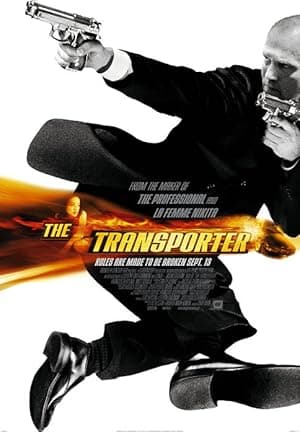
The Transporter
A one-man delivery service with three stubborn rules — until a package changes everything.
Feature presentation
You know the beat: a perfectly rehearsed routine, a driver who treats emotion like road kill and a single rule that keeps chaos at bay. The Transporter announces itself through Frank Martin's rules, then spends ninety-odd minutes arguing that rules can break when a person is at stake.
THE MOVIE
Frank Martin is still the reason this movie works
The clearest thing about The Transporter is a man who lives by a list. Frank Martin runs a driver-for-hire operation out of southern France and keeps to three iron rules: no names, no questions, never open the package. That tidy discipline is the movie’s personality in miniature.
The plot — what little of it you need to know at first — hinges on a single transgression: a parcel gets opened and there is a bound woman inside, Lai. That discovery forces Frank off autopilot and turns a cold, professional arrangement into something messier and, importantly, less predictable.
So why come back to this 2002 action-thriller directed by Louis Leterrier and Corey Yuen? Because the film is built around that brittle promise of detachment, and watching it crack is where the film finds its small dramas. Jason Statham’s Frank is the chassis everything else bolts onto.
THE SETUP
The idea that sets The Transporter in motion
The Transporter doesn’t dawdle. Its premise is straightforward and economical: Frank follows a strict courier code while moving packages around the south of France. The rules keep his life organised and his conscience clipped to a schedule.
Everything changes when one package breaks the rules for him. Inside is Lai, a human cargo whose presence instantly complicates the equation. Frank’s professional neutrality faces a test it was never designed to handle.
From there the film spins up a series of transport-flavoured set pieces: car chases, container runs and close-quarters confrontations that grow from a courier’s job gone very wrong. The stakes escalate because the delivery business here is a front for a trafficking operation, and the people who ordered the job aren’t keen on loose ends.
On the other side of the road you have the antagonists: the violent enforcer known as 'Wall Street' and an organised-crime figure called Mr. Kwai, plus law enforcement circling in the form of Inspector Tarconi. Frank, Lai and those pursuers form the compact dramatic triangle that keeps the movie moving.
THE CHARACTER
Why Frank Martin matters
Frank Martin is memorable because he’s such a clean, high-contrast idea: a professional whose life is organised around rules. That clarity makes his gradual shift — from a man who won’t open packages to one who will shield the person inside — satisfyingly dramatic.
He isn’t rewritten into a different character; he’s nudged. The movie asks whether a code can survive contact with responsibility, and Frank’s choices are where that question lands. The drama comes from watching a rule-bound loner weigh his method against a moral impulse.
The film was shaped as a vehicle for that character. It was developed within Luc Besson’s production setup as an English-language picture tailored to its lead, which is why so much of the film’s energy serves Frank’s particular rhythm: efficient, controlled, then increasingly personal.
That narrow focus keeps the movie brisk. Frank isn’t a puzzle of backstory; he’s a problem solver. The Transporter is, essentially, a movie about what happens when a man who refuses complications is given one he can’t ignore.
THE PERFORMANCE
Why Jason Statham's performance matters
Contemporary reviews singled out Jason Statham’s presence and physicality as a defining element of the film’s appeal. That observation does much of the heavy lifting here: the movie hands Statham a compact, almost schematic role and lets his screen persona fill out the space.
What that means in practice is simple: the framing, the choreography and the film’s pacing are built to show a controlled, efficient central figure. The material is pared back so Statham’s physical presence becomes the primary storytelling device.
So the performance functions as a tool. It isn’t a long character study; it’s a performance calibrated to deliver a particular kind of action lead — someone who feels like a professional, first and foremost.
Which is exactly what the film needs. The Transporter trades subtle interior psychology for the satisfaction of a performer who can make bodies, movement and a handful of rules feel like a complete personality.
UNDER THE SURFACE
The Transporter has more on its mind than the plot suggests
At face value The Transporter is a neat action-thriller about moving things from A to B while avoiding trouble. Under the surface, it’s rustled by three distinct ideas: a professional code bumping up against conscience; an acknowledgment that the delivery business in the film disguises exploitation; and a very particular kind of masculine restraint.
The film keeps returning to the rules-versus-responsibility problem: Frank’s three strictures are meant to protect him, but they also let others hide behind his anonymity. Once he breaks them, the movie tracks what that personal motion costs and what it saves.
Human trafficking and exploitation are the darker gears turning the plot. Lai’s presence isn’t just a device for action; it exposes that the world Frank moves through is organised around using people, which forces the hero to choose whether he remains an instrument or becomes someone who interferes.
Finally, there’s the loner-hero thing. Frank’s brand of masculinity is restrained — he’s efficient rather than boisterous — and the film uses that restraint to make his shifts in behaviour feel like difficult, credible decisions rather than melodramatic conversions.
THE FILMMAKING
How The Transporter was put together
The Transporter’s action language is the result of a dual-director approach: Corey Yuen handled action direction and fight choreography while Louis Leterrier appears in European credits as director and is listed as artistic director in some U.S. materials. The split shows in how the film balances stunt-minded sequences with a compact, producer-driven shape.
That collaboration was deliberate. The movie was built to combine Hong Kong-style choreography — the kind of kinetic, tightly rehearsed fights Yuen specialised in — with European production values, which keeps the action both flashy and contained.
The practical upshot is a film that feels engineered: the set pieces are designed to showcase movement and rules rather than to linger on exposition. The choreography-led approach gives the stunts a clear, rhythmic logic.
So when a confrontation happens you sense the fingerprints of an action director who understands how to stage a fight, and of a European-led production that frames those beats within a streamlined thriller.
PRACTICAL EFFECTS
The effects work that gives The Transporter its physical personality
The production didn’t wing its action. There was an extended rehearsal period — documented as eight weeks of training and rehearsals for the leads and stunt teams — which explains why the film’s physical sequences feel tightly coordinated.
A few of the set pieces were built around actual stunt work. The crew rehearsed and staged a sequence that uses oil tactically in a fight, and the film’s chase material relies on extended practical car stunts to sell its transport-based thrills.
There’s also an underwater scene that required specialist preparation: the lead actor trained with experienced divers to make the sequence believable and safe. Small, concrete investments like that anchor the film’s physicality.
Those choices matter because they let the movie trade cheap spectacle for a sense of real-world cause-and-effect: when a stunt lands it feels like something the characters did, not just CGI theatre.
PURE 00s
The Transporter could not belong to any other decade
The Transporter is a distinctly early-2000s product: a European-backed, English-language action film engineered to launch a new international star. That producer-led model — build a vehicle around a performer, then sell the whole package worldwide — was a clear industry pattern at the time.
It also sits in an era when Western productions were explicitly borrowing Hong Kong choreography to sharpen fight sequences. Corey Yuen’s involvement brought that kind of kinetic discipline into a film designed with Western markets and distribution in mind.
And the film’s afterlife — it became the first entry in a multi-film series, with sequels in 2005 and 2008 — is exactly the 00s playbook: make an efficient action picture, then extend it into a franchise if it finds traction.
Put simply, The Transporter feels like a business plan as much as a movie — which is why it feels so of its moment. The decade liked things that were engineered to travel.
THE LEGACY
Why The Transporter still matters
The Transporter’s clearest legacy is structural: it’s the first film in a series that produced two sequels and broader franchise entries. That continuation makes the original the origin point for a small action universe.
There’s another legacy in casting. Press coverage of the time treated the film as a breakout, high-profile role that helped establish Jason Statham as a mainstream action lead. The picture functioned as a practical vehicle to position him for that career direction.
Those are practical, industry-minded afterlives rather than claims of cultural dominion. The Transporter matters because it did what it set out to do: introduce a compact star character and a repeatable shape for more action films.
Which is perfectly respectable. Not every movie needs to change the world; some exist to carve out a lane. This one carved a very specific, transportable lane.
THE VERDICT
Does The Transporter still hold up?
Yes — if you watch it on its own terms. The Transporter is a 92-minute action-thriller from 2002 that keeps its focus tight. Its engine is a courier’s code: Frank’s three rules give the film a compact logic that makes the inciting moment — him opening a package to find Lai — feel consequential rather than arbitrary.
From there the central problem is simple and persuasive: Frank must protect Lai while dodging the police and the criminals who hired him. That tension keeps the set pieces honest because the action always ties back to the logistics of moving people and things.
The movie’s pleasures are structural: the way transport mechanics create escalating confrontations, the presence of an enforcer figure like Wall Street, an organised-crime pull in Mr. Kwai, and the recurrent, begrudging contact with Inspector Tarconi. Those elements add up to a lean crime thriller with a clearly defined centre.
If you want deep character psychodrama, look elsewhere. If you want a tightly designed action picture where a rule-bound loner is forced into human decisions — and you’re curious to see the early building blocks of Jason Statham’s action persona — The Transporter still delivers. It’s a car-and-code movie, and it does exactly what it promises.
Share this movie
Keep watching
More movies from the 00s

2002
The Pianist
A quiet life unmade by war — and a pianist who refuses to stop listening.
Read the retrospective
→
2006
Blood Diamond
A mercenary, a fisherman and a pink diamond — and a film that still asks who pays for our jewellery.
Read the retrospective
→
2003
Kill Bill: Volume 1
A yellow jumpsuit, a long list of enemies and one woman who refuses to be finished.
Read the retrospective
→