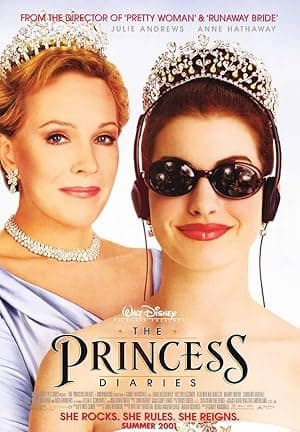
The Princess Diaries
An awkward teenager, a stern grandmother and a haircut that changes everything.
Feature presentation
There are films you remember for one moment — the quiz-show shock, the final speech, the laugh-out-loud gag. The Princess Diaries is more stubborn: it lives in the small, awkward beats. Mia Thermopolis’s discovery that she’s a princess isn't just a plot twist; it's the pressure that forces a painfully shy teenage life into the bright, ridiculous spotlight. Directed by Garry Marshall and introduced to audiences in 2001, the film is a family-ready coming-of-age about learning to be seen without losing yourself.
THE MOVIE
Mia Thermopolis is still the reason this movie works
What keeps The Princess Diaries from being merely a glossy fairy-tale is Mia Thermopolis. She starts the film as a painfully self-conscious San Francisco teenager whose life is normal in the smallest, most human ways — homework, gossip, the private business of being awkward — until she’s told she’s actually heir to a European throne.
That visit from her estranged grandmother, Queen Clarisse Renaldi, is the inciting bolt of comedy and pressure. The royal lessons that follow — etiquette, public poise, a very public presence — are the film’s visible engine. They force Mia into situations that test who she thinks she is against who the world expects her to be.
Anne Hathaway plays Mia in her feature debut opposite Julie Andrews’s dowager queen, and director Garry Marshall steers it in the warm, family-friendly key the story needs. At its heart the film is a coming-of-age about identity, duty and the awkward business of learning a public voice.
THE SETUP
The idea that sets The Princess Diaries in motion
The basic conceit is simple and stage-ready: an ordinary teenage life collides with an extraordinary responsibility. Mia learns she’s the hereditary princess of Genovia and, overnight, ordinary problems acquire a public dimension.
That public dimension is a recurring plot mechanic. Media attention and school gossip turn familiar adolescent humiliations into spectacles. The film makes a lot of its comic energy by letting Mia’s private awkwardness meet very public consequences.
Alongside the intrusion of fame sits the central choice: accept the role and its ceremonial duties or step away. The timetable of Genovia’s civic and ceremonial requirements gives weight to that decision — it isn’t an abstract question, it’s something with deadlines and expectations.
And at a story level the makeover sequence does more than change Mia’s hair and wardrobe. It’s staged as a turning point: the outward transformation mirrors an attempt to craft a public identity, which in turn forces Mia to reckon with who she wants to be in front of other people.
THE CHARACTER
Why Mia Thermopolis matters
Mia is written as the sort of awkward, self-conscious teenager you can’t help rooting for. The story gives her ordinary anxieties and then complicates them with extraordinary circumstances — she has to grow a public persona while trying not to lose the teenager underneath.
Those ordinary ties matter. Lilly Moscovitz is Mia’s best friend and the moral compass who keeps her grounded, and Michael Moscovitz is positioned as a peer whose friendship makes any romantic possibility feel complicated and earned rather than convenient.
There’s also a protective, pragmatic presence in Joe, the security figure who becomes a stabilising force in Mia’s suddenly public life. Together these relationships stop Mia’s story from becoming a solo ascent; she’s shaped by friends, mentors and the small loyalties of teenage life.
Anne Hathaway appears in the film as Mia in her feature-film debut, which is worth remembering: the movie depends on that central, recognisable awkwardness. Mia matters because the film keeps returning to how a shy girl learns to hold herself in public without losing the private person she already is.
THE PERFORMANCE
Why Julie Andrews's performance matters
Julie Andrews’s presence in the film is repeatedly noted in contemporary reaction as a casting that fits the material. Critics singled out how her casting reads as regally appropriate and how she steadies the film’s tone.
That steadiness matters because Queen Clarisse is both disciplinarian and mentor. The part demands a figure who can push Mia while still feeling like a relational anchor, and the contemporary response highlighted Andrews’s restraint and the way she gives the film a tonal centre.
Reviews also pointed to the chemistry between Anne Hathaway and Andrews as an important element. The relationship — a blunt, old-world grandmother teaching the ways of public life to a flustered teenager — relies on that intergenerational dynamic more than on spectacle.
Put simply: Clarisse’s role is not just to issue curt royal orders. She’s the guide who forces Mia into the choices that define the story, and the casting choices around that role were repeatedly recognised as giving the film the room it needs to be both funny and earnest.
UNDER THE SURFACE
The Princess Diaries has more on its mind than the plot suggests
On the surface it’s a rags-to-royalty story. Underneath, it’s a coming-of-age about identity: who you are when private life is made public, and how you negotiate the versions of yourself that other people want to see.
The movie keeps returning to duty versus choice. The royal line isn’t just a title; it arrives with expectations and public responsibilities. Mia’s dilemma — perform the role expected of her or step away — makes the film about the trade-offs between personal freedom and inherited obligation.
Public image is another strand. Gossip, media attention and school spectacle push the plot, but they also let the film ask how a teenager learns to manage being looked at. That pressure is the modern wrinkle in a traditional coming-of-age template.
Finally, there’s family and mentorship. The film pairs adolescent confusion with adult guidance; the lessons Mia receives are about more than manners. They’re about choosing how to be in the world, which is what keeps the movie from being only a series of charming set pieces.
THE FILMMAKING
How The Princess Diaries was put together
The film’s look supports its story choices. The credited cinematography leans into San Francisco locations and a bright, family-friendly palette, which keeps the tone sunny even when Mia’s life gets awkward and exposed.
Production design and costuming are used deliberately to mark before-and-after moments for Mia. The movie stages a clear visual contrast between her private, everydayness and the public persona she is taught to perform.
Those decisions matter because the makeover and etiquette lessons are both plot points and visual cues. When the film changes Mia’s wardrobe and bearing, it isn’t just a gag; it’s a readable signal of identity being negotiated on camera.
Garry Marshall’s direction keeps the pieces aligned: the photography and the design consistently feed back into the story’s emotional beats, so the filmmaking choices feel like part of the argument about growing up rather than window dressing.
PURE 00s
The Princess Diaries could not belong to any other decade
The Princess Diaries arrived in 2001 at a moment when studios were quick to turn contemporary young-adult novels into family-friendly films. It’s very much of that moment: a mainstream, studio-backed adaptation aimed at teens and families alike.
It also exemplifies the early-2000s formula of blending pop-friendly elements with old-fashioned romantic-comedy structure. That mix gave the movie broad appeal — it was pitched to kids and parents in the same breath.
Rapid screen adaptations of best-selling YA properties were part of the business logic then, and this film sits squarely in that trend. The source novel had been published just a year earlier, and the movie moved quickly to bring that story to a wider audience.
That commercial logic also produced a sequel: The Princess Diaries 2: Royal Engagement followed in 2004 with many of the same cast and the same director, underlining how the film fit into the studio’s early-2000s family strategy.
WATCHING IT NOW
What has aged — and what hasn't
Viewed today, the film still reads as an early-2000s family/teen comedy. Its core themes — identity and the pressure of being seen — remain legible and surprisingly straightforward in a streaming era that loves clear emotional beats.
Modern commentary often places the movie as a hallmark of its era: you recognise the structure and the tone immediately. That familiarity can be a comfort, but it also means some of the teen-comedy conventions feel of their time.
Not everything is timeless. Some of the genre’s shorthand and schoolyard plotting belong to an era of family films that favoured tidy arcs and broad comic setups. For viewers sensitive to that kind of shorthand, those moments will feel dated.
But the parts that hinge on relationships and choices — a shy teenager learning to stand up, an elder who insists on tough love — remain directly watchable. The film’s heart is simple, and simplicity sometimes outlasts stylistic fashions.
THE LEGACY
Why The Princess Diaries still matters
The film helped establish Anne Hathaway as a mainstream lead and served as what many viewers experienced as Julie Andrews’s reintroduction to a broad modern audience. That casting mix gave the movie a curious generational reach.
It also delivered enough of a commercial story to warrant a studio sequel in 2004 with returning principal cast and director, which keeps the film present in conversations about early-2000s Disney fare.
Beyond that, the property frequently turns up in retrospective coverage and anniversary pieces as a recognisable example of its moment — a family film with a YA root and a feel that reads as early 2000s.
So its legacy isn’t a single bold influence; it’s a combination of career-launching moments, a dependable studio follow-up and a place on lists and memories about that particular era of family cinema.
THE VERDICT
Does The Princess Diaries still hold up?
Yes — if you approach it on its own terms. The film is, at base, a story about a shy San Francisco teenager told in a family-friendly rom-com key: Mia learns she’s heir to Genovia, her grandmother arrives to teach her the public ropes, and everything becomes public in a hurry.
If you’re looking for complicated politics or a brutal deconstruction of celebrity, this isn’t that film. Its recurring mechanic is the pressure of public exposure: gossip, media attention and the way a schoolyard can become a spectacle. The stakes are personal and immediate rather than grand political drama.
What makes it worth watching now is that the central choice still lands. Mia’s dilemma — whether to accept the ceremonial responsibilities pressed upon her or to walk away — is a clean, watchable engine. The makeover and etiquette lessons are the visible moments, but the story is ultimately about who Mia wants to be in public.
So, if you’re in the mood for a warm, tidy coming-of-age with clear emotional beats, stick this one on. It’s a time capsule of early-2000s studio family filmmaking, yes, but it’s also a story about learning to be seen that keeps a surprising amount of its charm.
Share this movie
Keep watching
More movies from the 00s

2002
The Pianist
A quiet life unmade by war — and a pianist who refuses to stop listening.
Read the retrospective
→
2006
Blood Diamond
A mercenary, a fisherman and a pink diamond — and a film that still asks who pays for our jewellery.
Read the retrospective
→
2003
Kill Bill: Volume 1
A yellow jumpsuit, a long list of enemies and one woman who refuses to be finished.
Read the retrospective
→