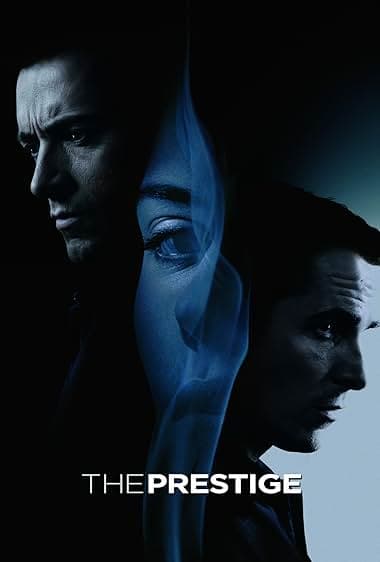
The Prestige
Obsession, misdirection and a man who will do anything to be remembered.
Feature presentation
Ask anyone to name a Nolan film that isn’t about explosions and you’ll get two answers: Memento and The Prestige. This one is a Victorian parable about two magicians whose rivalry turns into a private war of one-upmanship — and one of the men, Robert Angier, makes the whole thing hypnotic to watch.
THE MOVIE
Robert Angier is still the reason this movie works
There’s always a showman at the centre of a good drama, and in The Prestige that job belongs to Robert Angier. He wants the light, the gasp, the applause; everything he does is geared toward being seen and outshining Alfred Borden.
The fuel for the story is ugly and stubborn: a stage accident in which a magician’s wife drowns becomes the tinder for years of sabotage and revenge. That personal wound turns professional rivalry into something brutal and private.
Christopher Nolan stages all of this across 130 minutes with a fondness for puzzles and misdirection. He’s drawn to stories where obsession chews away at people, and here the ethical cost of perfecting an illusion is the story’s relentless engine.
THE SETUP
The idea that sets The Prestige in motion
At heart it’s simple: two turn-of-the-century London magicians who begin as apprentices and end up as bitter rivals. The friendly competition becomes an escalating contest to build and protect the superior trick.
Their signature obsession is the Transported Man — the illusion everyone in their world judges as the pinnacle of stagecraft. Each man throws everything into finding or inventing the secret, and the cost is part of the price the film asks us to reckon with.
Into all this comes a scientific element: a device built by Nikola Tesla that, in the story, creates a duplicate of whoever steps into it. That machine isn’t just a neat plot point; its consequences provide the moral and narrative twists that change everything later on.
So the set-up balances stagecraft and science, private vendettas and public spectacle. It works because the conflict is both professional — who has the better trick — and intensely personal.
THE CHARACTER
Why Robert Angier matters
Robert Angier isn’t merely one half of a rivalry; he’s the movie’s showpiece. The whole plot is drained through his hunger for fame and the need to be the one everyone remembers — not simply better, but unforgettable.
That hunger explains the kinds of choices he makes. He chases spectacle and visibility; his decisions are often performative, designed for an audience rather than private contentment.
The women around him matter because they expose different angles of his vanity and vulnerability. Olivia and Sarah act as emotional anchors whose relationships complicate the men’s feud, turning abstract professional spite into personal tragedy.
All of which makes Angier the engine of the film. Without a protagonist bent as visibly on being noticed, the film’s themes of deception and identity wouldn’t have the same dramatic weight.
THE PERFORMANCE
Why Hugh Jackman's performance matters
Contemporary critics kept circling back to the leads, noting how Hugh Jackman and Christian Bale set up a real contrast across the film. That pairing — two very different approaches to the same world — is part of what keeps the drama alive.
Mentioning that chemistry is not the same as claiming a performance is flawless, but it does explain why the story’s moral puzzles feel immediate: the actors sell the stakes so you buy the choices on screen.
Put simply, the casting makes the rivalry credible. When Angier needs to be all showmanship and barely contained desperation, the film gives you someone who can occupy both registers.
That critical attention to the leads is a clean, useful way of saying: the movie depends on them, and the early response recognised that.
UNDER THE SURFACE
The Prestige has more on its mind than the plot suggests
On the surface it’s a mystery-thriller about tricks and counter-tricks. Underneath, it’s a study of obsession: how the pursuit of artistic perfection hollows people out and reconfigures their priorities.
Deception is both theatrical and personal here. The film is constantly asking where illusion ends and identity begins, and whether someone can lose themselves by becoming their own act.
There’s also a clear argument about art and ethics. The film forces you to look at the cost of the perfect trick — what artists sacrifice, and what they leave behind to be admired.
All of this sits naturally in a fin-de-siècle London setting: it’s a world that lets showmanship and scientific curiosity collide, which is precisely where the story wants to be.
THE FILMMAKING
How The Prestige was put together
Nolan assembled a familiar crew for the film: Wally Pfister as cinematographer, Lee Smith editing, Nathan Crowley on production design. That team’s continuity with his earlier work gives The Prestige a definite sense of purpose and craft.
The movie’s biggest formal choice is its editing. It uses frequent time shifts — flashbacks and flash-forwards — to withhold information in the very same way a magician hides a method. The structure is a device: it makes the audience complicit in the trick.
Production design and narrative structure were pointed out by reviewers at the time. Critics noticed how the look and the storytelling choices worked together to create an atmosphere of secrecy and showmanship.
So the film’s style isn’t decoration; it’s a functional illusion. The filmmaking choices are rigged to deliver revelations at the moments that hurt most.
PURE 00s
The Prestige could not belong to any other decade
The Prestige arrived in autumn 2006 at an odd moment: critics were already pairing it with another period magician picture from the same year. That coincidence framed both films as part of a small trend rather than one-off curiosities.
It also sits in a clear spot in Nolan’s career — after he’d moved from indie puzzle films toward larger studio projects, and right before his later mainstream blockbusters. The Prestige feels like a transitional film, where Nolan’s appetite for ideas met bigger production ambition.
Saying it’s a mid‑00s film isn’t nostalgia; it’s noting that this was the moment when Nolan began to take puzzle-movie mechanics and apply them on a broader canvas. The casting and crew continuity underline that trajectory.
THE LEGACY
Why The Prestige still matters
People still bring The Prestige into conversations about Christopher Nolan’s development as a director. It sits in that slot where puzzle mechanics and period drama intersect, making it a useful reference point when mapping his career.
David Bowie’s appearance as Nikola Tesla also gets mentioned a lot in retrospectives. For many observers it’s one of his more notable late-screen turns, and it gives the film a curious, memorable note beyond the central rivalry.
Those two strands — the film as a milestone in Nolan’s trajectory, and Bowie’s distinctive cameo — help explain why The Prestige has remained part of film chat long after its release.
THE VERDICT
Does The Prestige still hold up?
Yes — and the reason is simple: it still gives you a story that’s carefully engineered to surprise without cheating. The central contest for the superior illusion and the sacrifices both men make remain compelling because the stakes are both public show and private ruin.
The Tesla device and its dramatic consequences are pivotal; they change the moral calculus of the story and force the audience to reckon with the price of perfection. The film doesn’t treat that twist as mere spectacle — it’s the point where art and ethics collide.
Nolan’s use of time shifts and framed narrations is no gimmick either. The fractured structure deliberately withholds information in the same way a magician misdirects an audience, and when the pieces fall into place the effect still lands.
If you like stories about obsession, secrecy and identity — and you’re curious to watch a director tighten his craft — The Prestige remains worth seeing. It’s a well-made trick that still keeps you guessing about who, in the end, was the illusion.
Share this movie
Keep watching
More movies from the 00s

2002
The Pianist
A quiet life unmade by war — and a pianist who refuses to stop listening.
Read the retrospective
→
2006
Blood Diamond
A mercenary, a fisherman and a pink diamond — and a film that still asks who pays for our jewellery.
Read the retrospective
→
2003
Kill Bill: Volume 1
A yellow jumpsuit, a long list of enemies and one woman who refuses to be finished.
Read the retrospective
→