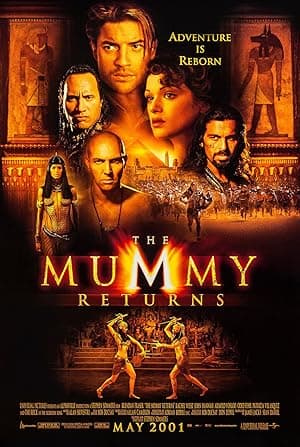
The Mummy Returns
Big monsters, bigger bracelets — and one stubborn man trying to keep his family intact.
Feature presentation
The Mummy Returns is the sort of sequel that announces itself with a stomp: more sand, more spectacle and a new, much bigger supernatural problem. What keeps it from collapsing under its own pyrotechnics is a surprisingly simple anchor — Rick O’Connell, the veteran adventurer who has swapped bachelor danger for family duty. Revisit it and you’ll find a film that knows what it wants to be: a 1930s romp about fate, bargains and how far a father will go.
THE MOVIE
Richard 'Rick' O'Connell is still the reason this movie works
The Mummy Returns straps its biggest ambitions to a very ordinary job description: Rick O’Connell’s job is keeping his wife and son safe. That domestic throughline — a married couple raising a curious boy in 1930s adventure mode — is the film’s emotional north star amid the chaos.
Stephen Sommers doubled down on spectacle here: the sequel ties an ancient prologue about the Scorpion King and his pact with Anubis to a present-day (well, 1930s) chase driven by a mysterious bracelet. It’s a neat trick — the past haunts the present by way of a single object, and everything after that is either rescuing a child or stopping a far older army from being unleashed.
If you remember the film for its waves of Anubis warriors or for introducing a hulking Scorpion King, that’s fine — Industrial Light & Magic supplied the visual muscle — but at its centre is a familiar, stubborn hero who treats destiny like a problem to be solved rather than a prophecy to be admired.
THE SETUP
The idea that sets The Mummy Returns in motion
The film picks up in the early 1930s with Rick and Evelyn as a married team navigating the practicalities of parenthood while the supernatural seeps back into their lives. It’s not a mystery plot so much as a straight line: something ancient wakes up, and the O’Connells have to stop it.
At the story’s heart there’s a classic jewellery MacGuffin — the Scorpion King’s bracelet — rooted in a prologue that shows his bargain with Anubis. That bargain isn’t decorative world-building; it directly powers the present threat and gives the villains a scale that makes the rescue mission urgent.
What keeps the mechanics clear is the central conflict: Alex's curiosity puts him in danger, and rescuing him becomes the spine of the movie. Once the boy is at risk, the film funnels every set piece and chase back into one practical purpose.
Reincarnation and resurrected identities thread the ancient scenes to the 1930s action: the past isn’t just history here, it’s a repeating pattern that pulls the protagonists into decisions about destiny and duty.
THE CHARACTER
Why Richard 'Rick' O'Connell matters
Rick O’Connell isn’t a thoughtful philosopher of fate. He’s an adventurer who has been turned into a husband and father, and that tension — action-man instincts vs domestic responsibility — is what makes him interesting. The stakes are emotional because the danger is personal.
The movie repeatedly asks him to choose: does he follow the Medjai tradition and a larger destiny, or does he simply save his family and get on with life? That dilemma keeps the spectacle from feeling entirely hollow; it gives the explosions somewhere to land.
As a character continued from the earlier film, Rick provides continuity and a practical anchor. While the sequel ramps up set pieces and supernatural scale, he keeps the story recognisably human: someone fighting for people he knows rather than abstract heroism.
Put bluntly, the film knows that audiences will happily watch armies of Anubis warriors if they believe there’s someone in the middle of it who cares about more than glory. Rick is that someone.
UNDER THE SURFACE
The Mummy Returns has more on its mind than the plot suggests
Beneath the sandstorms and CGI set pieces the movie is tangled up with bargains and consequences. The Scorpion King’s pact with a god is the bluntest reminder that power always comes with a price, and the film uses that bargain to show what ambition costs across centuries.
Family and responsibility are plugged into the big idea: it’s not just kingdoms at stake but a small household. That shrinks the apocalypse down to something recognisably human — a couple trying to bring their son home — which is why the film’s emotional beats, when they arrive, land with more force than you might expect.
Reincarnation and fate operate as storytelling shortcuts that let ancient wrongs play out in the present. By repeating identities across time the film suggests that history isn’t merely background; it insists on re-entering people’s lives until someone makes a choice.
And yes, there’s a persistent tension between spectacle and character. The Mummy Returns often prefers the roar of a set piece to quiet character work, but the two elements are constantly negotiating: spectacle amplifies stakes, and character keeps the stakes meaningful.
THE FILMMAKING
How The Mummy Returns was put together
There’s a production pedigree behind the sheen. The film credits Adrian Biddle as director of photography and Allan Cameron as production designer, names that point toward a big, composed studio look rather than handheld immediacy.
Sommers’ direction here leans into a classical studio grammar: clear setups, wide staging for stunts, and room for visual-effects work to sit in the frame. The result is a movie that feels constructed to show off set pieces rather than dissolve into improvisation.
That construction has a purpose: when a film is furnishing hundreds of complex effects shots, you need a stable camera and a clear sense of geography so the audience never loses where they are. The filmmaking choices supply that stability.
In short, the technical credits are not decorative. They’re the scaffolding that lets the spectacle read on screen and lets the film juggle action, mythology and the occasional quieter family moment.
PRACTICAL EFFECTS
The effects work that gives The Mummy Returns its physical personality
The movie mixes real-world stunts with digital characters. Some of the mummified warriors were played by stunt performers in-camera, which gives certain sequences a tactile, kinetic feel when bodies actually collide and fall.
That physical work coexists with a heavy digital layer: the production extended and reused digital models from the first film for Imhotep and related creatures, and motion-capture elements were integrated where the action demanded it.
The effect is a hybrid one. At its best you get the satisfyingly physical rhythm of live stunt work; at its most ambitious the film blends that with full-CG figures to build crowds and impossible movements that wouldn’t be safe to stage practically.
So when the film feels physical, it’s because stunt performers are in the frame; when it feels otherworldly, that’s often where the digital rigs take over. Both approaches are feeding the same appetite for spectacle.
PURE 00s
The Mummy Returns could not belong to any other decade
This is textbook early-2000s tentpole filmmaking: a summer-ready sequel built around bigger VFX and bolder set pieces. The movie exists in the era when studios were more willing to greenlight larger, effects-heavy follow-ups to crowd-pleasing originals.
Universal’s decision to fast-track a sequel to the 1999 film is telling: the studio wanted more spectacle, and they wanted it quickly. That urgency shaped the tone — bigger stakes, more characters, a broader mythology.
The appearance of the Scorpion King is a perfect example of decade logic: a striking, marketable monster introduced in a sequel and then spun off into its own feature the following year. It’s the kind of cross-pollination studios loved then.
Released in 2001, the film reads like a bridge between traditional adventure serials and modern blockbuster scale — an attempt to keep old-school genre pleasures while embracing new digital horizons.
WATCHING IT NOW
What has aged — and what hasn't
The Mummy Returns reads now as very much of its time: a showcase of early-2000s VFX ambition. That ambition is impressive on a logistical level, but some viewers now find parts of the computer character work visibly of its era.
Equally, the film’s preference for spectacle over extended character-focused scenes feels like a hallmark of the period. Contemporary reviewers noted the trade-off on release, and that balance both dates and defines the movie.
Where it still works is in the story’s compact human commitments. The family theme — parents protecting a child — keeps the film emotionally readable even when the scale threatens to swamp detail.
In short: if you watch for blockbuster entertainment and a clear, energetic spine of family duty, much of it still plays. If you want finely tuned character drama, this isn’t the best place to look.
THE LEGACY
Why The Mummy Returns still matters
Part of the film’s afterlife is practical: it directly led to a spin-off, The Scorpion King, enlarging one of its new characters into a standalone property. That move underlines how the sequel functioned as both continuation and recruitment drive for further stories.
Dwayne Johnson’s appearance as the Scorpion King here connects neatly to the next film where he starred — the role that helped launch a different kind of screen career. In other words, this movie did literal franchise work.
At the time it was also widely reported as a major summer sequel and it remains the middle chapter of the Sommers-era Mummy trilogy, the installment that took the established cast and pushed the mythology wider.
So its legacy is twofold: it’s the centre piece of a trilogy and a practical incubator for other studio projects — a film that kept a franchise rolling and gave the studio new options to exploit.
THE VERDICT
Does The Mummy Returns still hold up?
Yes — if you accept what it is. The film is a 1930s-set fantasy-adventure that ropes reincarnation, a bracelet that starts the whole mess, and a rescue mission that turns very large very quickly into an international hunt. That central mission — get Alex back and stop Imhotep from unlocking a terrifying army — is plain and satisfying.
Where the film strains for modern tastes is in balance. It privileges spectacle and mythic stakes over long character exploration, so viewers who want emotional slow-burns will find it wanting. But if you’re after propulsive plotting and a clear relational centre — a husband and wife trying to save their son — it still delivers.
Technically it’s a mixed bag now: the production built hundreds of complex effects shots, from Anubis warriors to a digital Scorpion King, and that scale shows. Some visuals read as dated; others retain a certain showman’s charm because they were conceived to astonish rather than to disappear into photorealism.
So should you watch it? If you want summer-movie muscle with a human core — fathers, mothers and legacy choices driving the action — then yes. The Mummy Returns is the kind of big, noisy, affectionate blockbuster that still makes a tidy case for being watched on a rainy evening when you want spectacle and a reason to care in the middle of it.
Share this movie
Keep watching
More movies from the 00s

2002
The Pianist
A quiet life unmade by war — and a pianist who refuses to stop listening.
Read the retrospective
→
2006
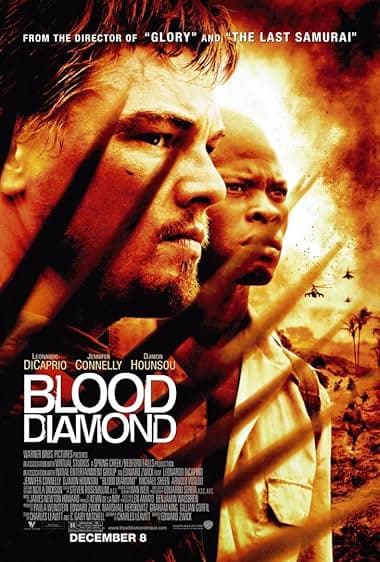
Blood Diamond
A mercenary, a fisherman and a pink diamond — and a film that still asks who pays for our jewellery.
Read the retrospective
→
2003
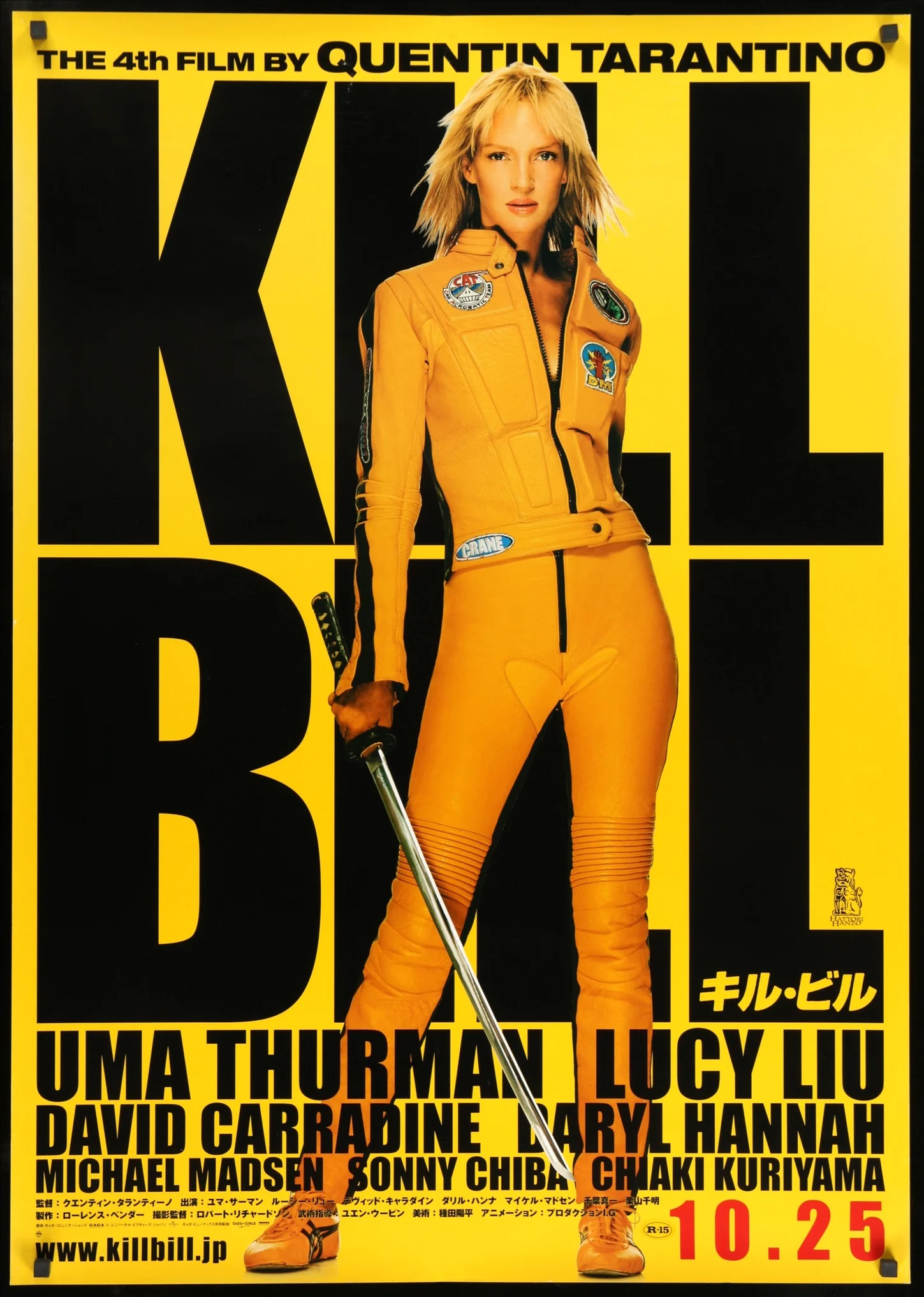
Kill Bill: Volume 1
A yellow jumpsuit, a long list of enemies and one woman who refuses to be finished.
Read the retrospective
→