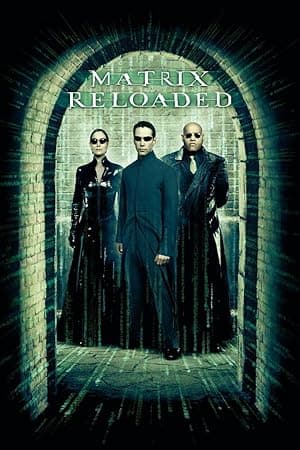
The Matrix Reloaded
A blockbuster middle chapter that still asks big questions while handing you a bewildering set of action spectacles.
Feature presentation
The Matrix Reloaded is that rare sequel which insists it has more to say than another round of punches and explosions — and then proceeds to deliver both. Lana Wachowski and Lilly Wachowski push Neo into choices that knot philosophy and spectacle together: a ticking clock for Zion, a hunt for a Keymaker, and a meeting with the program who literally wrote the rules.
THE MOVIE
Thomas A. Anderson / Neo is still the reason this movie works
What keeps The Matrix Reloaded from being just a bigger, noisier sequel is the way it keeps pulling everything back to Neo — his visions, his choices, his sense that whatever he does will have consequences. The film puts a hard countdown on the drama: Zion has 72 hours before an army of Sentinels arrives, and that urgency colours every decision.
That external clock sits beside a more metaphysical deadline. The Oracle sends Neo after the Keymaker so he can reach the Source, and that hunt knits the movie together, providing a simple objective that nonetheless carries enormous philosophical weight.
So yes, there are huge action set pieces — a purpose-built freeway chase and a digital 'Burly Brawl' among them — but what makes the film land emotionally is Neo’s increasing abilities inside the Matrix and the recurring visions of Trinity’s possible death that push him toward a very particular kind of choice.
THE SETUP
The idea that sets The Matrix Reloaded in motion
The movie balances two pressures. In the real world, Zion is digging in for a machine assault after a last transmission warns of Sentinels tunnelling toward the city. That external threat creates a clear, immediate clock.
Inside the Matrix, the Oracle sends Neo on a single, focused task: find the Keymaker so he can reach the Source. That quest becomes the linking thread between the film’s big sequences.
Those two drives — defend Zion and gain access to the Source — split the characters into different missions: Neo chases the Keymaker and the Source, while others take action both inside the Matrix and in the real world to slow or stop the machine threat.
Because the Keymaker is a program who can authenticate access to protected doors inside the Matrix, locating him isn’t just a plot convenience; it’s the literal means by which Neo can attempt to change the system from within.
UNDER THE SURFACE
The Matrix Reloaded has more on its mind than the plot suggests
Beneath the chases and the punches, Reloaded is preoccupied with systems: how control is built, how rebellion can be allowed for, and whether resistance can ever be more than a managed loop. The film keeps returning to the idea that individual acts take place inside designed architectures.
That leads straight into the franchise’s perennial question — what is real and what is simulation? — but Reloaded complicates it. The Oracle and the Architect together force us to reconsider whether freedom is ever truly free, or whether it’s another piece of the machine’s design.
From there the movie becomes a study of choice under constraint. Sacrifice is presented not as a romantic afterthought but as an operational necessity: characters must weigh what they can save and what they must give up to keep a larger community alive.
Finally, the film leans into messianic imagery. Neo’s progression and the way other characters respond to him makes the question inevitable: is he a rogue saviour or a figure the system can absorb and repeat? The tension between those options drives both the drama and the moral unease.
PRACTICAL EFFECTS
The effects work that gives The Matrix Reloaded its physical personality
One of the reasons the freeway sequence feels so confident is that it was built to be driven on. The production actually constructed a long stretch of road on the decommissioned Alameda Naval Air Station to stage that chase, which allowed for large-scale vehicle stunts and controlled destruction.
That construction wasn’t an indulgence: it gave the action a physicality that would have been hard to fake on a backlot or with smaller practical setups.
At the same time, the filmmakers didn’t pretend practical work could do everything. Sequences such as the freeway chase and the enormous multiple‑Smith 'Burly Brawl' combine real stunt driving and rigging with extensive digital work — an explicit hybrid approach.
The result is a film that often feels tactile in its action beats while accepting the digital tools needed to realise moments that practical means alone could not deliver.
PURE 00s
The Matrix Reloaded could not belong to any other decade
Reloaded sits squarely in an early‑2000s moment when films began to think beyond single-screen narratives. The sequels arrived in 2003 and were developed alongside transmedia projects — the Enter the Matrix game and the Animatrix shorts — as part of a multiplatform storytelling push.
That strategy feels very of its time, the era when studios were experimenting with tie-ins that expanded story worlds instead of just selling merchandise.
Visually and choreographically, the film also helped cement a look for mainstream action in the years that followed: bullet‑time derivatives, desaturated palettes and comic/anime-influenced fight language all travelled from the Matrix films into the wider decade.
Finally, Reloaded’s position as the middle chapter — released in 2003 and leading directly into Revolutions later that year — marks it as a structural experiment in blockbuster storytelling: part sequel, part bridge, part expanded myth.
THE LEGACY
Why The Matrix Reloaded still matters
Part of Reloaded’s afterlife comes from its place in the trilogy — it’s the middle chapter that directly precedes Revolutions — and from the way it broadened the original film’s ambitions rather than simply repeating them.
Its simultaneous release strategy with Transmedia tie‑ins (Enter the Matrix and the Animatrix shorts) pushed how studios could extend a story beyond a single film, making the franchise feel like a larger conversation rather than a single title.
Critically and culturally, the film also kept the discussion around The Matrix alive by blending spectacle with heavier philosophical notes: its scale and ideas contributed to ongoing conversations about what blockbuster cinema could attempt.
And on a practical level, Reloaded played a part in the decade’s action-language: its chase choreography and effects choices continued the franchise’s influence on visual effects and fight design across the 2000s.
THE VERDICT
Does The Matrix Reloaded still hold up?
Yes — but with a clear rider. If you watch Reloaded expecting neat answers, you’ll be frustrated: it’s the middle chapter, deliberately pushing questions and leaving some threads unresolved so Revolutions can resolve them.
If you watch it for ideas and scale, it delivers. The film foregrounds three major action set pieces — the freeway chase, the Burly Brawl and the infiltration to free the Keymaker — and uses those set pieces to move its deeper argument forward rather than just to dazzle.
It also changes the game narratively: Neo’s expanded abilities and his prophetic visions push him into moral decisions, while the Architect’s appearance reframes the 'One' as part of a designed cycle rather than a purely spontaneous saviour — a development that forces the audience to re-evaluate everything that came before.
So should you watch it today? If you want blockbuster spectacle married to big, uncomfortable ideas about choice, control and sacrifice — and if you don’t mind it functioning as a bridge rather than a tidy conclusion — Reloaded remains worth your time.
Share this movie
Keep watching
More movies from the 00s
2002
The Pianist
A quiet life unmade by war — and a pianist who refuses to stop listening.
Read the retrospective
→
2006
Blood Diamond
A mercenary, a fisherman and a pink diamond — and a film that still asks who pays for our jewellery.
Read the retrospective
→
2003
Kill Bill: Volume 1
A yellow jumpsuit, a long list of enemies and one woman who refuses to be finished.
Read the retrospective
→