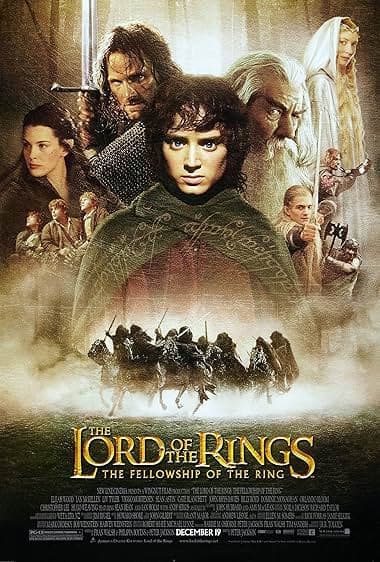
The Lord of the Rings: The Fellowship of the Ring
A small hobbit with a very large task — and a fellowship that makes the danger feel human.
Feature presentation
Peter Jackson's first take on Tolkien's trilogy still opens like a promise: a mythic prologue, a cosy Shire, then a ring that quietly changes everything. Rewatching The Lord of the Rings: The Fellowship of the Ring is less about spectacle and more about why a bullied little idea — friendship, duty, ordinary courage — holds a three-hour epic together.
THE MOVIE
Frodo Baggins is still the reason this movie works
There’s a lot to admire in Jackson’s Fellowship — the mountains, the armies, the sense that Middle-earth is properly lived in — but what makes the whole thing hold together is a hobbit who chooses to carry a burden he didn’t ask for. Frodo’s willingness to bear the One Ring turns an enormous fantasy into something that feels human-sized.
The film doesn’t bury that choice. It opens by giving the Ring history: a prologue shows an earlier age and the Ring’s theft, so you understand straight away why this small object matters in cosmic terms. That historical weight makes Frodo’s quieter decision feel riskier, not sentimental.
Peter Jackson stages the story as a long, deliberate journey — a 178-minute film that takes time to travel from the Shire to the wider world. Elijah Wood is the face of that journey; Frodo’s moral resolve is the engine that keeps the plot honest even when the scale of the action explodes.
THE SETUP
The idea that sets The Lord of the Rings: The Fellowship of the Ring in motion
The basic engine is simple and stubborn: Frodo inherits the One Ring and discovers it can’t stay where it is. The task is elemental — the Ring must be taken to Mount Doom and destroyed — and that single obligation gives the film a clear north star.
Jackson lets the inciting moment breathe. Bilbo’s birthday and Frodo’s inheritance aren’t just a bit of exposition; they’re the domestic hinge that flips the story from comfortable Shire life to the long, dangerous road ahead. It’s a neat trick that keeps the stakes personal even as armies and old evils arrive.
Once the Fellowship forms, the film threads together long journey episodes and a few big enclosed set pieces. The route — from hobbit-country to places like Rivendell and Lothlórien, and down into the Mines of Moria — keeps switching tone so the quest never feels one-note.
Those tonal shifts matter because the story isn’t just about landscape. The Ring’s corrupting influence is a story mechanic: it’s a pressure that tests people, and one mid-film turning point — the Fellowship’s passage into Moria and the terrible loss that follows — reshapes the rest of the trilogy.
THE CHARACTER
Why Frodo Baggins matters
Frodo is not a king, a soldier or a sage. He’s the little person the story keeps returning to, and that’s deliberate. When he volunteers to be ringbearer, the film hands its moral weight to someone who represents smallness rather than power.
That volunteerism is the dramatic pivot. Frodo’s choice makes the quest intimate: it’s no longer an abstract struggle between armies but a promise someone made to himself and to his friends. The film then measures everything against that promise.
Because the story privileges friendship and loyalty, Frodo’s decisions ripple out. He becomes a figure around whom different peoples — hobbits, humans, elves, dwarves — can rally, and that makes the Fellowship’s diversity feel emotionally necessary rather than just decorative.
One practical note: the production combined modern digital techniques with hands-on effects to realise creatures and crowd scenes. That mixture helps keep Frodo’s small, human moments grounded even as the movie’s scale grows.
UNDER THE SURFACE
The Lord of the Rings: The Fellowship of the Ring has more on its mind than the plot suggests
On the surface it’s a quest movie; underneath it’s quietly interested in what keeps people together. Friendship and loyalty across cultural divides isn’t a throwaway line here — it’s the film’s social glue. The Fellowship is an experiment in whether strangers can put duty before division.
There’s also a point about smallness. The hobbits are set up as unlikely heroes: the story repeatedly asks whether ordinary courage can actually change the course of larger events. That idea gives the movie a moral clarity that makes danger meaningful.
Corruption by power sits on the other side of that coin. The Ring is a test object: it reveals desire and weakness. The threat isn’t only armies and monsters; it’s the slow turning of hearts toward possession.
Finally, sacrifice and duty are woven through the Fellowship’s choices. The film stages those choices so you feel what’s given up — time, safety, friendship — which keeps the emotional stakes honest even when the action is spectacular.
THE FILMMAKING
How The Lord of the Rings: The Fellowship of the Ring was put together
There’s a formal backbone to the film: Andrew Lesnie was the director of photography and his work on this film earned the Academy Award for Best Cinematography. That recognition matters because the film needed a consistent visual logic to make its sprawling geographies feel coherent.
Behind the scenes, editor John Gilbert shaped the theatrical cut and Grant Major carried responsibility for the production design that built Middle-earth’s physical world. Those are the crafts that let the story move from intimate interiors to sweeping exteriors without losing rhythm.
Peter Jackson’s direction binds those elements: he keeps the story moving across different tones — from cosy Shire moments to darker subterranean sequences — while the technical team stitches it together.
The film’s awards run, which included multiple Academy Awards wins and nominations, is a reminder that these production decisions were noticed beyond fandom and contributed to how the film reads on repeated viewings.
PRACTICAL EFFECTS
The effects work that gives The Lord of the Rings: The Fellowship of the Ring its physical personality
A lot of the film’s tactile personality comes from hands-on work: Wētā Workshop produced armour, weapons, prosthetics and the large-scale miniatures — the so-called 'bigatures' — that give buildings and environments weight.
That handcrafted approach was balanced with creature makeup and other prosthetic elements, so when you watch the film you’re seeing a mixture of real objects and carefully made physical designs rather than purely digital creations.
At the same time, the production integrated digital work. Visual-effects supervision was led by Jim Rygiel and the team used motion-capture, crowd-animation tools and compositing to expand the scale where practical methods couldn't go alone.
The overall effect is a blend: practical materials give scenes texture and presence, while digital techniques extend scope and population in ways the production needed for an epic of this size.
PURE 00s
The Lord of the Rings: The Fellowship of the Ring could not belong to any other decade
If there’s a 00s identity to the trilogy, it’s in how the films were made and released as a unit. The production was financed and marketed by New Line Cinema and shot in New Zealand with an ambitious back-to-back schedule across 1999–2000 — a model of long-form franchise filmmaking that became emblematic of the era.
That production strategy fed into how audiences experienced the films: each instalment arrived in consecutive Decembers, turning them into recurring studio events rather than one-off releases.
The Fellowship’s 2001 release placed it at the start of that three-year cycle, and the decision to deliver the story as a tight cinematic sequence shaped how studios thought about committing to large-scale fantasy over multiple years.
Put simply: this was a project with the kind of industry confidence and marketing muscle that characterised early-00s franchise moves, and that context shaped both the film’s scale and its public profile.
WATCHING IT NOW
What has aged — and what hasn't
Certain themes in the film are stubbornly durable. Friendship and loyalty are baked into the story’s structure: the idea that people from very different backgrounds can protect a common good still reads cleanly and feels persuasive.
The hobbits’ everyday courage — ordinary people making extraordinary choices — also holds up. That moral centre keeps the film from tipping into mere spectacle because the stakes are always person-sized as well as epic.
On the technical side, the production mixed motion-capture, CG character work and crowd animation with practical elements. That combination was an early example of how to blend digital tools and physical crafts, and the integration still reads well in many sequences.
So while certain effects choices reflect their moment, the film’s human themes and the way it combines hands-on and digital techniques give modern viewers plenty that still works.
THE LEGACY
Why The Lord of the Rings: The Fellowship of the Ring still matters
Part of the film’s lasting profile comes from how it was recognised at awards time: it won Academy Awards across several technical categories, including cinematography, makeup, original score and visual effects, and received major nominations beyond that.
The production also put New Zealand houses like Wētā Workshop and Wētā Digital on the international map. Their work on armour, prosthetics and large miniatures helped establish them as go-to teams for large-scale fantasy projects.
Crucially, the Fellowship was the first episode in a trilogy that proved a commercially and critically successful model for long-form franchise filmmaking in the early 2000s. That production example fed into how studios later approached big, serialized adaptations.
Institutions later acknowledged the film in retrospective lists, too, which reflects the way the movie’s technical achievements and storytelling ambition have continued to be discussed beyond immediate fandom.
THE VERDICT
Does The Lord of the Rings: The Fellowship of the Ring still hold up?
Yes. The Fellowship still works because its big ideas are anchored by small ones: a mythic prologue gives the Ring meaning, but the film keeps returning to Frodo’s choice — the birthday in the Shire, the decision at the Council of Elrond, the formation of the nine-member Fellowship — and those personal beats stop the spectacle from spinning free.
The story mechanics remain satisfying. The Ring’s corrupting influence, the cross-cultural composition of the Fellowship, and the film’s alternation between journey episodes and the claustrophobic Mines of Moria all function as dependable engines that push the trilogy forward.
Technically the film is of its moment — it combines early motion-capture and crowd-animation work with substantial practical craftsmanship — but that blend still serves the story, and the production honours from cinematography to score show the crafts were working at a high level.
If you’re thinking of revisiting or watching for the first time, go because the movie is both an adventure and a steady moral experiment: it asks whether ordinary people can protect something greater than themselves, and keeps asking that question long enough for the answer to matter.
Share this movie
Keep watching
More movies from the 00s
2002
The Pianist
A quiet life unmade by war — and a pianist who refuses to stop listening.
Read the retrospective
→
2006
Blood Diamond
A mercenary, a fisherman and a pink diamond — and a film that still asks who pays for our jewellery.
Read the retrospective
→
2003
Kill Bill: Volume 1
A yellow jumpsuit, a long list of enemies and one woman who refuses to be finished.
Read the retrospective
→