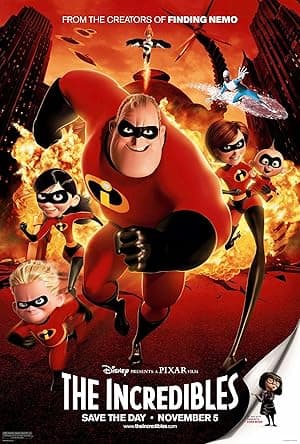
The Incredibles
A superhero story that is, at heart, a family argument about who gets to be special.
Feature presentation
Revisiting The Incredibles feels oddly like walking into your parents’ living room and finding the mantlepiece has a cape on it. Brad Bird’s 2004 superhero fable folds domestic bickering into action-movie mechanics, and it keeps swivelling between sticky family squabbles and proper, teeth-bared spectacle. If you remember the film for the action, stay — but the family is where it still surprises.
THE MOVIE
Bob Parr / Mr. Incredible is still the reason this movie works
The Incredibles starts with a neat switch: it presents superheroes as exhausted domestic types first, and caped legends second. The Parr family — Bob, Helen and their children — are living under civilian rules, keeping their past identities under wraps until something covert drags them back into the business of saving people.
That covert tug is literal: a mysterious, well-paid assignment sends Bob to a remote volcanic spot to take on an advanced robot called an Omnidroid. It’s the sort of cartoonishly specific MacGuffin that gets the action moving, but it’s also a tidy plot device for the film’s real motor — Bob Parr’s nostalgia for the days when he felt useful.
Which is to say: this is not just a film about punching robots. Directed by Brad Bird and fronted by Craig T. Nelson’s Mr. Incredible, The Incredibles is a superhero movie that keeps asking why someone might give up being exceptional for a quiet suburban life — and whether that trade-off ever truly settles.
THE SETUP
The idea that sets The Incredibles in motion
At its simplest, the film threads a domestic story through familiar superhero mechanics. The Parrs are hiding former hero lives in order to fit into suburban civvy existence, until deception and temptation yank them back into extraordinary circumstances.
That private-versus-public tension is mirrored by the villain: Syndrome, a fan-turned-antagonist, manufactures threats so he can control how hero worship works. It’s a sly inversion — the bad guy’s plan rests on faking the very crises heroes are meant to solve.
From there the film leans into genre tools: secret identities, a handler who uses deception, staged Omnidroid attacks and a remote island fortress. Those mechanics escalate what starts as a midlife itch into a rescue-and-climax that threatens far more than one man’s ego.
And in the middle of all that machinery are smaller, recognisable beats — the discovery of other captured supers, and the way the family must learn to combine their different abilities. The setup does the neat trick of letting personal arguments fuel genuine action.
THE CHARACTER
Why Bob Parr / Mr. Incredible matters
Craig T. Nelson is credited as the voice of Bob Parr, but what makes the character stick is the idea: a superhero who’s been asked to be ordinary. That tension — the pull between extraordinary past and ordinary present — is the hinge on which the film turns.
As a family film, The Incredibles uses Bob to dramatise family dynamics. He’s not just a man with great strength; he’s a husband and father whose impulses and regrets force the rest of the household to react, adapt and sometimes save him in turn.
He matters because his crisis is recognisable. In a household drama, the spectacle exists to show the stakes of his longing: it isn’t celebrity so much as the need to feel useful again. And when the plot starts asking the family to act collectively, Bob’s struggle to share centre-stage becomes genuinely dramatic.
Even the smallest family detail — like the presence of an infant with multiple credited baby voices — signals the film’s insistence that family life, in all its messy practicalities, is as important to the story as any villain’s scheme.
THE PERFORMANCE
Why Eli Fucile's performance matters
Jack-Jack’s credit is an unusual little production note: the infant character is voiced by multiple contributors, and Eli Fucile is one of those credited performers.
That arrangement is more than trivia. Using several baby voices underlines that Jack-Jack is both a family prop and a narrative wildcard — a character whose unpredictability is built into how he’s put on screen.
Saying that simply recognises a practical truth: the newborn in the household can be deployed as comic relief, to raise the stakes or to remind the rest of the family what ordinary parenting looks like amid the chaos.
So while Jack-Jack doesn’t carry the plot alone, the credited voice work — including Eli Fucile’s and Maeve Andrews’s contributions — is part of how the film mixes the domestic with the extraordinary.
UNDER THE SURFACE
The Incredibles has more on its mind than the plot suggests
On the surface it’s a superhero romp; underneath it’s a compact argument about identity. The film pulls on family dynamics to ask whether being ‘special’ is an individual badge to be worn or a responsibility that changes when you’re part of a group.
Midlife frustration is explicit: the film stages the search for purpose against the ordinariness of suburban conformity. Mr. Incredible’s nostalgia and dissatisfaction make the domestic setting feel less like a refuge and more like a trap he has to reckon with.
There’s also a playful bit of genre deconstruction. Syndrome’s scheme — engineering threats to control hero worship — flips the usual hero-villain dynamic and asks who owns heroism once it becomes commodified.
Put together, those threads give the movie an emotional gravity that isn’t loud or earnest; it’s quietly threaded through arguments about dinner, homework and who does the washing-up, then escalated into island-set spectacle.
THE FILMMAKING
How The Incredibles was put together
The film’s look leans into a retro-futuristic shorthand: production design borrows from mid-century modern and 1960s spy-film references to give sets, vehicles and costumes a distinctive, slightly stylised flavour.
That visual identity didn’t happen by accident. Lou Romano is credited as production designer and Janet Lucroy among the directors of photography on the CGI approach — names that point to deliberate design choices rather than arbitrary computer polish.
All that craft fed the picture’s tonal mix: family sitcom beats sitting alongside Bond-style gadgetry and action beats, which is why the world can feel both familiar and playfully heightened.
And those choices mattered at awards time: the film’s production and sound work were part of a package that won Best Animated Feature and Best Sound Editing at the Oscars, underlining the industry’s recognition of its technical and design achievements.
PRACTICAL EFFECTS
The effects work that gives The Incredibles its physical personality
Although the movie is wholly computer-animated, the filmmakers photographed real-world elements — things like leaf shadows and other photographic references — and integrated those images into the CG environments.
That blending of photographed detail with digital modelling helped the world feel textural and tactile, a useful trick when you’re asking audiences to care about domestic interiors as much as exploding robots.
It’s a reminder that even in animation, tangible, photographed material can be leaned on to anchor the imaginary in the recognisable.
The choice keeps the film feeling practical in its visual cues, which in turn supports the domestic beats at the story’s core.
PURE 00s
The Incredibles could not belong to any other decade
Released in November 2004, The Incredibles arrived at a moment when feature CGI animation was settling into mainstream maturity. Pixar was coming off hits and the studio’s work was both financially and technically setting expectations for what animated family films could do.
That timing matters because the film mixes ambitious action with family comedy in a way that felt new for animated features: it was willing to treat grown-up anxieties — purpose, identity, compromise — as material for a picture with kid-friendly thrills.
The movie’s place in Pixar’s run also shaped its production values: it premiered at a studio that was already treating animation as a canvas for broader storytelling, not just visual spectacle.
All of which made 2004 a sensible moment for a film that wanted to be both a genre piece and a household argument.
WATCHING IT NOW
What has aged — and what hasn't
A lot of the film’s staying power comes from the story choices: critics and retrospectives repeatedly point to the family-centred plot, the production design and the voice cast as elements that still land for modern viewers.
Technically, some of the rendering tricks that were notable in 2004 — advances in skin shading, muscle rigs and complex character animation — now sit in the history of CGI progress. They were important stepping stones, even if later software has moved the bar further.
That matters less to viewers who care about laughs, character arguments and the odd, affectionate send-up of superhero tropes. Those beats rely on writing and design choices rather than purely on cutting-edge rendering, so the emotional and comic components tend to hold up.
Even small production notes — like the multiple credited baby-voice contributors for Jack-Jack — read as deliberate craft choices rather than curiosities, underscoring the filmmakers’ attention to the domestic textures that give the film its heart.
THE LEGACY
Why The Incredibles still matters
The film’s awards record is part of its legacy: it won the Academy Award for Best Animated Feature and for Best Sound Editing, and picked up nominations in writerly and technical categories that underline both its craft and its ambition.
Industry recognition also came in the form of Annie Awards, including nods for voice acting — Brad Bird’s own turn as Edna Mode received notice — and other production categories at the 2005 Annies.
Finally, the fact that the story returned for a canonical sequel in 2018 speaks to the film’s narrative durability: these are characters and conflicts the creators felt worth revisiting.
Taken together, awards, craft recognition and a sequel form the practical scaffolding of why the film remains in the conversation.
THE VERDICT
Does The Incredibles still hold up?
Yes — and for a clear reason: the film’s central trade-off never goes out of style. Watching the Parrs juggle suburban life with secret identities, then escalate into a battle with an Omnidroid on Nomanisan Island, still feels like a clever way of turning private dissatisfaction into public stakes.
The story moves from one man’s midlife longing into a broader family equation: Bob’s nostalgia is counterbalanced by Helen’s pragmatic drive to protect the children, which makes the family’s cooperation genuinely satisfying rather than merely convenient.
Contemporary reaction singled out the voice cast as a strong element of the picture, calling the leads effective and Brad Bird’s Edna Mode a scene-stealing supporting turn. That vocal chemistry, combined with the production design and clear plotting, keeps the film watchable across generations.
So if you’re deciding whether to watch it now: the spectacle is fun, but the reason to return is the family. The Incredibles still works because its superhero action is built on the quieter, messier business of being a family — and that’s a tension nobody outgrows.
Share this movie
Keep watching
More movies from the 00s

2002
The Pianist
A quiet life unmade by war — and a pianist who refuses to stop listening.
Read the retrospective
→
2006
Blood Diamond
A mercenary, a fisherman and a pink diamond — and a film that still asks who pays for our jewellery.
Read the retrospective
→
2003
Kill Bill: Volume 1
A yellow jumpsuit, a long list of enemies and one woman who refuses to be finished.
Read the retrospective
→