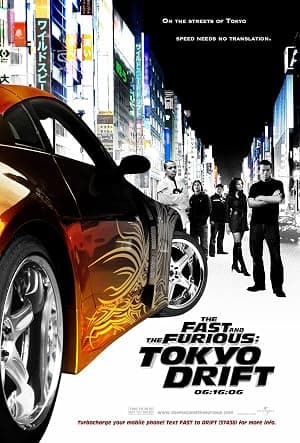
The Fast and the Furious: Tokyo Drift
An American kid, a Japanese subculture and a mentor who quietly stole the film.
Feature presentation
Tokyo Drift is the sideways entry in the Fast & Furious franchise: a coming-of-age about a teenager learning a new language — the language of drift. Justin Lin hands the story to Sean Boswell, and what feels like a genre detour turns into something altogether more personal.
THE MOVIE
Sean Boswell is still the reason this movie works
The Fast and the Furious: Tokyo Drift drops an American teenager into a world he doesn't understand and then refuses to let him be smug about it. Sean Boswell is sent to live with his father in Tokyo after losing control in U.S. street races, and the film's forward motion comes from him trying to learn how to belong where he clearly doesn't — yet.
What keeps the picture interesting is that Sean's problem isn't attitude; it's technique. He's impulsive and full of risk, but drifting is a different animal from the straight-line racing he knows. The movie turns that technical shortcoming into a neat coming-of-age device: apprenticeship inside a tightly policed subculture.
Justin Lin directs a film that smells faintly of initiation rites. It's a 104-minute action-crime-racing movie that trades the franchise's usual family trope for a new kind of mentorship, and Sean's bumping up against Tokyo's scene is how the plot, the culture and the characters all get moving.
THE SETUP
The idea that sets The Fast and the Furious: Tokyo Drift in motion
The basic engine is straightforward: Sean is shipped off to Tokyo after trouble with street racing back in the States, and there he meets a different kind of underground — drift racing. That discovery gives the film its primary competitive stakes as Sean keeps trying to measure up to local champions.
But the story isn't only about winning races. It's built around apprenticeship: Sean must actually learn how to drift, a skill set that runs counter to everything that made him dangerous at home. The technical learning curve becomes the movie's dramatic problem.
Tension deepens when personal and criminal stakes collide. Sean's rivalry with Takashi — the Drift King — is more than ego; it ties into a romantic connection with Neela and the local networks that control opportunity and punishment.
And woven through all of it is Han. His mentorship gives Sean instruction, protection and access. That relationship shapes what Sean can attempt and explains how he goes from outsider to competitive entrant in a subculture that otherwise wouldn't have him.
THE CHARACTER
Why Sean Boswell matters
Sean Boswell matters because he's neither a fish-out-of-water gag nor a blank hero; he's properly technical. The story hinges on him being an impulsive, risk-taking teenager who simply doesn't know how to drift, and watching him learn is what gives the film its pace and sympathy.
He's the kind of lead who carries the narrative by asking obvious, clumsy questions that force the audience into the world with him. That makes his wins feel earned — not because he suddenly becomes a prodigy, but because he actually learns the craft the subculture values.
Sean's social map is immediate and believable: Twinkie is his first friend and cultural introducer, and Neela supplies the romantic complication that ties him to local tensions. Those relationships keep Sean anchored as he moves from outsider to participant.
Crucially, Sean's story is less about being streetwise than becoming specialised. That apprenticeship structure — a young American figuring out how to belong in Tokyo's drift scene — is what makes him memorable long after the tyres stop smoking.
UNDER THE SURFACE
The Fast and the Furious: Tokyo Drift has more on its mind than the plot suggests
On paper it's an action-crime-racing movie. Under the skin it's mainly a coming-of-age through apprenticeship: the film stages initiation into a specialist craft and treats learning as the emotional through-line rather than mere spectacle.
There's also outsider assimilation at play. Sean is an American in Tokyo, and the awkwardness of cultural displacement feeds scenes that could have been gimmicks but instead shape how he is accepted — or excluded — by the local scene.
Mentorship and loyalty complicate that assimilation. Han's guidance links Sean to the networks that matter — both legal and otherwise — and shows how belonging often runs through a gatekeeper who can grant or withhold protection.
Finally, the film lives with the tension between authenticity and show. It aims to present real drifting techniques while also staging those techniques as cinematic spectacle, asking the audience to enjoy both the craft and the performance of the craft.
PRACTICAL EFFECTS
The effects work that gives The Fast and the Furious: Tokyo Drift its physical personality
Tokyo Drift leans on real-world driving skill. The production employed professional drifting and stunt drivers to perform the sequences, which gives many of the races a sense of tactile danger you can feel even if you can't name the manoeuvres.
To make some cars behave the way the story demanded, several production vehicles were modified — including temporary rear-wheel-drive conversions for models that otherwise wouldn't drift the same way. Those mechanical changes were chosen to enable specific driving moves rather than to fake them in post.
Large numbers of cars were used in on-set sequences, and trained stunt teams handled the precision driving. The result is a movie that presents drifting as a controlled, repeatable craft rather than an improvised pyrotechnic.
Put simply: when the film asks you to believe in a drift, it's because there was a team on hand who could deliver it for real, repeatedly, during production.
PURE 00s
The Fast and the Furious: Tokyo Drift could not belong to any other decade
This film arrived at a moment when drifting and Japanese car culture were filtering into Western pop culture. By 2006, those interests weren't niche curiosities any more — they were visible enough that a mainstream action franchise could build a whole movie around them.
Justin Lin's presence matters here. Hiring an Asian American filmmaker who brought elements from his earlier indie work — including the character Han — felt like an early example of a franchise widening its creative lens in the mid-2000s.
There was also a cross-pollination with similar projects; Tokyo Drift shared practical drifting consultation with other drifting-centred films of the era, which shows the moment's appetite for presenting the sport with a degree of technical seriousness.
So while the film is plainly of the 00s, it's not just period dressing: it sits at a specific cultural junction when a global subculture started to move into mainstream entertainment.
WATCHING IT NOW
What has aged — and what hasn't
One thing that really holds up is Han. Retrospective commentary has repeatedly singled him out as the element that aged best, and that’s partly why the franchise later worked to bring the character back into continuity.
Sean's fish-out-of-water arc is straightforward and still readable: an American teenager learning a technical craft in Japan remains a clear emotional through-line, which means the movie still hangs together structurally.
Han's mentorship remains narratively useful on repeat viewings because it connects Sean's small-scale growth to wider networks in Tokyo's racing scene. That linkage gives scenes weight beyond immediate race outcomes.
In short: the film's central relationships — the student, his guide and the subculture that tests them — are the parts that tend to survive rewatching better than any individual set-piece.
THE LEGACY
Why The Fast and the Furious: Tokyo Drift still matters
A large part of the film's afterlife comes from Han's popularity. Sung Kang's character became a fan-favourite and that response actually prompted filmmakers to reinsert him into later Fast installments — which retroactively changed how people looked at Tokyo Drift.
Justin Lin's long association with the franchise also traces back to this film. Tokyo Drift is frequently mentioned as the start of his multi-film relationship with the series, which gives the movie a kind of behind-the-scenes significance.
Musically, the film's main track — 'Tokyo Drift (Fast & Furious)' by Teriyaki Boyz — also stuck with audiences and remains the tune many people immediately associate with the film.
Taken together — character, director and a recognisable musical tag — the film left a mark that extended beyond its initial run and into the broader Fast & Furious story.
THE VERDICT
Does The Fast and the Furious: Tokyo Drift still hold up?
Yes — with a crucial caveat. If you want a conventional franchise sequel that ties neatly into the saga's biggest set-pieces, this one feels sideways. But judged on its own terms, Tokyo Drift works: it's a 104-minute action-crime-racing film about a teenager learning to belong in a new scene.
The film's central mechanic — Sean's apprenticeship in drifting, a technique unlike his straight-line racing — makes the stakes feel earned rather than arbitrary. His rivalry with Takashi and the Neela connection supply personal danger, while Han's mentorship gives him the routes into the world he needs.
For viewers curious about mid-00s car culture, or those interested in a Fast entry that treats initiation and subculture seriously, it still plays. And if you care about the franchise's connective tissue, Han's presence here explains later choices the series made.
So watch it for Sean's learning curve and for Han doing the quiet work that keeps the movie honest. It's not the franchise's loudest entry, but it's the one that taught the series a new language — and that alone makes it worth a revisit.
Share this movie
Keep watching
More movies from the 00s
2002
The Pianist
A quiet life unmade by war — and a pianist who refuses to stop listening.
Read the retrospective
→
2006
Blood Diamond
A mercenary, a fisherman and a pink diamond — and a film that still asks who pays for our jewellery.
Read the retrospective
→
2003
Kill Bill: Volume 1
A yellow jumpsuit, a long list of enemies and one woman who refuses to be finished.
Read the retrospective
→