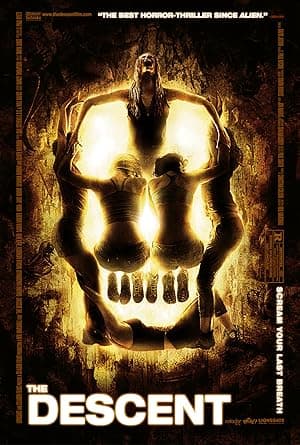
Feature presentation
Remember the moment the roof gives way and every plan collapses with it? The Descent is that contained, relentless panic distilled into 99 minutes, and it starts with a woman called Sarah already carrying a private disaster. Neil Marshall used a simple premise—six friends trapped, hunted and forced to make impossible choices—to turn personal grief into something you can almost feel on your skin.
THE MOVIE
Sarah is still the reason this movie works
The Descent begins with a small, terrible economy: six women go caving, a tunnel collapses and they find they’ve walked into a hunting ground of subterranean humanoids. It’s immediately clear the threat is both physical and existential.
What gives the story traction beyond jump scares is Sarah. The trip is set up as an attempt to move past a family tragedy, and that grief looms over every choice she makes underground. Seeing the film as a straight monster picture misses the point; Sarah’s unresolved trauma shapes how the expedition plays out.
Directed and written by Neil Marshall and released in 2005, The Descent keeps its focus tight. It’s a compact, female-led survival story that uses terrifying circumstances to test friendship, loyalty and what people do when there is nowhere left to run.
THE SETUP
The idea that sets The Descent in motion
The movie’s engine is deliciously straightforward: a caving weekend goes wrong when a rockfall strands the group, and exploration becomes escape becomes survival. That clarity keeps the plot lean and urgent.
Beneath the surface menace is a logistics problem — ropes, headlamps, dwindling light and the need to work out routes through unmapped tunnels. The physical demands are never abstract; they’re constant, specific obstacles the women must solve together.
The claustrophobic geography forces other dramas to surface. There are tensions and secrets within the group, and those personal fractures matter as much as the monsters for the decisions that follow.
In short, it works because the set-up hands the film two interlocking pressures: the practical difficulty of getting out alive, and the harder work of navigating relationships when everything else has been stripped away.
THE CHARACTER
Why Sarah matters
Sarah is the axis the whole film spins around. Played by Shauna Macdonald, she arrives at the outing already fragile; the trip is set up as an attempt to cope with a recent family loss.
That personal history isn’t window-dressing. Her grief alters how she sees danger, how she trusts — and crucially, how the group treats her. When your choices are being made in the dark, past hurts become immediate liabilities.
There’s a human sting to the story because some of the pressure Sarah faces comes from the people who brought her on the trip. Juno’s secret relationship with Sarah’s late husband hangs over events and complicates loyalties at the worst possible moments.
Even the brief opening family scenes—Paul and Jessica appearing as anchors—exist to remind us why this is about more than surviving monsters. It’s about the emotional ties that brought them underground in the first place, and whether friendship can survive that descent.
THE PERFORMANCE
Why Shauna Macdonald's performance matters
There’s a frequent note from reviewers that Shauna Macdonald’s portrayal of Sarah is central to the film’s emotional pull. That’s the right place to start when talking about what the role does.
Macdonald’s Sarah is not a two-dimensional victim; she’s the fragile, complicated human core whose reactions keep the audience tethered. When the film needs us to care, it turns to her, and that keeps the terror from drifting into mere spectacle.
Because so much of the picture trades on tight spaces and mounting panic, the performance functions as an emotional reference point. It’s the thing you return to when the walls feel like they’re closing in.
Put simply: reviewers highlighted the role’s importance because the character gives the movie something weightier to hang the shocks on.
UNDER THE SURFACE
The Descent has more on its mind than the plot suggests
On the surface it’s a creature movie; underneath it’s preoccupied with grief. Sarah’s unresolved trauma isn’t decoration — it’s the reason the outing happens and how the film finds emotional stakes among the claustrophobia.
Female friendship is another main current. The group dynamic—support, rivalry, old resentments—becomes as dangerous as any underground predator. When friends start to fracture, the story becomes uncomfortable in a recognisably human way.
Survival here is bodily and urgent. The caves make vulnerability literal: low ceilings, tight squeezes, exhaustion and the need to ration light and air mean every decision is physical and consequential.
And then there’s the fear of the dark itself. Claustrophobia isn’t just a setting detail; it’s the engine of the film’s horror, turning ordinary items like headlamps and ropes into lifelines and symbols of how thin the boundary is between safety and being lost forever.
THE FILMMAKING
How The Descent was put together
A lot of the movie’s personality comes down to where it was made: the caves you see on screen were built on soundstages at Pinewood rather than filmed in actual caverns. That construction allowed the production to control the environment in ways a natural cave wouldn’t permit.
Sam McCurdy served as director of photography and the crew ran camera and lighting tests to keep those subterranean scenes readable. The decision to work in formats suited to low-light capture was practical: it made the action visible without losing the oppressive feel.
Jon Harris edited the film, and that editing work later received industry recognition. The cutting is integral to how the movie balances shock with forward momentum — you feel the claustrophobia because the film never lets the tension ease for long.
All of those craft decisions — sets, camera choices and editing — combine to make the cave less like a backdrop and more like a character in its own right: unforgiving, changeable and always watching.
PRACTICAL EFFECTS
The effects work that gives The Descent its physical personality
The film relied on tangible, physical work to make the world feel lived-in. Production designer Simon Bowles built multiple reusable cave sets at Pinewood, including large water tanks, scale models and rotatable tunnel sections to simulate different parts of the system.
The creatures weren’t born in CGI studios: Paul Hyett designed the prosthetics and a team including Neil Morrill executed them. During testing the design shifted away from a slick, 'creature-like' look toward something grubbier and more human, an adjustment made to sit better with the lighting and the tight sets.
Even small bits of the environment were physical. The production used practical stalactites and stalagmites, real-feeling bone-pile sets and an eight-foot-deep tank for pool sequences, which anchors the film’s tactile sense of danger.
That materiality matters because it keeps the film feeling immediate: when hands claw at the rock or a headlamp picks out prosthetic skin, the danger reads as something occupied and present, not an effect superimposed after the fact.
PURE 00s
The Descent could not belong to any other decade
The Descent sits squarely in a mid-2000s moment when British genre films with modest budgets could find international audiences. Its success is part of a small wave of UK horror that married craft to commercial storytelling.
It feels of its time because it pairs a female-led ensemble with a visceral, practical-effects monster premise. That combination was becoming more prominent in the 00s as filmmakers moved away from franchise slasher mechanics and the extremes of the torture cycle toward something more tactile and immediate.
Released in 2005, the film’s timing helped it reach both festival and wider audiences, bridging a period in horror when word-of-mouth and festival acclaim could still launch a modest production into the broader market.
Recognition followed: the film won genre and technical awards attention and later earned a sequel, all signs that it resonated beyond the usual niche circuits.
THE LEGACY
Why The Descent still matters
The Descent kept showing up in conversations about 2000s horror for a reason: it married a compact premise to technical craft in a way that made people remember it. That recognition came early and stuck—Empire awarded it Best Horror and UK industry coverage noted its technical achievements.
It also left a tangible afterlife: a theatrical sequel arrived in 2009 with Neil Marshall attached as an executive producer, signalling that the story had legs beyond its original run.
Critics and institutions have often included the film on lists of notable 2000s horror, and it has been subject to restorations and anniversary reissues—signs that curators and distributors see lasting value in the title.
Put plainly: the film’s reputation rests on both its craft—sets, editing, prosthetics—and the way its compressed emotional stakes gave genre thrills an extra edge.
THE VERDICT
Does The Descent still hold up?
Yes. The Descent remains a film that delivers on its promises: six women, a collapsed tunnel, and the double pressure of hostile creatures and simmering interpersonal tension. That tight premise still produces genuine tension.
What helps it endure is how the stakes are layered. The rockfall that strands the party forces them to think like survivors — conserving light, rationing energy and finding routes through unmapped caverns — while old betrayals and Sarah’s grief make every choice morally complicated.
Shauna Macdonald’s Sarah still functions as the movie’s emotional anchor; reviewers at the time flagged her centrality to the film’s psychological tension, and that dimension keeps the picture from being only a sequence of shocks.
If you like horror where practical craft, enclosed spaces and personal drama feed one another, this 99-minute, 2005 Neil Marshall picture is worth the trip into the dark. It’s not just a monster movie; it’s a compact study of what friendship and sorrow look like when the light goes out.
Share this movie
Keep watching
More movies from the 00s

2002
The Pianist
A quiet life unmade by war — and a pianist who refuses to stop listening.
Read the retrospective
→
2006
Blood Diamond
A mercenary, a fisherman and a pink diamond — and a film that still asks who pays for our jewellery.
Read the retrospective
→
2003
Kill Bill: Volume 1
A yellow jumpsuit, a long list of enemies and one woman who refuses to be finished.
Read the retrospective
→