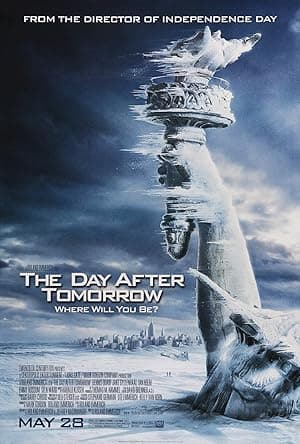
The Day After Tomorrow
Father, science and spectacle — Roland Emmerich's climate disaster in one loud breath.
Feature presentation
There’s a simple reason The Day After Tomorrow still gets talked about: it pins a global panic to a very human story. Roland Emmerich’s 2004 blockbuster keeps one central pair of hands on the wheel — Jack Hall’s — and lets the rest of the world convulse around him. Watch it as spectacle, sure, but don’t ignore the movie’s insistence that this is, at heart, a father’s fight against denial.
THE MOVIE
Jack Hall is still the reason this movie works
Roland Emmerich’s The Day After Tomorrow is an effects-led disaster picture, yes, but it’s hard to imagine the film holding together if Jack Hall didn’t feel like a real, working part of the machine. He’s not a generic scientist; he’s a NOAA paleoclimatologist whose research sets the whole thing in motion — the sort of figure you can both argue with and root for.
The film makes its stakes immediate: an Antarctic ice‑core mission goes wrong and, not long after, three superstorms conspire to produce catastrophic weather across the globe. That’s the premise — headline-grabbing, doom-laced — but the movie keeps coming back to the man who sounded the alarm.
What makes Jack interesting is the double pressure on him. He is fighting for proof in the lab and for his son on the street. Dennis Quaid plays the role, and Jake Gyllenhaal plays the son, Sam; the emotional push-and-pull between scientific authority and family urgency is what stops the picture from being nothing more than a visual rollercoaster.
THE SETUP
The idea that sets The Day After Tomorrow in motion
The film’s engine is a single scientific claim: disruption of North Atlantic circulation could spark extreme, hemisphere-scale cooling. That proposition is never treated as an abstract lecture — it’s the detonator for a sequence of vividly described weather emergencies.
We meet the threat on location — an Antarctic ice‑core mission where part of an ice shelf collapses — and watch how quickly the situation accelerates. From there, three superstorms take shape and begin to punch holes in normal life all around the world.
Emmerich threads two storylines through that setup. One is institutional: scientists and politicians scrambling to interpret and respond. The other is personal: a cross‑country rescue where Jack tries to reach his teenage son, while Sam and his small group take refuge inside the New York Public Library.
It’s efficient storytelling. The global idea gives the film grandeur; the rescue plot gives it feet on the ground.
THE CHARACTER
Why Jack Hall matters
Jack Hall matters because he connects the two halves of the movie. On paper he’s a career scientist — a NOAA paleoclimatologist — whose data and warnings are treated as inconvenient noise by the powers that be. On the screen he’s also a father with a crossing to make. Those two impulses — prove the science, save the son — keep the picture emotionally tethered.
The film leans on institutional friction to sharpen Jack’s task. Political figures act as foils whose dismissal of his warnings raises the stakes and makes the race to be heard feel urgent rather than procedural.
Jack’s function isn’t just exposition. He’s a kind of moral compass: the audience can disagree with his certainty, but they rarely doubt his motives. That personal urgency — scientific duty wrapped around familial worry — gives the action a human heartbeat.
And the casting lays that out plainly: Dennis Quaid plays the role, positioned opposite a supporting ensemble that keeps the story from becoming a one-man crusade.
UNDER THE SURFACE
The Day After Tomorrow has more on its mind than the plot suggests
On the surface it’s disaster cinema: set pieces follow one another, each bigger than the last. Underneath, the film is carrying a few steady concerns — climate change and the frightening idea of abrupt environmental collapse sit at the centre.
That scientific anxiety is matched by a political one. The movie stages a repeated contrast between expert warnings and institutional reluctance to act, which turns the disaster into both a physical and bureaucratic struggle.
Meanwhile, the family story is not decorative. The father–son thread gives the crisis a personal focus; reconciliation and the recalibration of priorities thread through the survival sequences.
Finally, the film is interested in how people cope together. Survival isn’t just about individuals heroically battling the elements — it’s about groups finding ways to shelter, share resources and make decisions under pressure.
PRACTICAL EFFECTS
The effects work that gives The Day After Tomorrow its physical personality
A lot of the film’s muscle comes from things built and shot for real. For the library/water‑surge sequences they used a very large on‑set water tank — a 250,000‑gallon set piece — with hundreds of extras and substantial wind and rain rigs. That kind of live chaos gives those scenes kinetic weight.
Snow and ice weren’t left solely to pixels either. The production used practical snow simulants — a diaper‑filling style material among other treatments — and applied staged sprayed ‘ice’ for surfaces. Closeups included practical makeup and prosthetic ice on actors’ faces, which keeps the human moments tactile.
There is, however, a clear blend. Nearly all the vast city‑destruction images come from CGI with photographic textures layered in, but the team did build a single miniature for a later underwater freighter interaction — a detail that shows the production mixed techniques where it mattered.
Those practical elements stop the CGI from feeling untethered. When bodies and weather react in-camera, the digital flourishes have something believable to latch onto.
PURE 00s
The Day After Tomorrow could not belong to any other decade
This is a very early‑2000s specimen: big‑budget disaster filmmaking marrying a headline topic to blockbuster spectacle. The movie uses that mix to pull mainstream audiences into a conversation about global warming without turning the whole thing into a sober science documentary.
Released in May 2004 and slotted into the summer tentpole season, it was designed to make a lot of noise and attract a mass audience. That scheduling and approach are pure franchise-era thinking: spectacle first, nuance second, conversation afterwards.
The film’s visual-effects pipeline and the publicity around its environmental subject matter are characteristic of the period — big effects teams, media debate, and movies that wanted to be both entertainment and event.
In short: it’s a product of its moment, and that moment loved a headline-grabbing premise wrapped in glossy blockbuster trappings.
THE LEGACY
Why The Day After Tomorrow still matters
One straightforward reason the film endures is its technical recognition. It won a BAFTA for Achievement in Special Visual Effects and drew attention from the Visual Effects Society — credentials that mark it as an effects milestone of the mid‑2000s.
Beyond trophies, it also stirred public debate. When it came out the movie prompted mainstream discussion about how climate change is depicted in fiction; scientists and the press engaged with the film’s premises and the questions it raised about abrupt climate shifts.
Commercially it was notable too: the picture reached large audiences worldwide and counted as one of 2004’s big disaster returns. Popular reach matters when you want a movie to be part of a conversation rather than a footnote.
Put together, the VFX recognition, the media attention and the box-office presence explain why people still bring it up: it was visible, it got talked about, and it left a recognisable footprint in the decade’s disaster-cinema catalogue.
THE VERDICT
Does The Day After Tomorrow still hold up?
Short answer: yes — if you go in for what it set out to be. The film hooks you with a vivid concept (a scientist warning about a failing North Atlantic circulation and the catastrophic weather that follows) and then commits to the drama that idea can produce, both on an institutional level and a painfully immediate one.
It balances two things well enough: the global debate — scientists, the UN, the White House — and the human story, the cross‑country rescue that threads Jack and Sam through the chaos. The set pieces escalate logically from local emergencies to near‑apocalyptic collapse, so you feel the scale rising rather than being swamped by it.
Technically and commercially the movie made its mark, and that matters to whether it still watches well. The visuals and production ambition were recognised at awards level and reached a mass audience; those are not trivial when you judge whether a film’s spectacle still delivers.
If you want a sober primer on climate science, this isn’t it. If you want a dramatic, heartfelt pivot inside a big disaster movie — a scientist trying to be heard and a father trying to get home — then The Day After Tomorrow still does its job. It remembers the people while the world is falling apart, and that makes a difference.
Share this movie
Keep watching
More movies from the 00s

2002
The Pianist
A quiet life unmade by war — and a pianist who refuses to stop listening.
Read the retrospective
→
2006
Blood Diamond
A mercenary, a fisherman and a pink diamond — and a film that still asks who pays for our jewellery.
Read the retrospective
→
2003
Kill Bill: Volume 1
A yellow jumpsuit, a long list of enemies and one woman who refuses to be finished.
Read the retrospective
→