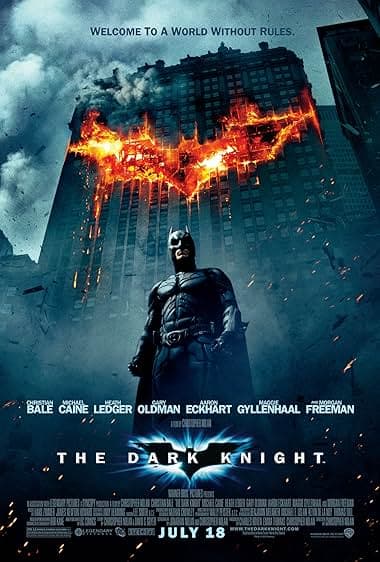
The Dark Knight
Gotham's moral dilemma: cape, code and a ludicrously persistent clown.
Feature presentation
Watch The Dark Knight again and it still feels like a debate in costume. Christopher Nolan turned a blockbuster into a city-sized moral test, and he kept the questions as loud as the bangs. This piece revisits why Batman — more than gadgets or spectacle — is the hinge the whole film swings on.
THE MOVIE
Bruce Wayne / Batman is still the reason this movie works
You remember the film by its set pieces — the bank job that introduces a very particular kind of trouble, the ambulances and the ferry test — and by a Joker who arrives like a philosophy wrapped in anarchy. Those moments are loud, but the engine that keeps them meaningful is quieter: Bruce Wayne's refusal to let the fight against crime consume him in the same way the villains surrender to their impulses.
Christopher Nolan stages a proper moral wrestling match. The Joker's campaign isn't just about robbery; it's about provoking impossible choices for Batman, Harvey Dent and Commissioner Gordon so the city itself becomes a courtroom. The film repeatedly asks whether a single man acting outside the law helps or harms the system he claims to protect.
That tension — a vigilante trying to do good without becoming monstrous — is what makes The Dark Knight worth returning to. It's not just an action movie with a famous antagonist; it's a long, noisy thought experiment about the limits of moral clarity.
THE SETUP
The idea that sets The Dark Knight in motion
At its simplest the film is a collision of three things: a Joker-led campaign of chaos, mobland power struggles, and an idealistic prosecutor who starts to look like the city's best hope. Nolan doesn't hand you a single McGuffin to chase; he builds a series of moral tests and watches how people respond.
The opening bank job does more than introduce a villain; it signals the kind of asymmetric warfare Gotham is about to face. From there, separate threads — corrupt money, legal institutions, and a masked crusader who prefers to work outside the system — weave together until the stakes are personal and civic at the same time.
What makes the setup effective is its refusal to reduce the story to a simple spectacle. The Joker's plan is designed to force choices, not merely to steal the plot. That makes the film feel less like a puzzle to be solved and more like an experiment with human ethics.
And because the film continues directly from its predecessor, those choices carry weight: the characters are not starting from zero, which keeps the moral consequences feeling earned rather than contrived.
THE CHARACTER
Why Bruce Wayne / Batman matters
Bruce Wayne is the deliberate centre of the film because he is the one trying to hold a moral line when everything around him wants to blur it. The story constantly measures Gotham against his refusal to abandon the rules he set for himself.
That refusal is a real dramatic engine. Batman isn't simply punching criminals; he is testing whether personal ethics can act as a stabilising force in a city sliding toward disorder. Much of the drama comes from the pressure placed on him by people who demand results at any cost.
Christian Bale plays that role in a film where the choice to stay principled is as dramatic as any chase or explosion. The movie asks whether integrity in a violent city is naive heroism or the only thing that keeps society functioning.
For a film that could easily have been about spectacle, it keeps returning to this question: can one man, operating outside the law, help the rule of law survive?
THE PERFORMANCE
Why Heath Ledger's performance matters
When critics wrote about the film at release they repeatedly pointed to Heath Ledger's Joker as a central reason the movie felt different. Ledger's portrayal drew sustained attention and awards recognition after the film came out.
That coverage mattered because it focused the conversation on how the Joker's particular brand of chaos reframes every moral choice on screen. Contemporary reviews set Ledger's role alongside Bale's Batman as the twin poles the film spins between.
Ledger completed his work on the film before his death in January 2008, and that fact coloured the reception without altering the film's internal mechanics: the Joker remains the disruptive force whose plans force the protagonists' hands.
In short, Ledger's Joker became a focal point for how reviewers understood the film's intensity and risk, and the attention he received helped shape how audiences approached the film's central dilemmas.
UNDER THE SURFACE
The Dark Knight has more on its mind than the plot suggests
At face value it's a crime thriller with capes. Underneath, the film is arguing—or at least testing—whether order can be preserved by rules or whether chaos inevitably forces escalation. Violence breeds more violence, and Nolan stages that as an observable pattern.
The film puts vigilantism and legal institutions in direct conversation. Batman's methods are contrasted with Harvey Dent's legal authority and Gordon's institutional compromises, so the audience is constantly asked to pick sides without ever being given an easy, satisfying choice.
Moral ambiguity is baked into the set pieces. Rather than resolving ethical questions neatly, the story constructs public tests and ethical traps that make us squirm—because good outcomes sometimes require bad acts, and the film refuses to let you feel comfortable about that.
All of which adds up to a movie that treats escalation and consequence as serious matters rather than convenient plot devices. The thematic weight comes from watching strategies and tactics change how people think and, crucially, what they are willing to sacrifice.
THE FILMMAKING
How The Dark Knight was put together
The film's creative team is a tight list of collaborators: Wally Pfister on cinematography, Lee Smith editing, and Nathan Crowley handling production design. Those credits matter because the film pairs a polished thriller language with the scale of a blockbuster.
One of the practical signatures people remember is Nolan's use of large-format photography: the production integrated IMAX cameras into several major action sequences, treating those moments as deliberately bigger and more immediate than the rest of the film.
Credits also make clear that the visual approach was hybrid: the production combined in-camera work and digital augmentation, coordinating practical effects supervisors with established visual-effects houses. That mix gives the film a tactile quality even when the action grows large.
All of this supports the film's ambitions: Nolan stages big ethical questions inside sequences that are clearly conceived and assembled with craft, so the story never reads as mere spectacle wrapped around an idea.
PRACTICAL EFFECTS
The effects work that gives The Dark Knight its physical personality
The film's credits point to a close collaboration between practical and visual teams: a special-effects supervisor appears alongside multiple VFX supervisors and companies, which is a sign the production consciously blended hands-on danger with digital help.
Dedicated IMAX technical staff are also credited, and the production used large-format cameras on several sequences, meaning some moments were captured with equipment and teams set up specifically to make them feel bigger in theatres.
Finally, production records show the movie relied on extensive vehicle and stunt work and real on-location set pieces. Those elements keep the action anchored in a physical world, so the spectacle retains a sense of actual risk.
Put together, the credits describe a film that wanted its action to feel present and mechanical where it counts, even while visual effects extended and polished what was shot on set.
PURE 00s
The Dark Knight could not belong to any other decade
Released in 2008, The Dark Knight arrived at a moment when superhero films were shifting toward more adult, realist tones. Industry conversation at the time framed it as part of that move: blockbusters borrowing crime-thriller language and moral seriousness from other genres.
That placement matters: Nolan didn't turn up in a vacuum. The film reads like a bridge between comic-book storytelling and the kinds of grounded, procedure-inflected dramas that were becoming mainstream in the 2000s.
Heath Ledger's performance and the strong critical attention it received also shaped how the film was talked about on release, making it feel like a critical, as well as commercial, event in the decade's movie culture.
And the awards recognition that followed—multiple nominations and wins—helped underline that this was more than a summer spectacle; it was a picture that tried to be artistically ambitious while still being a big-picture Hollywood film.
THE LEGACY
Why The Dark Knight still matters
Part of the film’s continuing visibility comes from the way it was recognised on its own terms: multiple Academy Award nominations and wins, including posthumous recognition for Heath Ledger, signalled that critics and institutions treated it as more than standard blockbuster fare.
The Library of Congress later selected the film for preservation, which formalises its standing as a picture of cultural or aesthetic significance. That kind of recognition matters because it records the film as part of the cinematic conversation beyond its initial run.
Industry and critical discussion also routinely point to the film as an example of superhero cinema attempting mature thematic and technical ambition. People reference it not just for spectacle but for the way it pushed genre expectations.
So its legacy isn't a single thing; it's a cluster: awards, preservation, and the manner in which it broadened what many viewers expected a comic-book movie could try to be.
THE VERDICT
Does The Dark Knight still hold up?
Yes — because its pleasures are structural, not merely decorative. The film's energy comes from moral pressure: a Joker deliberately forcing choices, multiple intersecting plot threads that test institutions, and constructed ethical dilemmas rather than a single shiny MacGuffin.
That design gives the film weight. Watching it now, you still feel the tug between vigilantism and the rule of law, and you still watch Batman as the character who insists on a code even when everyone else is tempted to abandon theirs.
Contemporary responses singled out the Joker as central to the film's power, and that attention is part of why the movie reads so strongly: the antagonist reframes each scene into an ethical test, which keeps the film sharp rather than merely loud. Its 152-minute runtime is spent asking hard questions, not just piling on action.
If you haven't seen it, it's worth watching. If you have, watching it again is satisfying because the stakes are moral as well as physical — and because the film keeps returning to the idea that sometimes the hardest work in a city of extremes is simply refusing to become what you're fighting.
Share this movie
Keep watching
More movies from the 00s
2002
The Pianist
A quiet life unmade by war — and a pianist who refuses to stop listening.
Read the retrospective
→
2006
Blood Diamond
A mercenary, a fisherman and a pink diamond — and a film that still asks who pays for our jewellery.
Read the retrospective
→
2003
Kill Bill: Volume 1
A yellow jumpsuit, a long list of enemies and one woman who refuses to be finished.
Read the retrospective
→