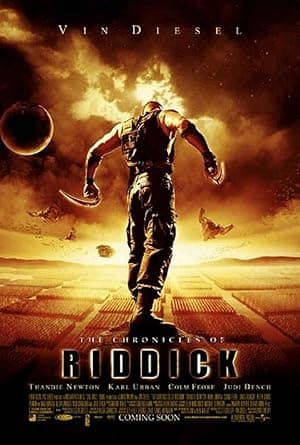
The Chronicles of Riddick
Vin Diesel’s fugitive antihero, a crusading empire, and a universe that got a lot bigger — loudly.
Feature presentation
The Chronicles of Riddick is the one that tried to turn a lean survival thriller into a full-blown space opera. David Twohy doubled down: same fugitive at its centre, much bigger stakes around him — religious crusaders called the Necromongers, planetary invasions and an expanded cosmology. Watch it for Riddick; stay for the ambition (and the moments where the ambition trips over its own boots).
THE MOVIE
Riddick is still the reason this movie works
People still talk about The Chronicles of Riddick because it’s the rare sequel that refuses to be a modest footnote. It takes the fugitive Richard B. Riddick from Pitch Black and drops him into a very different game: capture on Helion Prime while a conquering force called the Necromongers sweeps in.
That setup gives the film scope. David Twohy uses Riddick — played by Vin Diesel — not just as a survivor with knives and eyes that see in the dark, but as an antihero who gets dragged into political and metaphysical warfare far beyond the usual man-versus-monsters business.
Run time: 119 minutes. Tone: loud, baroque and occasionally stubborn. It’s not subtle, but it’s interested in big ideas: religious militarism, forced conversion and whether a lone outlaw can become the pivot of a galaxy-sized argument.
THE SETUP
The idea that sets The Chronicles of Riddick in motion
This is a sequel that scales up. Instead of the claustrophobic dread of a single-world survival story, Twohy plants Riddick on Helion Prime where several forces collide — most notably the Necromonger crusade and its Lord Marshal — and old connections from Riddick’s past reappear.
The thrust of the movie is straightforward: Riddick is caught up in rescue and escape beats while the bigger conflict — a religious, militaristic campaign of enforced conversion — plays out around him. That keeps the pace pulsing between personal stakes and sweeping spectacle.
Aereon, an Elemental intermediary, functions as a narrative hinge: she has knowledge about the Necromongers and the Underverse, and that information gives Riddick reason to move from survival to action. It’s the sort of myth-building that wants to explain not just who’s fighting, but why the fight matters.
The result is a hybrid: familiar rescue-and-escape mechanics sit beside planetary politics and metaphysical hints. It’s part action adventure, part space-fantasy sermon, which makes for some risky tonal choices — and for viewers, often a thrilling mismatch.
THE CHARACTER
Why Riddick matters
Riddick matters because he’s not a blank action figure; he’s an outlaw whose survivalist wiring and capacity for violence make him the exact problem — and occasional solution — a world of crusaders didn’t expect.
Vin Diesel plays the part, but the important point is what the character does in the story: practical instincts, stubborn independence and a past that keeps coming back (Kyra, for one) give him personal stakes inside a much larger conflict.
That collision — a loner forced to navigate politics, metaphysics and a personal history — is what makes the film interesting. It’s not just about who wins the big battle; it’s about how a single scrappy presence reshapes it.
Riddick’s presence refracts every faction he touches. Aereon’s interventions, Kyra’s return and the Necromonger threat all turn on him being someone who can survive where others cannot — and who, reluctantly, can alter the course of a crusade.
THE PERFORMANCE
Why Vin Diesel's performance matters
Contemporary response singled out one practical reason people stayed with the film: Vin Diesel’s commanding physical presence. It’s the kind of casting that anchors a movie when the scale starts wobbling.
That presence isn’t mere ornament. When the story moves from gritty escape scenes to operatic confrontations with an empire, having a central figure who reads as dangerous and self-contained helps the audience follow the thread.
Diesel’s Riddick is the narrative fulcrum; the movie asks you to believe that this man can survive both prison and priestly crusades. Contemporary coverage noted that presence as a stabiliser.
So whether you’re watching for spectacle or the quieter beats, Diesel’s casting is the useful, steady thing at the centre of the noise.
UNDER THE SURFACE
The Chronicles of Riddick has more on its mind than the plot suggests
Beneath the armour and the explosions, the film is interested in religious militarism — a crusade that converts by force rather than argument. The Necromongers aren’t merely bad guys; they represent a system that makes belief into policy and conquest into salvation.
That’s where the theme of free will versus ideological conversion sits: the picture keeps returning to whether people can choose their fate when an entire empire treats belief as an endpoint to be enforced.
At the same time, the film trades on the antihero-and-reluctant-saviour trope. Riddick is not a born messiah but someone whose survival skills and stubbornness push him into a saviour’s role, whether he wants it or not.
And the expanded myth-making — Elementals, the Underverse, the Necromonger hierarchy — gives Twohy space to ask big questions without pretending to be a neat allegory. The film offers ideas more than answers, and that ambition is part of its charm.
THE FILMMAKING
How The Chronicles of Riddick was put together
The film leans into baroque production design and elaborate costumes; it wants its worlds and cultures to feel distinct and overstuffed in the way space opera often is.
That abundance extends to the set pieces. The production keeps treating each new faction and planet as an opportunity to make something visually and materially different, which is a director’s choice as much as a design one.
Hugh Johnson is the credited director of photography, with Martin Hunter and Dennis Virkler on editing duties — names behind the craft that shaped the film’s pacing and visual rhythm.
Critics at the time flagged this ambition: the production design and effects were widely noted, even when reviewers thought the plotting and tone didn’t always match the scale of the visuals.
PRACTICAL EFFECTS
The effects work that gives The Chronicles of Riddick its physical personality
Contemporary coverage emphasised that the picture is effects-heavy. The film uses extensive computer-generated imagery alongside creature and production-design elements to realise its larger-than-life factions and worlds.
That combination is part of how the film builds its physical personality: CGI to extend environments and creatures, and tangible design work to make alien cultures feel specific.
Because the movie wants to be immersive on a planetary scale, the effects choices are everywhere — in armour, ships and the sense of populated worlds rather than empty matte backdrops.
If you watch it now, you’ll see a film that married practical thinking and digital finishing to push the story toward spectacle as often as toward intimacy.
PURE 00s
The Chronicles of Riddick could not belong to any other decade
This film is a textbook early-2000s move: take a modest cult sci-fi property and turn it into a summer tentpole with expanded world-building and cross-media tie-ins.
Twohy’s Riddick didn’t arrive alone — the movie was released in June 2004 alongside franchise tie-ins, including an animated short and a licensed video game, the sort of cross-platform push studios favoured back then.
That scheduling — a June opening and simultaneous tie-ins — marks it as a film built for the summer marketplace, where spectacle and franchise potential trumped the tightness of the original.
It’s a film very much of its moment: ambitious in scope, keen to grow into a franchise and happy to trade a smaller story for a bigger, more commercial one.
WATCHING IT NOW
What has aged — and what hasn't
What still works: the cast list reads like a shop window of interesting choices — Judi Dench as an Elemental intermediary, Colm Feore as the Lord Marshal, Karl Urban, Thandiwe Newton and Keith David. Their presence gives the movie texture beyond the headline name.
What also holds up is the personal throughline: setting Riddick back on Helion Prime and bringing Kyra from his past into the story keeps the film rooted in a relationship-driven core even when the scale grows.
Where it shows its age is less about actors and more about ambition: modern tastes can be less patient with blockbuster detours that expand mythology without tidy narrative payoffs.
But if you come for the world-building and the gamble of turning a lone survivor into the hinge of a myth, parts of the film still feel audacious rather than merely dated.
THE LEGACY
Why The Chronicles of Riddick still matters
The Chronicles of Riddick matters because it tried something that wasn’t fashionable for every sequel: it went big. The gamble produced more Riddick stories across formats — an animated short (Dark Fury), a licensed game (Escape from Butcher Bay) released the same month, and later another theatrical sequel.
Its mixed reception didn’t end the project; rather, that reception and the world-building pushed the franchise into multiple platforms. The film’s ambition, for better or worse, created a broader universe to explore.
Put simply: the movie matters less as a clean success and more as the moment the Riddick concept became a franchise — messy, interesting and persistent.
For fans of weird, sprawling sci-fi, that persistence is important; it’s proof the idea had enough life to outgrow a single film and keep returning in different forms.
THE VERDICT
Does The Chronicles of Riddick still hold up?
Yes — but with a big caveat. If you want the tight survival story of Pitch Black, this is not that. The Chronicles of Riddick deliberately trades small-scale dread for a broad space-opera sweep: planetary invasions, a religious-military antagonist and formal mythic elements such as Elementals and the Underverse.
If you come for Riddick, you’ll be rewarded. Vin Diesel’s presence is the linchpin that keeps the film from floating away when the world-building takes over; contemporary observers credited that presence with keeping audiences engaged.
If you come for tidy plotting and tonal restraint, the film will frustrate you — contemporary reviews noted its plotting and tonal excesses even as they admired the production design and effects.
So should you watch it? Yes, if you’re curious about grand, slightly unruly science fantasy and you’re willing to accept an antihero-centred adventure that prefers mythic reach over narrative neatness. It doesn’t always land, but it’s the sort of bold misfire that’s never boring.
Share this movie
Keep watching
More movies from the 00s

2002
The Pianist
A quiet life unmade by war — and a pianist who refuses to stop listening.
Read the retrospective
→
2006
Blood Diamond
A mercenary, a fisherman and a pink diamond — and a film that still asks who pays for our jewellery.
Read the retrospective
→
2003
Kill Bill: Volume 1
A yellow jumpsuit, a long list of enemies and one woman who refuses to be finished.
Read the retrospective
→