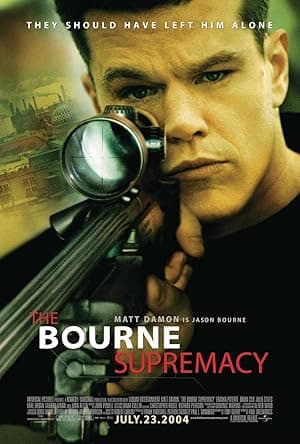
The Bourne Supremacy
A man with holes in his memory, a state with holes in its conscience — and an awful lot of running.
Feature presentation
There’s a moment in The Bourne Supremacy where everything that made the first film interesting turns crankier, sharper and faster. Paul Greengrass drops Jason Bourne back into a life he was trying to forget, and then somebody makes sure he can’t. It’s a sequel that doesn’t coast on familiarity: it raises the stakes for Bourne’s search for himself and pushes the spy movie into a paranoid, close-up, almost personal thriller.
THE MOVIE
Jason Bourne is still the reason this movie works
The film drops us into a surprisingly domestic scene: Bourne is off the grid in Goa with Marie, trying to live small and forget big. That quiet never lasts. An operation in Berlin is staged so that Bourne’s fingerprints turn up at a massacre, and suddenly the man who wants to disappear has been handed a new, violent identity.
That tension — a man defined by missing pieces and the people who refuse to leave him alone — is the engine. Bourne’s quest is simple in description and messy in reality: survive, find who set him up, and try to understand what he did when he couldn’t remember himself.
Greengrass steers the whole thing. The director’s name is on the film, the runtime is compact, and Matt Damon is back as Bourne, with Franka Potente’s Marie as the small human stake that makes his return to the field feel urgent rather than procedural.
THE SETUP
The idea that sets The Bourne Supremacy in motion
The brief, practical setup is this: Bourne is framed, an attempt is made on his life and something personal is taken from him, which forces him back into action. That painful push is precisely what the film needs; it turns a geopolitical spy plot into something that feels personal and immediate.
From there the movie becomes a hunt across cities — Naples, Berlin, Moscow — as Bourne follows fragments: a passport, a phone call, a name. The puzzle pieces are small, found moments rather than neat revelations, and that keeps the narrative propulsive without ever feeling like a checklist of exposition.
Part of why the setup works is the way Bourne operates: improvisation. He rebuilds the trail through little discoveries rather than sit-down explainers. It’s an old-school spy route — follow the clue — but seen through a character who can’t trust his own past.
All of this sits within the continuity of the trilogy: Supremacy is the direct sequel to The Bourne Identity and the middle chapter that steers Bourne toward the next confrontation.
THE CHARACTER
Why Jason Bourne matters
Jason Bourne is not a blank-slate action man; he’s a man who keeps tripping over the past. That missing history — the fragments of memory, the instincts, the guilt — is what makes him stick in the head. He’s not defined by gadgets or swagger, but by that messy need to know who he was and why.
The movie keeps his aims basic and human: stay alive, answer the questions he can’t remember, and deal with what he might have done. Those simple stakes make everything that happens feel urgent. It’s about consequences, not just capability.
Marie matters here because she provides the small human tether that makes Bourne’s choices mean something beyond survival. Her presence early on anchors him; when the film removes that anchor, his mission acquires a different, sharper momentum.
You can treat Supremacy as a spy story in motion, but at its core it’s still Bourne trying to reconstruct himself while everyone with power would rather keep the book closed.
UNDER THE SURFACE
The Bourne Supremacy has more on its mind than the plot suggests
On the surface this is an action-thriller about pursuit and escape. Underneath, the film is consistently interested in identity and memory: the plot is pushed forward by what Bourne cannot recall, and those gaps force every character into moral reckonings about past deeds.
That ties neatly into another strand — institutional secrecy. The CIA’s past operations and the decisions of senior figures create a web that tries to contain the truth. The agency isn’t merely background; its cover-ups are the mechanisms that frame Bourne and complicate any clean resolution.
Surveillance and paranoia are not just atmosphere either; they’re part of the movie’s logic. People are watching, records can be manufactured, and Bourne is hunted not only by assassins but by systems that prefer oblivion to accountability.
Finally, revenge and atonement thread through the story. Bourne’s quest is half-answer-seeking, half-payment: he wants to know what he did, and he wants to make a kind of recompense — or at least to stop the machine that keeps hurting people.
THE FILMMAKING
How The Bourne Supremacy was put together
Greengrass’s direction leans into a handheld, close-in style that pushes the audience into the chaos. The action feels immediate because the camera is rarely at a polite distance; it’s close, narrow and often breathless.
Oliver Wood is the credited director of photography and the visual game is clearly about tight framings and low angles during fights and chases. That framing makes the action feel tactile rather than glossy.
For the big sequences — especially car work — the production used multi-camera coverage and specific second-unit approaches to get the intensity without cutting away into abstraction. Those choices are why a chase scene feels like a sequence of choices rather than a montage of explosions.
All told, the filmmaking assembles the film’s personality: nervous, quick, and always focused on what the characters are doing in the moment rather than on grand spectacle for its own sake.
PRACTICAL EFFECTS
The effects work that gives The Bourne Supremacy its physical personality
The film’s big car set-pieces weren’t faked in a vacuum. They relied on real stunt driving and camera vehicles configured to get those low, close shots that make the Moscow chase a thing you remember.
That practical stunt work paid off in industry recognition: the second-unit and stunt teams received attention for the choreography and coordination required to make those sequences both tense and comprehensible.
PURE 00s
The Bourne Supremacy could not belong to any other decade
Supremacy arrived at a moment when mainstream action was willing to borrow documentary energy. Having Paul Greengrass — a filmmaker known for that kind of immediacy — helm a big studio spy sequel meant the film carried a different texture than the polished espionage pictures that came before.
As the middle chapter of Matt Damon’s original Bourne trilogy, it also helped define early-2000s tastes for grittier, kinetic spy action. That was a crowd ready for hand-to-hand tangibility rather than gadget-led glamour.
Released in 2004 and operating as the direct sequel to The Bourne Identity, the film sits clearly in its moment: part franchise continuation, part stylistic recalibration for what a blockbuster spy film could feel like.
THE LEGACY
Why The Bourne Supremacy still matters
Within the original Matt Damon trilogy, Supremacy is the connective tissue: it maintains the personal throughline from Identity and escalates toward Ultimatum. That continuity is partly why the film remains a frequent reference when people talk about this era of spy filmmaking.
The movie also cemented Paul Greengrass’s place in mainstream action. His approach helped crystallise a recognisable 'Bourne' house style — a certain nervous, immediate vocabulary that other films would pick up in various ways.
Finally, the production’s stunt and vehicle achievements weren’t just window dressing; the practical driving sequences and choreography were acknowledged within the stunt community, which is a reminder that the film’s physical work mattered as much as its ideas.
THE VERDICT
Does The Bourne Supremacy still hold up?
Yes — and not for the reasons a poster might promise. Supremacy holds together because it keeps the focus tight: Bourne is a man haunted by holes in his memory, framed in a way that makes every step toward truth feel like a risk. The inciting Berlin framing and the personal tragedy that forces him back into motion make the stakes concrete rather than abstract.
The film is economical: Bourne bolts from Goa, traces a fractured trail through Naples, Berlin and Moscow, and relies on improvisation — stolen passports, overheard calls, little clues — to rebuild a past he can’t access. That mode of discovery keeps tension high and story beats compact within a 108-minute runtime.
It also helps that the opposition is clear and varied: there are institutional players, embodied by senior CIA figures whose past decisions created the mess, and there are physical threats like the hired assassin Kirill. Those elements combine to make the chase both political and painfully personal.
If you want a tightly wound mid-00s spy-thriller that prioritises character-driven momentum and practical stuntcraft, this is still well worth the watch. Greengrass’s direction, the compact script, and the film’s commitment to practical, vehicle-led sequences give it a personality that ages better than many more glittering, less grounded action pictures.
Share this movie
Keep watching
More movies from the 00s

2002
The Pianist
A quiet life unmade by war — and a pianist who refuses to stop listening.
Read the retrospective
→
2006
Blood Diamond
A mercenary, a fisherman and a pink diamond — and a film that still asks who pays for our jewellery.
Read the retrospective
→
2003
Kill Bill: Volume 1
A yellow jumpsuit, a long list of enemies and one woman who refuses to be finished.
Read the retrospective
→