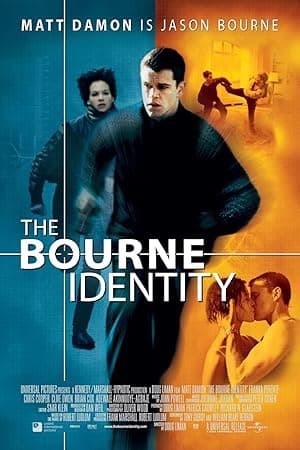
The Bourne Identity
Amnesia, hand-to-hand brawls and a man trying to remember who he taught himself to be.
Feature presentation
You remember the moment: a man pulled from the sea with no name, a pile of passports and one urgent question — who is he? Doug Liman's The Bourne Identity turns that single neat conceit into a movie that feels both lean and oddly human, an action thriller that keeps asking what it costs to be someone else.
THE MOVIE
Jason Bourne / (identified in-film as several cover names) is still the reason this movie works
The image that sticks is simple: a badly wounded, nameless man washed ashore and alive by accident. From that muddled beginning the film refuses easy answers and builds everything — action, plot, sympathy — around a question of identity.
What keeps the film moving is that those small mysteries are practical. A safety-deposit box, bank records and several different passports are not just MacGuffins; they are the breadcrumb trail this man follows to reconstruct himself. The hunt for facts becomes a search for personhood.
Doug Liman directs a movie that pairs that puzzle with the bones of a thriller: a covert programme that would rather eliminate its problem than confront it. Matt Damon plays the man at the centre, Franka Potente is the pragmatic local who becomes unexpectedly important, and the tone is lean and unflashy — built for motion, not spectacle.
THE SETUP
The idea that sets The Bourne Identity in motion
At its simplest: a man with severe amnesia discovers he has skills he can't remember learning. That mismatch — capability without memory — is the film's engine.
The practical mechanics keep things honest. Instead of scenes of exposition, the story hands Bourne bits of evidence: passports, bank records, a safety-deposit box. Each reveal nudges him (and us) a little further down the trail of who he might have been.
That search collides with an institution that wants the problem closed. The CIA black-ops project introduced in the film treats him as a liability and sends people to neutralise what he might expose.
Liman frames the investigation as a series of waypoints. Zurich, Paris, Rome and Marseille function less as exotic postcard stops and more as stages in an inquiry — small globe-trotting set pieces that let story and action happen at once.
THE CHARACTER
Why Jason Bourne / (identified in-film as several cover names) matters
Bourne's memoriless state is not a neat party trick. It makes him curious and dangerous in equal measure: resourceful because he has to be, haunted because he can't forgive or explain what he might have done.
That ambiguity is the character's hook. He isn't a mystery wrapped in a riddle for the audience's cleverness — he's trying to know himself. That inward quest turns routine chases and fights into something with emotional weight.
The film also trades on a practical believability. Damon prepared physically for the role and performed many of his own stunts, and the close-quarters fighting is built around that readiness. The result is a protagonist who feels like a skilled, improvising operative rather than an untouchable action hero.
And quietly, the story makes room for someone to matter to him: Marie starts off as a pragmatic, money-motivated companion but becomes an emotional anchor whose choices shape Bourne's next moves. That human tether keeps the character from becoming just an idea.
THE PERFORMANCE
Why Matt Damon's performance matters
A lot of the film's dramatic ground is won in small moments rather than grand speeches. Contemporary coverage singled out the chemistry between Matt Damon and Franka Potente as a key reason the story feels grounded; those scenes make the stakes personal.
The effect isn't theatrical. Damon offers a focused presence that contemporary critics noticed, the kind of screen energy that keeps a character plausible when the plot throws increasingly fraught choices at him.
Because Bourne is a man learning himself, the role requires restraint as much as physicality. The combination of those two sides — the quiet internal searching and the readiness to act — is the performance story the film asks viewers to accept.
Put simply: the casting lines up with the material. The relationship and the subdued intensity around Bourne stop the movie from being only a series of thrills.
UNDER THE SURFACE
The Bourne Identity has more on its mind than the plot suggests
Memory and identity are the film's obvious concerns. Bourne is literally rebuilding himself, which allows the movie to ask whether who you are is what you remember doing or how you choose to act now.
There is a sustained tension between individual freedom and institutional control. The covert programme that created — and then hunts — Bourne represents state power; his struggle is remarkably simple: keep living on your terms or be reduced to an asset to be managed.
Those two ideas produce an ethical dimension. The story invites you to consider the moral cost of operations conducted out of public view — when secrecy erases accountability, how easily do ends justify means?
Finally, trust and betrayal thread through the relationships. Allies can turn into liabilities, and the film makes betrayal feel like both a practical risk and an emotional wound for someone trying to rediscover himself.
THE FILMMAKING
How The Bourne Identity was put together
Doug Liman favoured a restrained, handheld approach that keeps the camera close to people rather than stretching for spectacle. He often operated the camera himself, which gives many scenes a directness that suits the story.
That intimacy matters because the movie asks us to inhabit a character who doesn't know who he is. The cinematography and editorial choices steer us into a smaller world where observation and reaction carry the drama.
Oliver Wood handled cinematography and Saar Klein provided the primary editing credit; together they leaned into a kinetic, close-quarters action style. The film's physical energy comes less from extravagant set-pieces than from the way a scene can turn dangerous in an instant.
In short, the filmmaking choices keep us rooted in the thriller while allowing quieter, character-driven moments to breathe between the blows.
PRACTICAL EFFECTS
The effects work that gives The Bourne Identity its physical personality
The film's fights feel tactile because they were developed with experienced stunt coordinators and trainers who built sequences around the environment. Those close-quarters moves read like improvisation rather than choreography for its own sake.
Matt Damon prepared physically and performed many of his own stunts, which helps sell the idea that Bourne's responses are muscle memory rather than cinematic trickery.
Driving action, too, was treated with practicality. The Paris car sequence and other set pieces used real driving stunts staged by second-unit specialists rather than depending on digital replacement.
All of this gives the movie a bodily presence: when you watch, you can sense the weight and the risk in each move.
PURE 00s
The Bourne Identity could not belong to any other decade
The film's route to release is telling. Production ran into studio concerns, late rewrites and reshoots that pushed its debut into mid-2002 rather than the originally targeted 2001 slot — the kind of behind-the-scenes churn that felt very 00s.
There were also real sensitivities in that immediate post-9/11 period about tone and content, and the movie navigated those concerns before opening in June 2002.
Its handheld, intimate action language was also part of the era. Contemporary reviewers flagged that approach as a distinguishing trait among early-2000s studio action films — a move away from gleaming, gadget-driven set-pieces toward something grittier.
Put together, the production history and the film's tone make it feel squarely of the moment: a studio picture trying on a rougher, more immediate style and arriving in a changed cultural moment.
WATCHING IT NOW
What has aged — and what hasn't
The parts that still sit well are the quieter ones: the character-driven approach and the measured action sequences. Those elements offer a counterpoint to blockbuster excess and still feel watchable because they keep consequences and people close to the frame.
The film's practical grounding — fights that register and driving that feels lived-in — continues to give it mileage against more obviously theatrical action movies.
There are elements that later films in the series would push further and that some viewers have since critiqued (particularly in how handheld action is used), but the first film's temperate mix of character and craft often reads as refreshingly unflashy today.
Finally, it's worth noting objectively that this film did not simply stand alone: it launched sequels and set the template for the series that followed.
THE LEGACY
Why The Bourne Identity still matters
The most concrete legacy is straightforward: this film launched a commercially continuing franchise, with direct sequels that picked up Bourne's story.
Beyond that, discussions about 21st-century spy cinema often return to this movie when talking about tone and physicality. It helped shift expectations toward a more grounded, kinetic kind of espionage film.
That influence is not a blanket claim of dominance; it's narrower and more practical: filmmakers and critics have repeatedly pointed to this movie as an example of how action can be leaner and more immediate.
So The Bourne Identity matters because it proved a different way to do a big-studio spy picture — one that favours proximity to characters and the use of real physical stakes over sheen.
THE VERDICT
Does The Bourne Identity still hold up?
Yes. The Bourne Identity remains worth watching because it pairs a compelling, intimate premise — a badly wounded man piecing together who he is after being pulled from the sea — with action that feels earned rather than showy.
The central conflict still lands: a man trying to recover his identity while a covert programme treats him as an expendable liability. That set-up makes every reveal and every confrontation feel consequential.
Add to that the practical filmmaking choices — a handheld, immediate tone, kinetic close-quarters action, and real driving stunts — and the film plays as a thriller that privileges plausibility and character over gadgetry.
If you're wondering whether to rewatch or introduce someone new to it, the answer is straightforward: it's a tight 119 minutes of spycraft, memory work and moral friction that still cuts clean. The Bourne Identity doesn't just start a franchise — it shows a smarter, leaner way to do spy cinema, and that approach still matters.
Share this movie
Keep watching
More movies from the 00s

2002
The Pianist
A quiet life unmade by war — and a pianist who refuses to stop listening.
Read the retrospective
→
2006
Blood Diamond
A mercenary, a fisherman and a pink diamond — and a film that still asks who pays for our jewellery.
Read the retrospective
→
2003
Kill Bill: Volume 1
A yellow jumpsuit, a long list of enemies and one woman who refuses to be finished.
Read the retrospective
→