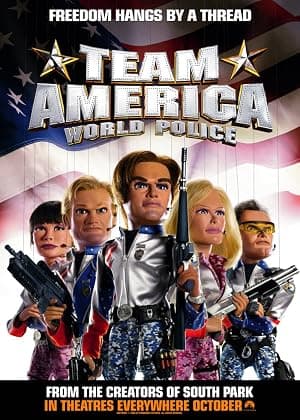
Team America: World Police
Puppets, pop-satire and an embarrassingly effective send-up of the world’s biggest action movie instincts.
Feature presentation
Team America: World Police still feels like a dare: can you send up blockbuster bluster, American interventionism and celebrity virtue-signalling — all with marionettes? Directed by Trey Parker and released in 2004, it answers with a grin, a belt of musical numbers and the sort of gleeful nastiness only possible when the players are literally on strings.
THE MOVIE
Gary Johnston / Joe Smith / Carson / Kim Jong Il / Hans Blix / Osama bin Laden / Matt Damon (puppet) / Tim Robbins (puppet) / Sean Penn (puppet) / Michael Moore (puppet) / Helen Hunt (puppet) / Peter Jennings (puppet) / Susan Sarandon (puppet) / Liv Tyler (puppet) / Janeane Garofalo (puppet) / Additional voices is still the reason this movie works
People still talk about Team America because it refuses to behave like a polite satire. It recruits a Broadway actor into an international counterterrorism squad, then uses that absurdity — celebrity shoved into action-movie machinery — to lean on every ridiculous muscle the genre has.
That cast of targets is broad: terrorists, blockbuster tropes and the kind of celebrity activism that looks good in a magazine but doesn’t always survive close inspection. The central tug-of-war — gung-ho militarism versus the messy fallout it leaves behind — gives Parker something sharp to skewer between the jokes.
And then there’s the delivery. Trey Parker and Matt Stone don’t just write and direct; they voice and embody a ridiculous roster of characters, and the whole thing is staged in marionette scale with miniature sets. It’s a gag that’s also a technical choice, one that makes the satire feel tactile and properly daft.
THE SETUP
The idea that sets Team America: World Police in motion
At its simplest the film is an action broad-parody: an international strike team recruits a Broadway performer, Gary Johnston, and drags him into a series of set-piece assaults on villains both real and celebrity-adjacent.
That mismatch — show business meets military precision — is the movie’s engine. Gary’s inexperience and celebrity identity create comic friction inside the team and drive several plot beats without the film ever pretending the joke is subtle.
The tone is blunt and kinetic. Musical numbers sit cheek-by-jowl with miniature explosions and staged rescues, which keeps the satire moving at the same breathless pace it mocks.
Because the film is built as a parody of blockbuster excess, it can aim its jokes at both the spectacle and the human cost that spectacle leaves in its wake.
THE CHARACTER
Why Gary Johnston / Joe Smith / Carson / Kim Jong Il / Hans Blix / Osama bin Laden / Matt Damon (puppet) / Tim Robbins (puppet) / Sean Penn (puppet) / Michael Moore (puppet) / Helen Hunt (puppet) / Peter Jennings (puppet) / Susan Sarandon (puppet) / Liv Tyler (puppet) / Janeane Garofalo (puppet) / Additional voices matters
Gary Johnston — a Broadway actor drafted into a paramilitary outfit — is more than a straight man for jokes; he’s the film’s deliberate misfit. The fact he’s famous for the stage and not battlefield experience explains a lot of how scenes cascade from embarrassment into catastrophe.
That contrast is useful. It lets the film poke at the arrogance of both sides: the team’s certainty that force is the answer and the celebrities’ belief that moral pronouncements amount to action.
The movie’s relationships also matter: Lisa Jones and Sarah Wong anchor Gary’s romantic and emotional arcs, which provides a few genuine stakes amid the satire. Those subplots stop the film turning into a mere gag reel and give the marionette melodrama some shape.
And it’s worth noticing how central the Parker/Stone authorship is. Trey Parker voices a huge chunk of the cast and the film is written and directed by the team (with Pam Brady on the script), so the characters feel drawn from a single, mischievous imagination rather than a scattergun lampoon.
THE PERFORMANCE
Why Trey Parker's performance matters
Trey Parker isn’t just the director and co-writer — he supplies the voice for Gary and a raft of other characters. That concentration of creative roles gives the film a kind of tonal unity: the same satirical voice that writes a lyric also speaks the punchline.
Because Parker voiced so many parts, the cast reads less like an ensemble of independent targets and more like a chorus of variations on the same comic instinct. It’s why the film’s mockery feels consistent rather than scattered.
That practical fact — one performer covering a wide range of roles — is also part of the joke. When a single mouth voices both hero and many of the celebrities he’s fighting, the satire becomes conversational rather than forensic.
So, even without digging into vocal choices or delivery, Parker’s multiple credits are foundational: they shape character dynamics simply by existing.
UNDER THE SURFACE
Team America: World Police has more on its mind than the plot suggests
On the face of it, the film is a ball of mean jokes. Underneath that, its satire targets a cluster of related ideas: action-movie clichés, the instinct to use force as a universal answer, and the kind of celebrity activism that looks compelling but can feel performative when set against real-world conflict.
The Film Actors Guild subplot makes that last point bluntly: celebrity outrage is dramatised as a foil to the team’s blunt instrument approach. The result isn’t a defence of one side over the other so much as an eye-rolling at both extremes.
At the same time, parodying action-film archetypes allows the film to show how spectacle can hide consequences. The gung-ho solutions that look neat in a trailer have a nasty habit of producing collateral damage — and that’s the target of several extended gags.
Taken together, these ideas make the film more than a spoof: it’s a satire that uses its own noise and artifice to ask whether spectacle and righteousness actually solve anything.
THE FILMMAKING
How Team America: World Police was put together
The film’s look is a deliberate mash-up. Production design — led by Jim Dultz with David Rockwell advising — concentrated on tiny, meticulous sets; contemporary coverage singled out those miniatures as a highlight. It’s not just a gimmick: the small-scale world shapes every gag and staging choice.
The cinematography took that miniature world and treated it like a big-budget action movie. Bill Pope was director of photography, and the filmmakers deliberately referenced blockbuster aesthetics — asking, effectively, 'What would a big-studio action picture look like if it were tiny?' That choice lets the film both mimic and mock the genre it’s satirising.
So much of the comedy comes from that collision: cinematic language designed for explosions and hero shots applied to marionettes and toy cities. The filmmaking decision to align high-end action values with puppetry is what gives the satire its teeth.
In short, the movie’s identity is as much mechanical as it is verbal. The jokes rely on a production-level commitment to treating the marionette world seriously, then undercutting it with the script.
PRACTICAL EFFECTS
The effects work that gives Team America: World Police its physical personality
The film’s physical personality comes from its hands-on approach: principal photography and effects used marionette puppets working on roughly one-third-scale miniature sets, an explicit nod to 'Supermarionation' techniques.
That scale demanded inventive solutions. The production constructed detailed miniature versions of international landmarks and even used practical stand-ins — for comic effect and to sell scale — rather than relying on obvious digital tricks.
The human touch is visible in the credits too: lead puppeteers such as Greg Ballora, Scott Land, Seb Hartman and Tony Urbano are named for a reason. Those craftsmen are where many of the movie’s physical jokes are born.
Put simply: the tactile production methods aren’t nostalgia or novelty; they’re central to how the film stages and times its gags.
PURE 00s
Team America: World Police could not belong to any other decade
This is very much an early-2000s film. Conceived and released in the wake of 9/11, it’s often read as a post-9/11 satire engaging the language and policies of the 'war on terror.' That context gives its jokes a sharper, sometimes uncomfortable edge.
Its October 2004 release also landed near that year’s U.S. presidential campaign, which made the film feel of-the-moment even when the filmmakers say timing was driven by production rather than politics.
Stylistically, the movie blends two early-00s preoccupations: parodying blockbuster excess and making topical political satire that aims at targets across the spectrum. The result is a film that is both a lampoon of Hollywood spectacle and a commentary on the era’s real-world anxieties.
All of which is to say: remove it from 2004 and you lose a good deal of the impetus behind the jokes and the targets they’re aiming at.
THE LEGACY
Why Team America: World Police still matters
The film has stayed in circulation in critical conversations; it didn’t vanish after its initial run but kept turning up in lists and discussions about notable comedies of the 21st century.
Specific elements — the songs and a handful of set-piece sequences — are the bits most frequently remembered and quoted when commentators revisit Parker and Stone’s work.
That continued presence is telling. It isn’t that the whole film is endlessly recycled; rather, certain moments and melodies lodged themselves in the culture as efficient, quotable encapsulations of the movie’s thrust.
For fans of Parker and Stone, Team America occupies a clear slot in the catalogue: an experiment in scale and satire that left a few unmistakable fingerprints behind.
THE VERDICT
Does Team America: World Police still hold up?
Yes — if you’re looking for something that still lands as a piece of shameless, pointed satire. The film’s central joke — a Broadway celebrity thrown into an international counterterrorism team — gives it the structural oddness it needs to keep surprising you.
It works because the satire aims at interlocking targets: action-movie tropes, American militarism and the performative side of celebrity activism. Those aims are embedded in the film’s design: musical numbers sit inside set-piece assaults, and the staging on one-third-scale marionettes makes spectacle itself an object of ridicule.
Trey Parker and Matt Stone’s concentrated authorship — Parker voicing key characters and the pair steering the script and direction — keeps the tone consistent, while the production choices (miniature sets, intentional blockbuster cinematography) make the jokes feel crafted rather than slapped together.
So should you watch it now? If you enjoy satirical teeth, musical jabs and the deliberate weirdness of puppets being taken seriously and then mocked, it still delivers. It’s an acquired taste, loud and occasionally uncomfortable, but it’s the kind of film that still makes you grin — and then think for a moment about what that grin is covering.
Share this movie
Keep watching
More movies from the 00s

2002
The Pianist
A quiet life unmade by war — and a pianist who refuses to stop listening.
Read the retrospective
→
2006
Blood Diamond
A mercenary, a fisherman and a pink diamond — and a film that still asks who pays for our jewellery.
Read the retrospective
→
2003
Kill Bill: Volume 1
A yellow jumpsuit, a long list of enemies and one woman who refuses to be finished.
Read the retrospective
→