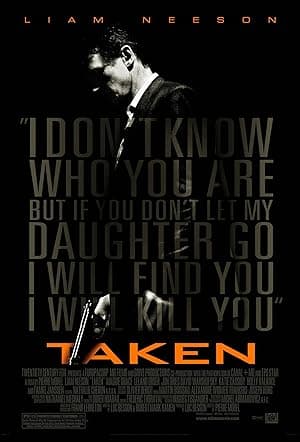
Taken
A tough dad, a short fuse and a particular set of skills — and yes, it’s still an entertaining ride.
Feature presentation
Taken keeps turning up in conversations because it gives you one very simple bargain: a compact, loud thriller built around a single, furious purpose. Pierre Morel’s lean direction and Liam Neeson’s Bryan Mills turn a messy real‑world crime — the abduction of a teenager in Paris — into a propulsive, near‑single‑minded race to get her back.
THE MOVIE
Bryan Mills is still the reason this movie works
Taken opens with a plainly human scene: Bryan Mills trying to stitch his life back together with his teenage daughter before she flies to Paris for a few days. That ordinary attempt at reconciliation matters because it makes what follows feel urgent and personal rather than just plot.
When Kim and her friend are snatched and folded into a human‑trafficking network, the film’s engine shifts. The abduction turns what might have been a globe‑trotting procedural into something more personal — a focused mission that sits squarely on one man’s shoulders.
What gives the film its pulse is the way it marries that personal motive to a clear genre promise. Pierre Morel directs a taut 93‑minute action thriller in which Liam Neeson’s Bryan Mills, a former U.S. government operative, uses his training to pursue, interrogate and do whatever it takes to get his daughter back.
THE SETUP
The idea that sets Taken in motion
Taken’s plot is simple and almost gleefully economical: Kim is taken in Paris and sold into a trafficking network; Bryan Mills has to find and recover her before she’s moved beyond reach.
That simplicity is part of the film’s cleverness. The screenplay repeatedly makes Mills’ race against time into something almost procedural — he converts fragments of information into clear leads, improvises police impersonations and leans on an international 'black book' of contacts.
A device the film uses again and again is the phone. Mills uses calls to direct his daughter and to squeeze information from people he corners; it’s an efficient storytelling tool that keeps the search feeling immediate and connected.
Crucially, the rescue is framed as a near‑solo campaign. The movie gives you a protagonist who operates unilaterally, moving across borders with quick violence, surveillance and a handful of contacts rather than a large institutional force.
THE CHARACTER
Why Bryan Mills matters
Bryan Mills is not mysterious. He’s a retired U.S. government operative with the tools and training to do extreme things — and, crucially, a clear reason to use them. The film places his desire to repair a broken relationship with his daughter beside his willingness to go back to work when she’s taken.
That combination — a father who’s also a professional with a certain set of skills — gives the whole movie its moral and dramatic weight. Mills’ personal project of reconnection is what turns violence into an instrument rather than spectacle.
Put differently: everything Bryan does in the film makes sense inside the movie’s own rules. His experience explains his methods, and his fatherhood explains his relentlessness. Together they make him more than an action figure; he’s the story’s engine.
THE PERFORMANCE
Why Liam Neeson's performance matters
Contemporary critics singled out Liam Neeson as the film’s anchor, and for good reason: the film needs a centre that can carry threat and grief in the same glance.
Neeson’s Bryan Mills is organised rage — a restrained fury that keeps the plot believable even when he’s doing extreme things. The parts of the movie that feel tight and immediate are the parts where his presence controls the scene.
You don’t watch Taken for nuanced interior drama, but you do need to believe the person at its heart. The performance supplies that belief, which lets the rest of the film get on with being brisk and propulsive.
UNDER THE SURFACE
Taken has more on its mind than the plot suggests
On the surface Taken is a rescue thriller; under the surface it’s about a cluster of ideas that give those actions weight. Parental protection is obvious — the whole story pivots on a father’s refusal to accept an ordinary tragedy.
That refusal slides naturally into vigilantism and revenge. Mills isn’t trying to reform a system; he’s trying to bypass it. The movie privileges the skilled individual taking extrajudicial action over institutional process.
There’s also the darker backdrop of human trafficking and sexual exploitation: the criminal world the victims are plunged into is the reason the plot feels urgent and dangerous rather than merely adventurous.
Finally, there’s an argument about masculine identity. The film stages a reconstruction of a man who has the competence to act in violent ways and uses those competencies to reclaim a domestic role as father — it’s about fixing a relationship by cleaning up a catastrophic mess.
THE FILMMAKING
How Taken was put together
Pierre Morel stages action in a way that never lets the audience lean back. The film favours close, often handheld coverage during fights and chases, which keeps the energy tight and the pacing brisk.
That visual approach helps the movie feel urgent rather than ornamental. The cinematography — credited to Michel Abramowicz — focuses on tightly framed, kinetic shots that put you near the characters instead of giving you wide, detached vistas.
Frédéric Thoraval’s editing matches that intent: short, sharp cuts and an economical rhythm mean the film rarely stalls. Taken is built to move — and it mostly does, from the first scene to the last.
PRACTICAL EFFECTS
The effects work that gives Taken its physical personality
Taken’s action has a physicality because the production relied on coordinated practical stunt work. The credits list numerous stunt performers, coordinators and credited stunt drivers, which points to hands‑on fight and driving sequences rather than purely digital replacements.
That practical commitment matters because it gives several set pieces a convincing, tactile bite: when cars crash or people tumble, you feel the choreography beneath the spectacle.
Practical stunts can’t carry a story by themselves, but in a film this compact they help the action land as credible and lived‑in rather than just suggested.
PURE 00s
Taken could not belong to any other decade
Taken arrived in 2008 as a French‑produced, English‑language thriller designed for a global market — a late‑2000s Europop action formula that aimed squarely at international audiences.
Part of what makes it feel of its moment is the way it repositioned an established dramatic actor into the action lead lane. Contemporary coverage treated the film as a turning point for Liam Neeson, who became a dependable name for late‑career action roles in the years that followed.
Seen this way, Taken is very much a product of the late 2000s: efficient scripts, European production houses exporting English‑language thrillers, and a hunger for compact, high‑concept action films that travel easily across markets.
THE LEGACY
Why Taken still matters
Taken endures because it created something simple and extendable: a clear character with a clear modus operandi and a hook that’s easy to repeat. That blueprint is what produced two theatrical sequels and later television development.
Equally important was what the film did for its lead. Critics at the time pointed to Liam Neeson as the film’s anchor, and the movie’s success is commonly identified as a career inflection that established him as a reliable late‑career action lead.
So its legacy is practical rather than mythical: a commercially useful formula and a starring turn that reshaped one actor’s career trajectory, both of which kept the property alive long after the opening credits.
THE VERDICT
Does Taken still hold up?
Yes — if what you want is a lean, efficiently told thriller that puts a single, motivated man at the centre of a race against time. The film’s engine is clear: Kim’s abduction sends Bryan Mills into a near‑solo campaign that uses interrogation, surveillance and a black book of contacts to close distance quickly.
Taken is short and sharp — 93 minutes of brisk pacing, phone calls that turn into leads and a screenplay that refuses to bloat its premise. Liam Neeson’s presence, singled out by contemporary critics, keeps the drama believable and focused as the action escalates.
The movie isn’t subtle about its themes: parental protection, vigilantism and revenge drive every choice. If those ideas appeal to you as a moral framing for a thriller, the film delivers them with ruthless efficiency.
If you’re asking whether to watch it today: give it a go. Taken does what it sets out to do cleanly, and its combination of motive, pace and a single strong central figure still makes for an effective, satisfying 90‑odd minutes.
Share this movie
Keep watching
More movies from the 00s

2002
The Pianist
A quiet life unmade by war — and a pianist who refuses to stop listening.
Read the retrospective
→
2006
Blood Diamond
A mercenary, a fisherman and a pink diamond — and a film that still asks who pays for our jewellery.
Read the retrospective
→
2003
Kill Bill: Volume 1
A yellow jumpsuit, a long list of enemies and one woman who refuses to be finished.
Read the retrospective
→