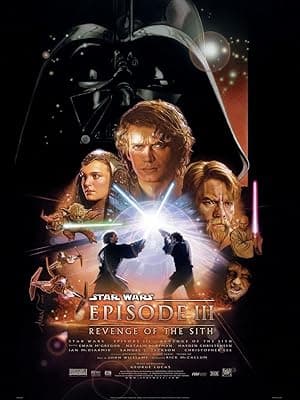
Star Wars: Episode III – Revenge of the Sith
The political coup, the love that unravels a man — and one heartbreaking fall everyone still argues about.
Feature presentation
There’s a particular kind of hurt in watching Anakin Skywalker choose the wrong promise of safety over the hard work of trust. George Lucas’s final prequel ties personal panic to public collapse: a private fear about Padmé becomes the engine that propels the galaxy into imperial shadow. That mixture — domestic desperation shoved into an epic political machine — is why Revenge of the Sith still gets people talking.
THE MOVIE
Anakin Skywalker is still the reason this movie works
Revenge of the Sith is the film where the prequel trilogy stops being about politics in the abstract and becomes, very plainly, about one man unravelling. It’s set during the fall of the Republic, and the story follows Anakin Skywalker as a mix of fear, ambition and grief pushes him toward the dark side.
At the film’s heart is a grim, domestic worry: Anakin’s secret marriage and recurring visions that Padmé will die. Those private terrors are not a subplot — they are the pressure valve the story uses to explain why a promising Jedi starts making catastrophic choices.
George Lucas directs the whole thing with an eye for scale: personal panic sits inside political decay, and that pairing — lover and state collapsing simultaneously — is what gives the movie its bitterly specific personality.
THE SETUP
The idea that sets Star Wars: Episode III – Revenge of the Sith in motion
The basic setup is tidy and powerful: it’s the end of the Clone Wars, and the Republic is already wobbling. Anakin is the hinge. The film follows his final descent toward the dark side while the institutions around him collapse.
What actually pushes Anakin — the plot engine you can point to — is painfully intimate: his secret marriage and visions that Padmé will die. Those visions make him desperate for control, and desperation is what makes him listen to the wrong promises.
On the political side, Palpatine is doing the work of a slow coup. He manipulates legal and military levers — including the mechanism known as Order 66 — to dismantle the Republic and to neutralise the Jedi as a political force.
All of this builds toward a set of direct confrontations that close the loop with the original trilogy: personal, ideological and physical clashes that explain how the galaxy moves from Republic to Empire.
THE CHARACTER
Why Anakin Skywalker matters
Hayden Christensen’s Anakin is the movie’s gravitational point. This isn’t just a villain origin story; it’s a portrait of what happens when fear and ambition collide in someone who has been told they are destined for greatness.
Anakin is driven by two blunt forces: fear of losing Padmé and a fierce ambition. Those anxieties make him brittle and open to argument — especially the kind of secret knowledge and power Palpatine dangles in front of him.
Obi‑Wan Kenobi exists in the story as agreed moral counterpoint and mentor — the man who’s supposed to steer Anakin away from catastrophe. Their relationship tightens into genuine conflict as ideology and emotion begin to push them apart.
Because the film follows Anakin through the closing days of the Clone Wars, his personal choices matter at a public scale: his fall is not merely tragic, it is causally bound into the Republic’s collapse.
THE PERFORMANCE
Why Hayden Christensen's performance matters
When the film first premiered, reviewers noticed Christensen’s portrayal and described it as uneven. That observation matters because the movie asks us to follow an emotional spiral — and when the performance sometimes flickers, the spiral can feel jagged.
Saying the performance is uneven isn’t the same as saying it’s useless. It’s a reminder that the film’s success rests on the audience accepting Anakin’s internal crisis; where that acceptance is partial, the narrative’s emotional blows land differently.
UNDER THE SURFACE
Star Wars: Episode III – Revenge of the Sith has more on its mind than the plot suggests
There are obvious plot mechanics at play, but the film repeatedly returns to a handful of ideas: political collapse and the seductive logic of authoritarianism; the fear of loss and possessive love that warps judgement; and how power promises easy answers to people in pain.
The seduction of power is presented bluntly. Palpatine’s offers are not abstract temptations — they are practical bargains that promise knowledge or control to someone convinced they can stop catastrophe by any means necessary.
Underneath that sits mentor/mentee conflict: Obi‑Wan and Anakin are not only teacher and student, they’re two different answers to the same problem. The film stages their disagreement as both ideological and painfully personal.
Identity and transformation are the final bend of the movie’s arch. The sequence of choices Anakin makes shifts him from hopeful Jedi to the figure the original trilogy opens on; it’s a transformation that the narrative treats as both psychological and consequential for the whole galaxy.
THE FILMMAKING
How Star Wars: Episode III – Revenge of the Sith was put together
Production design under Gavin Bocquet mixes on-set builds, studio sets and heavy post-production work. That combination gives the film a layered look: tangible pieces occupy the frame alongside environments finished later.
The movie’s credits read like a who’s-who of the technical team: cinematographer David Tattersall photographed the material, while editors Roger Barton and Ben Burtt shaped the pace. Those names are important because the film is repeatedly balancing spectacle with intimate scenes.
Lucas leaned on a big production apparatus to tell what is, at its core, a character-driven story. Knowing who handled which departments matters because this is the point where design, cutting and camera choices carry the narrative from intimate argument to epic fallout.
PRACTICAL EFFECTS
The effects work that gives Star Wars: Episode III – Revenge of the Sith its physical personality
The film doesn’t abandon practical work. Creature and crowd sequences mix costumed performers and animatronics with digital extras; that hybrid approach is especially visible in certain set-pieces where physical presence matters.
Some characters and set pieces began life as physical maquettes, puppetry or costumed performers and were then augmented or multiplied digitally. The result is a film that uses practical elements as a base, even while visual effects play a large final role.
PURE 00s
Star Wars: Episode III – Revenge of the Sith could not belong to any other decade
Revenge of the Sith sits squarely in the mid-2000s story of cinema moving to digital. Lucas was explicit in his advocacy for digital production and exhibition, and the movie’s pipeline reflects that industry shift.
It’s also a VFX-heavy tentpole in the ILM era: the film’s shot count and Industrial Light & Magic collaboration placed it among the technical blockbusters of the period and made its production methods a recurring topic in industry coverage.
John Williams recording with the London Symphony Orchestra and the traditional score release bookend the film’s high-tech production with a classical, franchise-rooted music approach — an old-school touch inside a very new-school production model.
Released in 2005 and produced by Lucasfilm, the movie feels like a bridge between eras: modern visual ambition married to franchise continuity.
WATCHING IT NOW
What has aged — and what hasn't
The emotional through-line that holds up is the idea of possessive love and fear of loss. The way Anakin’s panic about Padmé propels large decisions is still narratively persuasive: fear is a believable motivation for a catastrophic moral slide.
The film’s role as the connective tissue to the original trilogy remains practical and useful. Because it directly continues the prequel storyline, Episode III still functions as the canonical explanation for how the Republic becomes an Empire and how Anakin becomes the figure readers already know.
THE LEGACY
Why Star Wars: Episode III – Revenge of the Sith still matters
The film matters because it completes a story the franchise set itself: it narratively explains how Anakin becomes Darth Vader and how the Republic collapses into the Empire. For anyone curious about that transformation, Episode III is the answer.
It also won industry recognition — including an Academy Award nomination for makeup — which is a reminder that parts of the production were noticed by peers for their craft.
Beyond awards, Lucasfilm and StarWars.com have continued to revisit the film with retrospectives and behind-the-scenes material, which keeps it present in the conversation around the saga’s history.
THE VERDICT
Does Star Wars: Episode III – Revenge of the Sith still hold up?
Yes — but with a precise caveat. If you care about the story of a Republic turning into an Empire and want to see the literal answers to how Darth Vader came to be, this film remains the necessary chapter. It places Anakin’s private desperation — his secret marriage and visions of Padmé’s death — at the heart of a public catastrophe.
The political machinery is persuasive: Palpatine’s legal and military manipulation, including the mechanism known as Order 66, ties personal betrayal to institutional collapse in a way that still reads clearly today.
Where the film is uneven is on the margins that depend on small performance beats; contemporary critics noted Hayden Christensen’s portrayal as mixed, which means some emotional passages may not land the same way for every viewer. That unevenness changes the texture, not the architecture.
So should you watch it? Yes, if you want the emotional and narrative payoff of the prequels and a direct bridge into the original saga. Watch it as the story it was built to be: a picture of a man who, because he is terrified of loss and tempted by power, makes choices that remap a galaxy.
Share this movie
Keep watching
More movies from the 00s
2002
The Pianist
A quiet life unmade by war — and a pianist who refuses to stop listening.
Read the retrospective
→
2006
Blood Diamond
A mercenary, a fisherman and a pink diamond — and a film that still asks who pays for our jewellery.
Read the retrospective
→
2003
Kill Bill: Volume 1
A yellow jumpsuit, a long list of enemies and one woman who refuses to be finished.
Read the retrospective
→