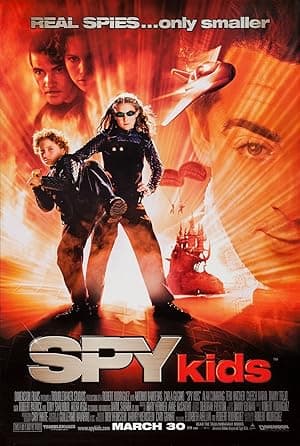
Spy Kids
A family of spies, a father who swapped guns for bedtime stories, and a film that still loves being unabashedly fun.
Feature presentation
Remember the moment the kids discover their parents were secret agents? That jolt—equal parts thrill and betrayal—is Spy Kids in miniature. Robert Rodriguez built a compact, fast-paced family adventure around a simple, irresistible idea: what if the grown-ups you trusted had been living a double life?
THE MOVIE
Gregorio Cortez is still the reason this movie works
There’s a neat trick at the heart of Spy Kids: it asks you to care about spy-gear and slime monsters because you already care about the people using them. The Cortez family’s secret—that Gregorio and Ingrid once lived dangerous spy lives and concealed them to protect their kids—turns the usual gadget-gloss into something with emotional weight.
Gregorio Cortez is the linchpin. A former OSS field agent who traded fieldwork for family life, he’s dragged back into the game and becomes determined to recover his family. That choice—fatherhood over thrills, and then striking back to reclaim both—is what gives the film its pulse.
Directed by Robert Rodriguez and clocking in at a lean 88 minutes, Spy Kids makes its case briskly: family loyalty, child empowerment and wide-eyed imagination wrapped up in a bright, kid-friendly spy adventure. It’s no accident people still bring it up—there’s warmth in the centre of the spectacle that keeps the spectacle from feeling empty.
THE SETUP
The idea that sets Spy Kids in motion
The film’s engine is straightforward: Gregorio and Ingrid Cortez are retired spies who’ve hidden their past from their children, and when the parents are called back to duty and subsequently disappear, the kids must step up. That neat moral exchange—parents kept the kids safe by lying, and now the kids have to return the favour—keeps the stakes human.
What follows isn’t a long, grown-up espionage puzzle. Instead, the Cortez children improvise spy skills and use child-friendly gadgets to outwit eccentrics and strange creatures. The tone favours clarity and momentum over knotty plotting, which is exactly the point for a family audience.
The mechanics of the story give it texture: there’s an internal spy organisation (the OSS), a children’s TV host whose show ties into the kidnappings, and a parade of fantastical elements—the Fooglies and other inventions—that let the film swing between domestic emotion and outright fantasy.
It’s designed to keep younger viewers onside while giving adults something affectionate to hold onto: family loyalty threaded through an action-adventure that never pauses for long.
THE CHARACTER
Why Gregorio Cortez matters
Gregorio isn’t just the parent you’d like to see at the centre of a kids’ adventure; he’s the moral fulcrum. The fact that he’s a former OSS field agent who swapped fieldwork for family life gives every madcap set-piece an emotional counterweight.
When he’s pulled back into service his motivation is instantly readable: this isn’t a quest for glory, it’s a man insisting on his family. That makes his choices feel familiar, even when the movie leans into the absurd.
Because Spy Kids is a family film, those stakes are the point. The plot may be populated by Fooglies and quirky villains, but the reason the audience keeps turning pages is Gregorio’s refusal to let his family be collateral—he’s the film’s steady, human axis.
And casting Antonio Banderas in that role roots the character in a recognisable centre, so the fantasy around him never quite tips into nonsense.
THE PERFORMANCE
Why Tony Shalhoub's performance matters
One piece of commentary that keeps cropping up in retrospectives is Tony Shalhoub’s turn as Alexander Minion. Critics and viewers have pointed to his comic work as a highlight.
There’s a specific reason for that: his straight-faced delivery plays the surreal elements off the floor. When the world around him leans strange, Minion’s manner acts as a grounding groove—funny because the character treats lunacy as ordinary.
In a film that mixes talking monsters and bizarre gadgets, that kind of delivery matters. It gives the film somewhere sensible to bounce off, which lets the whimsy feel intentional rather than flailing.
So even amid cartoonish business, Shalhoub’s Minion provides a consistent comic pitch that helps the movie hold together.
UNDER THE SURFACE
Spy Kids has more on its mind than the plot suggests
It’s tempting to file Spy Kids next to other family entertainments and forget it has a few clear ideas of its own. First off: family. The story hinges on parents and children and the mutual obligations between them.
Closely tied is child empowerment. This is a film where kids are expected to solve problems, use gadgets and protect their family. It treats youthful resourcefulness as more than a gag; it’s a trait the plot relies on.
Then there’s imagination: espionage conventions are filtered through the logic of childhood—TV hosts, toy-like inventions, strange creatures—so the spy genre becomes a playground rather than a strict thriller template.
Finally, there’s representation. A Latino family sits at the heroic centre of a mainstream family action film, which matters for visibility in a genre that didn’t often foreground such families at the time.
THE FILMMAKING
How Spy Kids was put together
There’s a do-it-yourself energy behind the polish. Cinematography credit goes to Guillermo Navarro and the picture was produced through Robert Rodriguez’s Troublemaker Studios—a compact operation that lets Rodriguez dial the film’s personality precisely.
Rodriguez also brought a playful visual logic to the production design, adapting whimsical drawings and childhood ideas—such as the Thumb Thumbs—into tangible movie elements. That translation from doodle to set-piece gives the film a homemade charm.
The result is a movie that wears its imagination on its sleeve: not every idea lands, but the ones that do feel like the product of a filmmaker making the family-movie template his own.
Keeping things tight—an 88-minute runtime—helps the film sustain its pace and avoid flabby stretches, which suits its intended young audience.
PRACTICAL EFFECTS
The effects work that gives Spy Kids its physical personality
Part of the film’s tactile charm comes from its willingness to mix techniques. Some creature and character effects were achieved with practical pieces—Rodriguez and his crew used gel-molded prosthetic pieces for certain mutated-head effects, noted in production accounts as lightweight.
Those on-set elements sit alongside computer-assisted visual effects for the film’s more fantastic creations, like the Fooglies and the Thumb-Thumbs. The blend keeps the movie feeling physical even when it goes full fantasy.
The practical pieces aren’t subtle, but they give the oddball creatures a sense of presence on set. In a family film, that kind of physicality helps the actors and the audience react to something that feels tangible.
So the effects strategy is pragmatic: use prosthetics where a real, touchable object sells the gag, and use digital help where scale or movement demands it.
PURE 00s
Spy Kids could not belong to any other decade
Arriving in 2001, Spy Kids landed at a moment when studios were keen to expand into bright, franchise-ready children’s fare. Dimension Films/Miramax were clearly aiming for that family market, and Spy Kids fit the brief neatly.
At the same time, it’s very much a filmmaker’s picture: Rodriguez produced and shot the film through his own Troublemaker Studios in Austin, part of a broader early-2000s movement where directors used in-house tools and regional production centres instead of standard Hollywood pipelines.
That independent-minded approach gave the film some freedom to be idiosyncratic—quick sequels followed in 2002 and 2003, which is typical of the era’s appetite for fast-building franchises.
So while the movie indulges in broad family-friendly spectacle, its production story anchors it in the industry shifts of the early 00s: franchise potential, director-driven control and regional shoots outside the L.A. studio system.
WATCHING IT NOW
What has aged — and what hasn't
As a family film released with a PG rating, Spy Kids was built to be accessible, and that quality helps it now. Its tone is clear about who it’s for: younger viewers and the adults who watch with them.
The familial concerns—the parents who hide their past, the children who rise to responsibility—are simple and durable. Those emotional beats don’t rely on trendiness, which gives the film a measure of timelessness.
Some of the spectacle and comedy are rooted in the early 2000s’ toy-and-gadget sensibility, but because the central drive remains family loyalty and kids’ agency, the movie still functions as a family entertainment.
Put simply: the film’s genre and its focus on family are the parts that age best.
THE LEGACY
Why Spy Kids still matters
The clearest legacy is literal: Spy Kids launched a multi-film franchise, with sequels and related entries that kept returning to Carmen and Juni’s missions. That continuity kept the brand alive for a new generation.
Beyond the franchise, the film’s selection for the Library of Congress National Film Registry in 2024 is formal recognition that it holds cultural, historical or aesthetic significance. That’s not hyperbole; it registers the movie as part of a national cinematic conversation.
Put together, the sequel string and the Registry nod explain why Spy Kids keeps cropping up in discussions: it’s both a launchpad and a preserved piece of family-movie history.
And at its centre sits a family story that made a crowd-pleasing, franchise-friendly movie feel homegrown enough to matter beyond its toys and gags.
THE VERDICT
Does Spy Kids still hold up?
Yes—if you’re seeking the precise thing it set out to be. Spy Kids is a brisk, 88-minute family spy-adventure that hinges on a clear premise: retired spies Gregorio and Ingrid hide their pasts, they’re called back to duty and captured, and their children step up to rescue them.
That central conflict—kids using improvised spy skills and kid-geared gadgets to free their parents while navigating an eccentric world—is still entertaining. The film balances familial stakes with action and accessible humour; it doesn’t pretend to be anything more than a lively family picture.
Robert Rodriguez’s direction, the cast’s lineup and the film’s mix of practical and digital creature work give it a distinct personality, and moments like Tony Shalhoub’s comic turn help the surreal bits land. For families, or anyone who enjoys a compact, imaginative adventure, it’s worth a watch.
Bottom line: Spy Kids holds up as what it always claimed to be—a family-centred adventure where the emotional engine is simple and true. And because it remembers that the point of gadgets is to protect people, Gregorio’s choice to fight for his family remains the clearest reason to revisit it.
Share this movie
Keep watching
More movies from the 00s

2002
The Pianist
A quiet life unmade by war — and a pianist who refuses to stop listening.
Read the retrospective
→
2006
Blood Diamond
A mercenary, a fisherman and a pink diamond — and a film that still asks who pays for our jewellery.
Read the retrospective
→
2003
Kill Bill: Volume 1
A yellow jumpsuit, a long list of enemies and one woman who refuses to be finished.
Read the retrospective
→