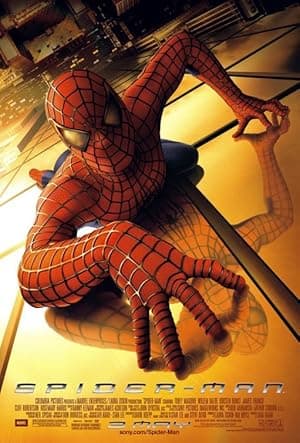
Spider-Man
A coming-of-age wrapped in a web of guilt, heroics and a very pointy helmet.
Feature presentation
Remember Spider-Man not as a blockbuster franchise starter, but as Peter Parker’s film — a shy schoolkid who gets absurd powers and then spends a long time figuring out what to do with them. Sam Raimi’s 2002 take pairs that intimate, embarrassed teenager with big, noisy set pieces, and the contrast is what makes the film worth revisiting.
THE MOVIE
Peter Parker / Spider-Man is still the reason this movie works
The hook is straightforward: a shy high-school student gets bitten by a genetically altered laboratory spider and suddenly finds himself with strength, agility and the annoying ability to stick to things. That change is the film’s engine — not just because it makes cool set pieces possible, but because it forces Peter into choices he was never trained for.
Peter doesn’t immediately don a cape and pose on rooftops. He adopts a mask, starts selling photographs of himself to the Daily Bugle and spends time learning the practicalities of being Spider-Man. The new life is clumsy as well as heroic; the costume is as much a social problem as a solution.
What keeps the movie grounded is motive. Peter’s actions are driven by guilt and a growing sense of responsibility traced back to his relationship with Uncle Ben — the small, human reasons that keep the spectacle honest. It’s Sam Raimi’s film, but it’s Peter’s problem, and Tobey Maguire is the face of that knot.
THE SETUP
The idea that sets Spider-Man in motion
At its simplest the film is an origin story: bite, discovery, decision. Peter learns how to use his powers while juggling school, family and an awkward social life — and that private arc gradually spills into public danger.
The external threat comes from Oscorp’s Norman Osborn. After taking an experimental performance-enhancing formula, Osborn’s personality fractures and he becomes the Green Goblin, a corporate antagonist who turns the movie’s intimacy into escalating spectacle.
Raimi structures the film so the early, personal drama — Peter’s home, his relationship with Aunt May and Uncle Ben — sits beside larger set pieces. The transition from small moments to Goblin attacks gives the story emotional stakes as well as action.
That shape is why the setup works: the film never forgets that the origin story is about a boy learning responsibility, even when the consequences are a citywide threat.
THE CHARACTER
Why Peter Parker / Spider-Man matters
Peter is not written as a larger-than-life poster boy. The film keeps him small: a kid whose superpowers complicate rather than solve his problems. That sense of everyday friction — schoolwork, family, the awkwardness around people he likes — makes his choices feel real.
Guilt is the engine. Peter’s developing sense of responsibility, which links back to Uncle Ben and the consequences of inaction, is what pushes him into the costume and keeps him there when it’s easier to walk away.
Raimi surrounds him with recognisably ordinary figures — J. Jonah Jameson, Aunt May, Ben Parker — precisely so the superhero life will keep tugging against normality. Those smaller characters anchor Peter in a world that gets disrupted by Spider-Man, rather than the other way round.
There is also the seed of franchise drama: Harry Osborn exists as Peter’s friend and as the son in a fraught father–son relationship with Norman Osborn, introducing a family theme that will echo through the trilogy.
THE PERFORMANCE
Why Tobey Maguire's performance matters
Contemporary reception singled out Tobey Maguire’s take on Peter Parker. Criticism at the time frequently noted the way the character’s awkwardness and introspection are foregrounded rather than smoothed away.
That emphasis matters because the film asks us to follow a character who is unlike the swaggering heroes audiences might expect. Maguire’s portrayal keeps the centre of the film vulnerable and hesitant, which is precisely the film’s point.
The choice gives the origin story emotional ballast: Peter isn’t a confident kid suddenly given an advantage — he’s a reluctant one, and the audience is invited to watch him figure out what responsibility feels like.
In short, the performance helps seal the movie’s tonal promise: this is a comic-book blockbuster that still cares about the human being inside the suit.
UNDER THE SURFACE
Spider-Man has more on its mind than the plot suggests
Power and responsibility are not a slogan in this film; they’re the operating problem. Peter’s guilt and loss — the private reasons he chooses to act — tie the superhero business back to ordinary human consequences.
Dual identity is another constant. The cost of secrecy shows up in Peter’s private relationships, and the film keeps returning to the practical awkwardness of being two people at once: a teenager and a city’s guardian.
It’s also an unmistakable coming-of-age story. The transition from adolescence into public responsibility is staged through set pieces that force Peter to choose between what he wants and what he must do.
There’s a familial strand, too: father–son legacy is threaded through Norman and Harry Osborn’s situation, offering a dark mirror for Peter’s own version of inherited obligation.
THE FILMMAKING
How Spider-Man was put together
One detail that shapes the film’s feel is its production approach: the movie mixes constructed sets and built pieces with on-location shoots to represent New York interiors. That blend keeps scenes feeling tactile even when they lead into larger-than-life moments.
Those grounded interiors help the story sell the contrast between Peter’s domestic life and the wider city drama. When your downstairs kitchen looks lived-in, the hero-in-a-mask moments read as interruptions rather than a uniform spectacle.
Sam Raimi’s direction ties these pieces together, moving the story from private spaces to public spectacle without losing the human thread that runs through it.
The result is a film that can be intimate one moment and set-piece-driven the next, simply because the production design remembers what the characters need.
PRACTICAL EFFECTS
The effects work that gives Spider-Man its physical personality
The movie creates its swinging and fight sequences using a combination of acrobatic stand-ins/performers and computer-generated imagery. That hybrid approach keeps movement readable while allowing for feats the human body can’t safely perform.
The visual-effects work was recognised at the awards level: the film’s VFX team received an Academy Award nomination for Best Visual Effects, which underlines how central that craft was to the movie’s success.
In practice, the mixed technique keeps the action from feeling entirely divorced from the physical world of the characters. The stunts still read as movement the audience can follow, even when the camera takes liberties.
Ultimately the effects serve the story’s two halves: enough practicality to feel lived-in, enough digital work to sell the impossible.
PURE 00s
Spider-Man could not belong to any other decade
Released in 2002, Spider-Man arrived as studios were beginning to treat comic-book adaptations as major commercial events rather than niche projects. For Columbia and Marvel, it was a headline moment in that early expansion.
The timing matters because the film balances earnest character drama with the new appetite for spectacle — it’s both a personal story about a teenager and a big-studio action picture in the same breath.
That balance is why the movie helped set a template: a franchise-friendly origin story that left room for sequels and broader world-building.
Raimi’s film lives in the early 00s precisely because it expects both intimacy and box-office scale to coexist.
THE LEGACY
Why Spider-Man still matters
Spider-Man launched Raimi’s trilogy and kept those central relationships — Peter, Norman, Mary Jane, Harry — at its narrative heart, so its legacy is partly about the storylines that followed.
The film earned major awards recognition, including Academy Award nominations in Best Visual Effects and Best Sound, which highlights the production values that made the spectacle convincing at the time.
Crucially, it was a commercial milestone: the film’s success helped studios feel confident about large-scale comic-book adaptations and franchise sequels during the 2000s.
So the movie matters both for what it contains — a tightly focused origin and character set-up — and for what it made possible in the industry.
THE VERDICT
Does Spider-Man still hold up?
Yes — and the reason is simple: the film is built around a recognisably human problem. Peter Parker’s bite and new life as Spider-Man are spectacle, but the movie repeatedly forces him into moral-choice set pieces that test whether he can balance school, unrequited love and the responsibility of protecting a city.
Those choices are the movie’s spine. The origin-story shape — from personal family drama into public spectacle — gives the action stakes that matter because they’re personal. Norman Osborn/Green Goblin functions as both a corporate antagonist and a fractured mirror to Peter, which keeps the conflict emotional as well as physical.
Technically and industrially the film held up for its moment: it was made in 2002, directed by Sam Raimi, and its visual-effects work received awards recognition. Contemporary reviews commonly praised Tobey Maguire’s depiction of Peter, and the movie’s commercial success showed it landed with audiences.
If you’re wondering whether to rewatch it, think of it this way: Spider-Man still works because it remembers that being a hero is mostly a decision, not a costume. The spectacle is there, but the story keeps bringing you back to a boy learning what responsibility feels like.
Share this movie
Keep watching
More movies from the 00s

2002
The Pianist
A quiet life unmade by war — and a pianist who refuses to stop listening.
Read the retrospective
→
2006
Blood Diamond
A mercenary, a fisherman and a pink diamond — and a film that still asks who pays for our jewellery.
Read the retrospective
→
2003
Kill Bill: Volume 1
A yellow jumpsuit, a long list of enemies and one woman who refuses to be finished.
Read the retrospective
→