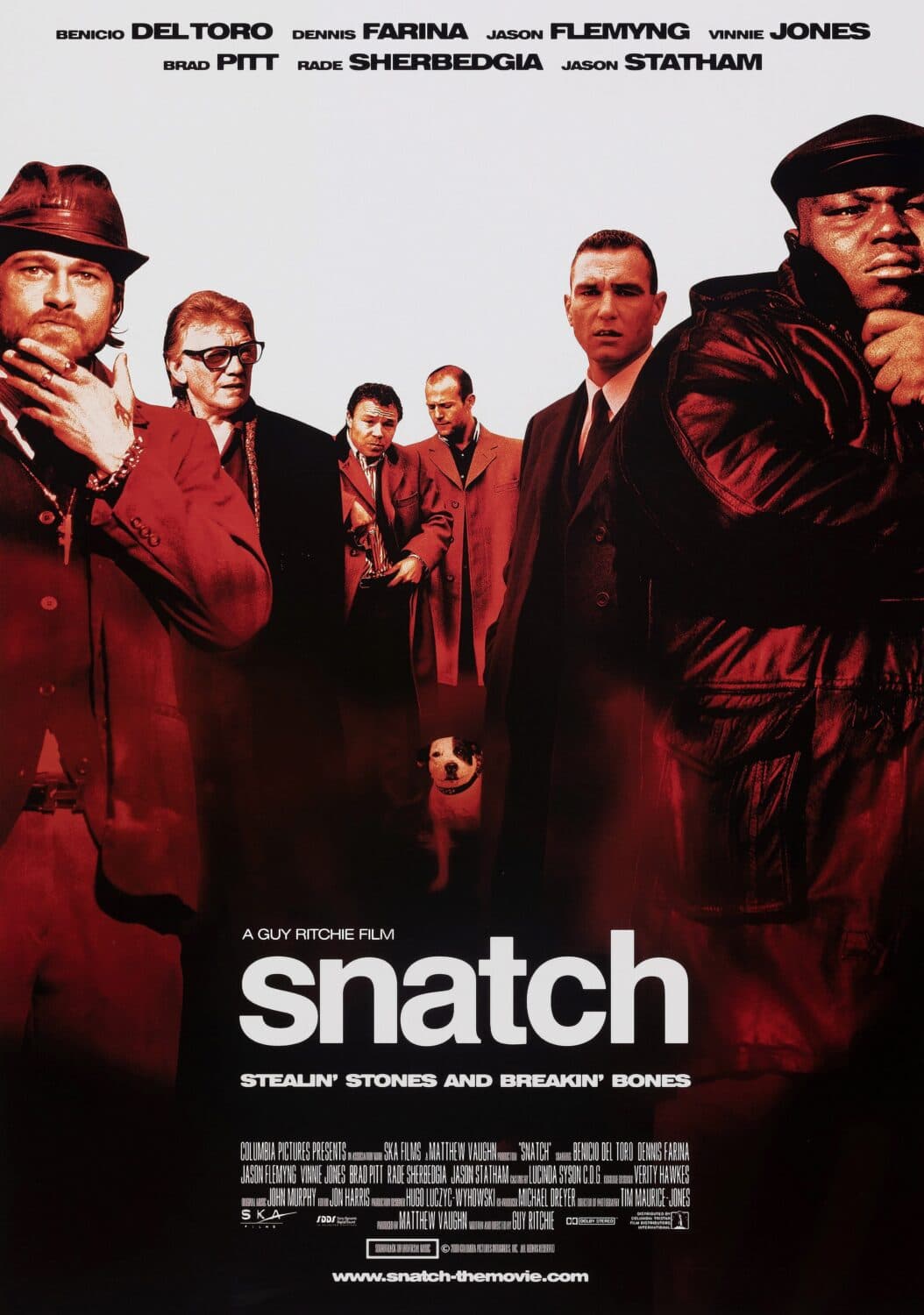
Snatch
A cut‑fast, laugh‑meaning crime caper where a lost diamond, a bare‑knuckle boxer and a bloke called Turkish keep everything moving.
Feature presentation
Snatch never pretends to be anything other than a fast, knuckle‑headed bit of fun — a movie built from two messy ideas: a nicked diamond and two promoters trying not to get their heads caved in. Guy Ritchie stitches those threads together with breakneck edits, an ensemble of memorable characters and a knack for letting chance do the heavy lifting.
THE MOVIE
Turkish is still the reason this movie works
People still talk about Snatch because it pairs two properly entertaining ideas and refuses to apologise for either of them: a professional thief on the run with a huge diamond, and two small‑time boxing promoters trying not to get eaten by a local gangster. Those strands run side‑by‑side, crash into one another and keep the film’s wheels spinning.
What holds that chaos together is a tonal stitch — humour and violence elbow each other out of the way, and Guy Ritchie’s cuts and music keep everything moving at a pop‑py tempo. It’s a hyper‑stylised underworld where a single misplaced action can pass the stone from one criminal’s hands to another’s — sometimes via a dog — and the film delights in watching the consequences pile up.
At the middle of the racket is Turkish. Jason Statham’s character is our steady thread through the noise: part everyman, part navigator, and the viewpoint that makes the film readable even when its plot is gleefully messy.
THE SETUP
The idea that sets Snatch in motion
Snatch runs two headline acts at once: Franky Four Fingers steals a large diamond and has to get it to his contact, while Turkish and Tommy — small‑time promoters — are scrambling to keep their boxing business afloat after a fixed fight blows up. The film’s pleasure comes less from neat plotting and more from how these threads repeatedly entangle.
A lot of the movie’s forward motion comes from luck and stupidity. Objects and decisions move between people in ways that feel accidental rather than tidy, and the diamond’s travel is a running joke and a plot engine: it changes hands, turns up where it shouldn’t and sometimes takes a very unexpected detour thanks to an opportunistic dog.
That setup works because it keeps stakes immediate and simple: the promoters want to survive; the thief wants to get paid; everyone else wants a cut. The chaos between those aims is the movie’s main sport.
THE CHARACTER
Why Turkish matters
Turkish isn’t the slickest player in the film. He’s practical, a promoter whose job is to keep the fights on and the money in — which, in Snatch’s world, is a hazardous profession. That plainness is the point: while other characters swagger or threaten, Turkish is the one trying to read the mess and make it pay.
His motivation is straightforward and believable: protect the business and avoid Brick Top’s brutal consequences. That pressure gives him a sensible urgency, and it’s what makes the film easier to follow when the plot goes deliberately off its rails.
Because the story hops between crews and capers, having a central figure who’s trying to hold the account books together makes the comedy and danger land. Turkish is the map you consult when the movie’s compass keeps flipping.
THE PERFORMANCE
Why Brad Pitt's performance matters
Brad Pitt’s turn as Mickey O'Neil — the travelling bare‑knuckle fighter who can change a fight with one punch — became one of the film’s most talked about elements right away. Contemporary critics on both sides of the Atlantic singled out the Traveller material and his role as a thing audiences noticed.
That attention matters because Mickey’s presence shifts the balance of the promoters’ problem: he’s unpredictable, he complicates plans and he gives the film the kind of off‑kilter energy that keeps a caper from becoming a simple checklist of heist beats.
So even if the movie is a noisy ensemble, the chatter around Pitt’s part helped make Mickey feel like more than just another plot device — he’s the unpredictable fulcrum the promoters keep dropping and picking up.
UNDER THE SURFACE
Snatch has more on its mind than the plot suggests
On the surface Snatch is a caper and a string of gags; underneath it’s a movie fascinated by how tiny choices ripple out. Chance and causality aren’t tacked on — they’re the mechanics. A misplaced throwaway, a dog with bad timing, a decision to take one route instead of another: these are the things the film uses to move the diamond and the story.
There’s also a deliberate tone in which humour and violence sit cheek by jowl. The comedy isn’t there to soften the brutality so much as to make it feel like part of the same industry: masculinity is performed by threats, fights and bravado, and the film often treats that performance as both ridiculous and dangerous.
Finally, the Traveller angle — threaded through Mickey and the scenes around him — gives the film a subcultural texture. It adds a different set of rules and loyalties, which both disrupt the criminal world’s expectations and underline how characters belong to distinct, clashing communities.
THE FILMMAKING
How Snatch was put together
Snatch’s feel is largely editorial. The film rides on quick, music‑punctuated cuts, jump‑frames and rhythmic edits that prefer momentum to invisible continuity. Those choices give the film a breathless comic timing and make even short scenes feel like miniature set pieces.
Music plays more than a supporting role here. The mix of score and pop/rock tracks is used as fuel for the editing — a beat‑led approach that keeps transitions sharp and scenes punchy.
Contemporary reviewers noticed this immediately: the cut‑heavy, music‑driven sequences were a defining part of the film’s identity, and they remain the mechanism that delivers both jokes and jolts.
PURE 00s
Snatch could not belong to any other decade
Snatch sits squarely in that late‑1990s/early‑2000s British crime‑caper moment: fast edits, pop music driving the rhythm and an ensemble cast juggling crooked schemes. It’s a continuation of the tone Guy Ritchie had been trimming since his earlier film, and it leans into that same mix of swagger and formal play.
Being released in 2000 places it at the hinge of two eras: it keeps the rough‑and‑ready indie energy of the late 1990s while also nudging toward broader international visibility. The premiere and staggered openings that followed show how the film was positioned for both local and overseas audiences.
In short, Snatch feels very of its moment because it amplifies a particular mode of British caper filmmaking that dominated the turn of the century.
WATCHING IT NOW
What has aged — and what hasn't
The film’s continued visibility — from retrospectives to modern home releases — shows that people still come back to it. That ongoing interest isn’t accidental: Snatch’s energy is immediate, and its central pleasures are plot momentum and pure entertainment, which translate easily to later viewings.
The diamond’s peregrinations — and the comic absurdity of one detour involving a dog — remain a neat trick. The sequence of mishaps that moves the stone between hands still functions as a playful machine, and it’s the kind of plotted accident that rewards repeat watches.
That said, Snatch is very deliberately stylised. If you’re not inclined toward loud editing or gleeful mixing of humour and menace, those same choices might feel showy rather than inventive. But for the audiences who respond to that aesthetic, the film’s core mechanisms still land.
THE LEGACY
Why Snatch still matters
Snatch has remained commercially present enough to inspire a later television adaptation: a Sony Crackle series in 2017 that used the film as its source while following new characters. That move from screen to serial suggests the story world had legs beyond the film’s immediate moment.
The title’s reissue in modern home‑video formats, including a 4K Ultra HD edition, is another sign that distributors see continuing audience demand. Between TV and high‑definition catalog releases, the film’s afterlife has been practical as well as nostalgic.
THE VERDICT
Does Snatch still hold up?
Yes — if you enjoy films that privilege momentum, swagger and a bit of controlled chaos. Snatch’s two main strands — the diamond heist and the promoters’ scramble — are simple enough to follow, but they’re arranged so that small incidents ripple across the whole story. That mechanism, and the film’s willingness to let chance and misdirection drive the plot (dog included), keeps it lively.
Jason Statham’s Turkish gives the movie a readable centre: a promoter trying to keep the lights on while threats close in. Brick Top’s pressure and the promoters’ debts mean the stakes feel immediate, which helps the film balance its comic flourishes with genuine danger. The chatter around Brad Pitt’s Mickey also matters — his role is one of the elements contemporary critics flagged as central to how audiences experienced the film.
If you find fast, heavily edited, music‑driven filmmaking entertaining, Snatch remains an enjoyable blast. If that style isn’t your thing, the film will probably feel loud and mannered. Either way, it’s still worth a watch for the sheer kinetic pleasure of its plotting and for seeing how a handful of strong character ideas — Turkish, Mickey and the walking disaster that is the diamond — keep the whole thing entertaining.
Share this movie
Keep watching
More movies from the 00s
2002
The Pianist
A quiet life unmade by war — and a pianist who refuses to stop listening.
Read the retrospective
→
2006
Blood Diamond
A mercenary, a fisherman and a pink diamond — and a film that still asks who pays for our jewellery.
Read the retrospective
→
2003
Kill Bill: Volume 1
A yellow jumpsuit, a long list of enemies and one woman who refuses to be finished.
Read the retrospective
→