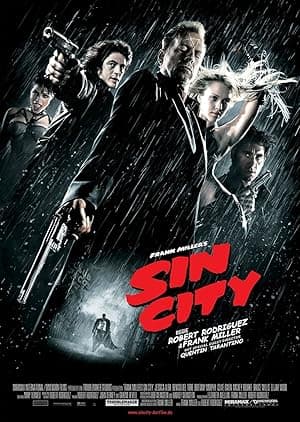
Feature presentation
Sin City arrives like a comic book you can sit inside: three brutal yarns and a prologue stitched together into a single, breathless two‑hour ride. It’s a film that wears its source material on its sleeve—panel‑for‑panel ambition, stylised direction and a lead who will bite through the scenery if you give him half a chance.
THE MOVIE
Marv is still the reason this movie works
Sin City doesn’t feel like one long film so much as several hits of hard noir stitched together. It opens with a short prologue, then intercuts three main yarns — 'That Yellow Bastard', 'The Hard Goodbye' and 'The Big Fat Kill' — so the city itself becomes the connective tissue.
Those segments give us different leads: an ageing, principled cop, a hulking avenger and a private investigator. Their stories overlap; they move through the same streets, run into the same faces and trade favors in a place where ordinary justice has clearly checked out.
And at the heart of the whole thing is Marv. Mickey Rourke’s bruiser is both the engine and the thermometer: you can tell what the film thinks of Basin City by the lengths Marv will go to for loyalty and revenge. That single focus — revenge as a response to a rotten system — is precisely what keeps Sin City sharp rather than merely stylish.
THE SETUP
The idea that sets Sin City in motion
Sin City’s structure is almost old‑school pulp: short, jagged bursts of narrative that loop back into each other. The film cuts between an ageing cop, a revenge‑driven bruiser and a private eye, rather than laying out one long, linear plot.
It leans on classic noir tricks — first‑person voiceover, terse moral certainties and a string of pulp‑motivated revenge plots — so each segment feels like its own crime story while still belonging to the same ecosystem.
Those overlapping timelines and character crossovers matter. Short vignettes feed into longer arcs and characters reappear in new contexts, which gives the movie the texture of a lived‑in but corrupt place rather than three isolated set pieces.
Crucially, the film keeps a few central promises from the comics: Hartigan’s attempt to protect a young Nancy; Marv’s single‑minded hunt after Goldie’s killer; and Dwight’s getting pulled into the Old Town versus police turf conflict. Each thread is focused and explicit about what’s at stake.
THE CHARACTER
Why Marv matters
Marv is the kind of character who makes you realise the movie isn’t interested in rehabilitation or subtlety. He’s physically imposing and morally single‑minded: loyalty and revenge are his currency, and he spends them without hesitation.
That simplicity is actually a strength. In a city where institutions fail, Marv’s arc — driven by personal loyalty after Goldie’s murder — operates like a moral ledger. He wants a balance put back in place, even if his methods are brutal.
The film’s visual processing helps here. The predominantly black‑and‑white image, with splashes of colour on specific objects and people, turns Marv into something that reads straight off the page: a chunk of pulp rendered in high contrast.
And the look isn’t only digital. Prosthetics and make‑up were used to get Marv’s grotesque, comic‑accurate feel across. That mixture of cartoon fidelity and physical detail keeps him lodged in your memory.
THE PERFORMANCE
Why Mickey Rourke's performance matters
Contemporary reviews paid special attention to Mickey Rourke’s turn as Marv. Critics singled out the portrayal as a centrepiece of the film’s ensemble.
Part of what reviewers noted was the physical transformation: heavy facial prosthetics were used to approximate the comic’s look, so what you see on screen is an attempt to map inked features onto a living face.
That prosthetic work is a practical commitment to the source — the film didn’t ape the comics lazily, it reworked them into bodies and faces.
Whether you respond to it or not, Rourke’s Marv is a major organising figure for the film: the character’s presence shapes tone, pace and the kinds of choices the movie asks its audience to accept.
UNDER THE SURFACE
Sin City has more on its mind than the plot suggests
On the surface it’s pulp: wrongs, fists, bullets, and tidy revenge arcs. Underneath, the film repeatedly stages the same idea — vigilantism as a response to rotten institutions — and asks whether personal justice is the only justice left in Basin City.
The system is shown as compromised. Police, political power and other civic institutions are crooked or impotent, which forces characters into moral corners where the usual rulebook doesn’t apply.
That produces moral ambiguity. The people who fight back aren’t saints. They’re pragmatists and avengers who make terrible choices for reasons the film treats as understandable, if not excusable.
Finally, the movie wears its fidelity to Frank Miller’s visuals as a statement: it insists that the form of these stories — the high‑contrast frames, the selective colour — matters as much as the tales of revenge themselves.
THE FILMMAKING
How Sin City was put together
The film looks the way it does because it was photographed on high‑definition digital cameras and then processed into a largely black‑and‑white image with deliberate colour highlights. That choice turns light and shadow into storytelling tools.
Rodriguez staged much of the shoot on green‑screen stages in Austin and built stylised digital backgrounds in post. The result is a world that feels deliberately unreal — like panels brought to life rather than a literal city.
Those production choices matter because they let the movie chase a comic‑book fidelity that ordinary location shooting would struggle to deliver.
Put simply: Sin City’s distinctive identity comes as much from how it was shot and assembled as from what happens in any single scene.
PRACTICAL EFFECTS
The effects work that gives Sin City its physical personality
Even with a digital backbone, the picture relied on physical make‑up to sell its characters. Mickey Rourke’s appearance used significant facial prosthetics to match the comic‑book design.
Special make‑up and prosthetic effects were also used for grotesque character transformations — the Yellow Bastard among them — so some of the film’s most shocking moments are anchored in practical work.
That blend of digital sets and hands‑on prosthetics gives the film a hybrid feel: cartoonish and tactile at the same time.
Because those physical elements were used to approximate Miller’s exaggerated designs, they help the movie reach for the comic’s mood rather than merely imitating it.
PURE 00s
Sin City could not belong to any other decade
Released in 2005, Sin City sits squarely in the mid‑00s moment when Hollywood was figuring out how to translate comics to film en masse. But it chose a different road: fidelity over spectacle, a panel‑for‑panel attitude rather than conventional blockbuster camouflage.
It also exemplifies early experiments with digital cinematography and virtual sets. The green‑screen stages and HD cameras were as much a practical response to the decade’s new tools as they were an aesthetic decision.
Festival coverage at the time picked up on that; the film’s visual approach was a talking point and it even earned technical recognition at Cannes, which shows how its look was central to its appeal.
In short, Sin City feels of its moment because it both embraced and interrogated the 00s’ new filmmaking possibilities: it wanted comics to look like comics, even if that required rejigging how films were made.
WATCHING IT NOW
What has aged — and what hasn't
The film’s high‑contrast, almost comic‑book processing still reads clearly. That black‑and‑white framework with selective splashes of colour keeps the images bold and immediate even when fashions or camera toys change.
Likewise, the make‑up and prosthetic work that transform characters into grotesques still feel tactile. When the Yellow Bastard appears, the effect is physical, not just a CGI trick — that hands‑on quality helps the shock hold up.
Where some viewers might falter is with the movie’s moral arithmetic: its celebration of violent, private justice and the gleeful cruelty of some sequences can feel of its time and may jar modern tastes.
But if you come for the formal daring and the pulpy stories, the core ingredients still do what they set out to do: they look distinct, they read as comic pages translated to film, and they keep the city’s brutality blunt.
THE LEGACY
Why Sin City still matters
Part of Sin City’s afterlife comes from how visibly it tried to do something different. The film premiered at the end of March 2005 and its striking visuals earned it festival recognition; it was the sort of movie you talked about for its look as much as its stories.
It also left a clear mark on conversations about faithful comic‑book adaptations. Rather than HQ spectacle, the film foregrounded a cartoonist’s visual signature and asked filmmakers to consider fidelity as a creative choice.
That emphasis on visual faithfulness — the black‑and‑white photography, the prosthetic translations of Miller’s designs, the panel‑for‑panel instincts — is why the film still turns up in discussions about how to adapt comics honestly.
Finally, the fact it later returned for a sequel proves there was more story to mine in Basin City, even if opinions differ on whether the world needed expanding.
THE VERDICT
Does Sin City still hold up?
Yes — if your yardstick is formal daring and unashamed comic‑book translation. The film intercuts its three main yarns and keeps the noir machinery — voiceover, intersecting timelines and pulp revenge plots — moving at a steady clip, so the anthology format feels deliberate rather than scattershot.
It preserves the central beats readers expect: Hartigan protecting Nancy, Marv’s revenge after Goldie’s death, Dwight’s pull into Old Town’s turf wars. Those promises are kept, which makes the film satisfying to anyone wanting the comics rendered faithfully.
Mickey Rourke’s Marv remains the film’s lodestone. Contemporary attention to his portrayal — and to the heavy prosthetics used to approximate the comic look — shows the production treated character design as integral, not incidental.
So should you watch it today? If you want a film that looks like a comic and is willing to let its characters take justice into their own hands, Sin City still delivers. It’s not everyone’s cup of tea — it’s loud, violent and morally prickly — but as an experiment in translating a cartoonist’s world to the screen, it still hits its mark.
Share this movie
Keep watching
More movies from the 00s

2002
The Pianist
A quiet life unmade by war — and a pianist who refuses to stop listening.
Read the retrospective
→
2006
Blood Diamond
A mercenary, a fisherman and a pink diamond — and a film that still asks who pays for our jewellery.
Read the retrospective
→
2003
Kill Bill: Volume 1
A yellow jumpsuit, a long list of enemies and one woman who refuses to be finished.
Read the retrospective
→