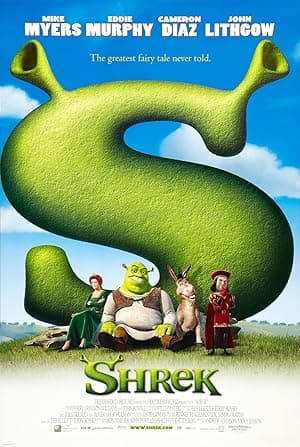
Shrek
An ogre, a donkey and a fairy-tale that decided to be properly rude about happily-ever-after.
Feature presentation
Shrek still arrives like a proper surprise: a grumpy ogre at the heart of a punchy, pop-culture-savvy fairy tale. It pairs a road-quest and a rom-com with a relentless appetite for parody, and somehow keeps the emotional bits honest beneath the jokes. That mix—outsider anger, found-family warmth and a stubborn refusal to take fairy tales at face value—is why people keep going back to it.
THE MOVIE
Shrek (also voices a Blind Mouse) is still the reason this movie works
Right from the storybook opener, Shrek announces itself as the sort of animated film that’s going to both tell a fairy tale and pinch its nose at one. An ogre who likes his privacy suddenly finds his swamp full of exiled fairy-tale characters, and that rude imbalance is the little shove the movie needs to get moving.
What follows is straightforward on the surface — go to Duloc, deal with the ruler who kicked everyone out, rescue a princess — but the film keeps turning the expected beats inside out. It’s the combination of parody and genuine feeling that gives Shrek its personality: the jokes land because the stakes underneath them are real enough to care about.
And at the centre of it all is Shrek himself, voiced by Mike Myers. He gives the film a solid anchor: brusque, stubborn, defensive about his solitude and, crucially, gradually persuaded that maybe solitude isn’t everything. Directors Andrew Adamson and Vicky Jenson shape those choices into a compact ninety-minute comedy-adventure that still moves in surprising directions.
THE SETUP
The idea that sets Shrek in motion
The film’s engine is almost comically simple: a ruler evicts fairy-tale extras into an ogre’s home, and that eviction forces the ogre to go on a mission to put things right. It’s a tidy premise, which is why the filmmakers can use the journey to play with expectations rather than spend time inventing new ones.
The plot arranges familiar ingredients — a quest to Duloc, a dragon-guarded tower and a princess to be rescued — but uses them as scaffolding for other things. There’s a road-quest structure, a reluctant-hero friendship at its heart, and a steady stream of jokes that riff on fairy-tale rules and cartoon conventions.
Importantly, the movie doesn’t turn its payoffs into early spoilers. Key reversals and the romantic beats are kept as late rewards, so the audience experiences the surprises alongside the characters rather than long before them.
That restraint is why the basic setup works: it gives the film a clear path while leaving room for character business, comedy set pieces and the occasional unexpected tenderness.
THE CHARACTER
Why Shrek (also voices a Blind Mouse) matters
Shrek matters because he gives the whole parody a moral centre without ever asking for pity. He’s written as an outsider who prizes solitude; that’s his problem and his point of identification. You root for him not because he’s conventionally heroic but because the movie lets you see what his privacy costs him.
The film fills its world with turned-around fairy-tale figures — Gingerbread Man, Blind Mice, a Dragon — and they’re mostly there to reflect or invert the old stories. Against that noisy backdrop, Shrek’s humanity (or ogre-ness) becomes the stable note. He’s where the audience can quietly care.
Because the movie treats friendship as a discovery rather than a given, Shrek’s relationships feel earned. He begins the film alone and defensive; by the end he’s part of a found family. That journey is what makes him memorable, long after the jokes have been quoted.
THE PERFORMANCE
Why Mike Myers's performance matters
There’s a particular production footnote that actually matters to how the character reads: Mike Myers re-recorded substantial amounts of dialogue late in production and adjusted Shrek’s vocal delivery. That editorial change shifted the film’s tone and helped lock Shrek into the gruff-but-warm place he occupies.
Because the voice was revisited in the final stages, Shrek’s personality on screen benefits from a degree of shaping that goes beyond the first pass. It’s a reminder that animated characters are built in the sound-dub as much as in the visuals — small changes in delivery can tilt a comic moment toward sympathy or snark.
So when we talk about Shrek the character, it’s fair to point out that the voice work was an active part of his creation: the recorded choices were refined until the film found the balance it needed.
UNDER THE SURFACE
Shrek has more on its mind than the plot suggests
On one level Shrek is a gag-dense parody of fairy tales and animated-movie tropes. But those jokes are a dressing for sturdier ideas: being an outsider, wanting to be accepted and what it takes to make a family from strangers.
The film repeatedly asks who gets to be counted as beautiful, heroic or worthy of a happy ending. It does so by inverting expectations — the ogre isn’t the villain, the princess keeps secrets — and by letting the characters’ bonds answer the question rather than a tidy moral curtain speech.
Friendship and found family are threaded through the comedy: the reluctant companionship between Shrek and Donkey gradually becomes the film’s emotional spine. And the pop-culture satire keeps it feeling of-the-moment, which helps the serious notes land without becoming earnest.
PURE 00s
Shrek could not belong to any other decade
Shrek is very much an early-2000s creature in how it was put together and presented. It was one of DreamWorks’ early big computer-animated features, arriving as the medium was becoming a mainstream tentpole format.
The film’s appetite for pop-culture references and for celebrity voice casting is a particularly 00s move: animation aimed to play to kids and adults at the same time, and Shrek leans into that dual audience with jokes that land on different levels.
The film’s festival and awards profile also speaks to the period: a Cannes presence and the first Academy Award for Best Animated Feature helped make animated releases feel like mainstream, awards-worthy events rather than purely children’s fare.
All of that places Shrek in the moment when large-scale CG animation was broadening its audience and ambitions — it’s both of its time and one of the titles that showed what the decade’s animation could do.
WATCHING IT NOW
What has aged — and what hasn't
If you watch Shrek today, the thing that still holds up best is the relationship work. The friendship between the lead pair and the found-family vibe are storytelling choices that don’t rely on trendy jokes or dated cultural shorthand.
The film’s sequels and spin-offs underline that the characters had more stories to tell; that continued life doesn’t change the original’s strengths. It simply confirms that the emotional through-lines — the bonds the film builds — were worth returning to.
Some of the pop references are of their era, which can make a few jokes feel time-stamped. But because the emotional core stays personal and immediate, those time-stamped moments rarely destroy the film’s pleasure for a modern viewer.
So in short: watch it for the friendships and the heart beneath the laughs; those beats are the bits that age like paperbacks — they keep their shape even if the cover looks a little different.
THE LEGACY
Why Shrek still matters
There are a few tidy, concrete reasons Shrek isn’t just a memory. It won the very first Academy Award for Best Animated Feature, which is a clear milestone in how animation was being recognised at the time.
Beyond awards, the film launched a substantial multimedia franchise: several direct sequels, a Puss in Boots spin-off, stage and theme-park adaptations, television projects and a lot of licensed merchandise. That sort of afterlife shows the film’s characters travelled well beyond a single ninety-minute story.
Finally, its combination of festival profile and awards attention helped establish Shrek as a high-profile animated release of the early 2000s — a film that mattered to contemporary audiences and to the industry in ways beyond simple family entertainment.
THE VERDICT
Does Shrek still hold up?
Yes — mostly. If you’re after the film’s emotional rewards, they’re still there because the story is built around character shifts rather than a string of one-off gags. Shrek starts as an outsider defending his privacy, is pushed into a mission by a ruler’s edict, and moves through a road-quest where friendship and romantic stakes genuinely change him.
The film keeps a couple of narrative surprises for late in the game, which preserves the romantic-comedy beats and makes the emotional payoffs land. That structural discipline matters when you rewatch it: the laughs and the heart arrive at the right moments rather than colliding in a messy heap.
Some jokes are of their time, and the pop-culture satire flags that. But Donkey’s relentless sociability forcing Shrek to confront loneliness, Fiona’s guarded mystery shaping the romance, and the parade of parody characters all combine into a movie that still does what it set out to do.
So should you watch it now? If you want a sharp, funny fairy-tale that actually cares about its leads, yes. Shrek still works because underneath the wisecracks it remembers to be about people — or ogres — trying to belong.
Share this movie
Keep watching
More movies from the 00s
2002
The Pianist
A quiet life unmade by war — and a pianist who refuses to stop listening.
Read the retrospective
→
2006
Blood Diamond
A mercenary, a fisherman and a pink diamond — and a film that still asks who pays for our jewellery.
Read the retrospective
→
2003
Kill Bill: Volume 1
A yellow jumpsuit, a long list of enemies and one woman who refuses to be finished.
Read the retrospective
→