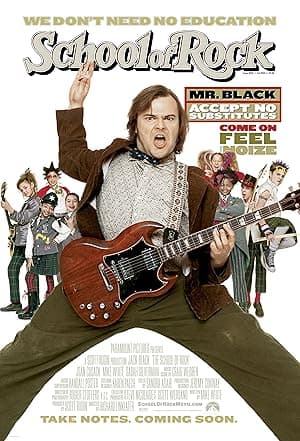
School of Rock
A grubby-hearted riff on teaching, rebellion and why a man in a cardigan can still make kids want to play loud.
Feature presentation
School of Rock feels like a very specific kind of mischief: a desperate musician in a prep school, a class that secretly becomes a band, and a film that chooses expression over exam results. It’s the sort of movie that announces itself through one character more than its premise — and that character is Dewey Finn.
THE MOVIE
Dewey Finn is still the reason this movie works
People keep coming back to School of Rock because it centres on a single, loud idea: a down-on-his-luck guitarist impersonates his roommate to take a substitute-teacher job and, well, upends everything. That con — equal parts selfishness and showmanship — is the film’s motor.
Once Dewey discovers his pupils can play, he quietly turns their lessons into rehearsals and builds them into a proper rock band, using the Battle of the Bands as his impossible goal. The movie thrives on that collision: an exam-driven school confronted by unscripted noise.
Richard Linklater directs this 2003 comedy-music mash-up that trusts a simple antagonism — creativity versus conformity — to carry 110 minutes, and Jack Black as Dewey is the human amplifier at its centre. Even the soundtrack choices underline the gamble: the film leans on big rock moments to make its point.
THE SETUP
The idea that sets School of Rock in motion
The film’s premise is clean and economical: Dewey’s deception—answering for his roommate and taking a class under false pretences—creates a ticking conflict with school rules and anxious parents. That lie keeps the story honest: it’s not a noble crusade, it’s a scramble that grows into something real.
Against that pressure, the students face their own choice: follow the expected academic path or try music. The tension comes from those competing demands — conformity on one side, self-expression on the other.
Mechanically, the movie is straightforward and smart: Dewey identifies students’ strengths, slots them into band roles from lead guitar to backing vocals, and replaces formal lessons with hands-on rehearsals.
All of this funnels toward a single public moment — the Battle of the Bands — which gives the classroom stakes an outward, theatrical consequence.
THE CHARACTER
Why Dewey Finn matters
At base, Dewey Finn is a musician who refuses to shrink. Jack Black plays him: a struggling guitarist who’s both pride and impulse, driven as much by devotion to rock as by a need to keep his life from collapsing.
That mixture—ego and genuine belief in music—makes him combustible in a school setting. He privileges creative expression over the curriculum, and that stubborn choice forces the story’s moral reckonings.
Dewey’s relationship with his roommate Ned provides a useful contrast: Ned is responsible and risk-averse, the kind of person the school rewards. Having that foil keeps Dewey’s excesses legible; you can see why both men are wrong and, crucially, why they’re necessary to each other.
The students matter because they bring real musical skills and personal obstacles — family pressure, shyness, social anxiety — that Dewey helps surface. That sense of a mismatched group becoming something like family gives the film its heart.
THE PERFORMANCE
Why Jack Black's performance matters
Contemporary critics repeatedly pointed to Jack Black as a key reason the film worked: reviews singled out his energetic lead turn as the film’s engine, and that attention shows up in awards recognition.
The film’s reception and later aggregations lean on Black’s presence when describing what makes School of Rock watchable; the role earned him industry notice, including a Golden Globe nomination and an MTV award.
That pattern of critical focus is itself useful: the movie asks you to ride Dewey’s momentum, and the reception suggests most viewers were happy to do so.
UNDER THE SURFACE
School of Rock has more on its mind than the plot suggests
On the surface it’s a comic caper about a man who shouldn’t be teaching. Underneath, the film keeps returning to creativity versus conformity: kids nudged by exams into safety, and one loud man insisting they try something riskier.
It’s also a film about mentorship that breaks the usual rules. Dewey’s methods are unorthodox — he’s not a model teacher — yet the movie treats mentorship as messy and practical rather than neat and credentialed.
Music functions here as empowerment. Learning to play doesn’t just give the children a skill; it gives them a voice that sits outside the school’s measured expectations.
All of these elements fold into the idea of found family: a ragged group of adults and children who assemble into something supportive because they share a belief in what music can do.
PURE 00s
School of Rock could not belong to any other decade
Released in October 2003, School of Rock is very much a product of the early 2000s appetite for family comedies built around a charismatic outsider who changes a rigid institution.
That trend loved a simple premise: an irreverent messiah figure arrives, unsettling order for the better. School of Rock fits that pattern but gives it a musical heartbeat, which helped it break out commercially.
It did break out: the film opened at number one and went on to gross over $130 million worldwide on a modest budget — a sign that this particular brand of noisy, feel-good rebellion found an audience in 2003.
Even its production feels of the era: Linklater and the team travelled to cast real young musicians, a choice that links the film’s period to a practical, performance-forward approach rather than CGI spectacle or glossy franchise building.
WATCHING IT NOW
What has aged — and what hasn't
When people revisit School of Rock, they most often point to the film’s insistence on creativity and to Jack Black’s role as reasons it survives the years. That pattern shows up in retrospective lists and roundups.
Practically speaking, Linklater’s decision to cast children who could actually play keeps the musical moments compelling: the performances feel lived-in because the musicianship is real.
The film’s found-family core — a mismatched group learning to listen to one another — also holds up. It’s a straightforward emotional promise and one that doesn’t depend on early-2000s packaging.
What feels more period is the film’s particular comic shorthand and its comfort with a certain kind of broad, safe rebellion. If that style sits well with you, the movie still rewards a watch.
THE LEGACY
Why School of Rock still matters
School of Rock didn’t just make money and win a few awards; it turned into other things. A stage musical version produced by Andrew Lloyd Webber opened on Broadway in December 2015, translating the film’s energy to a different medium.
It also became a multi-season television property: a Nickelodeon series ran from March 2016 to April 2018, extending the story into a children’s programme and introducing the premise to a new generation.
Those adaptations suggest the concept — a teacher who champions music and rebellion in a school setting — has a durability beyond the original film and can be reshaped for stage and TV.
THE VERDICT
Does School of Rock still hold up?
Yes. School of Rock still holds up because its central gamble — a selfish musician turning a class into a band — produces honest, visible change in the children. Dewey’s lie (he impersonates his roommate to take the job) starts as a mess but becomes the engine for genuine discovery.
The film’s conflicts remain clear and effective: the push-and-pull between school rules, parental expectations and the students’ need to be heard gives the story readable stakes, and those stakes resolve around a public test — the Battle of the Bands — that makes the classroom’s private work matter publicly.
Practically, the movie benefits from two durable choices: Jack Black as the film’s focal presence, and the casting of real young musicians so the music scenes land. The result is a comedy that still plays as loud, messy and generous rather than dated novelty.
So if you’re wondering whether to watch it now — yes. It’s a 2003 film that still rewards an audience willing to enjoy the noise, the mess and the odd apprenticeship at its heart. Dewey Finn is the film’s blunt instrument and its charm: he’s a bit of a wreck, but he finally teaches something worth learning.
Share this movie
Keep watching
More movies from the 00s

2002
The Pianist
A quiet life unmade by war — and a pianist who refuses to stop listening.
Read the retrospective
→
2006
Blood Diamond
A mercenary, a fisherman and a pink diamond — and a film that still asks who pays for our jewellery.
Read the retrospective
→
2003
Kill Bill: Volume 1
A yellow jumpsuit, a long list of enemies and one woman who refuses to be finished.
Read the retrospective
→