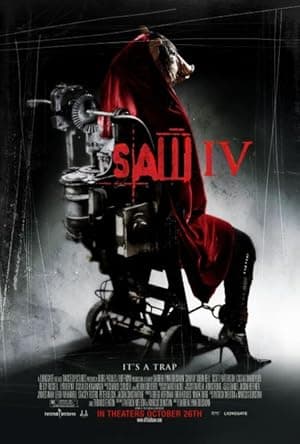
Saw IV
A dead man’s tape, a living philosophy: Saw IV keeps Jigsaw very much in charge.
Feature presentation
Saw IV opens like a forensic puzzle — an autopsy, a found tape and a set of instructions that pull everyone into one last game. It’s less about shock for shock’s sake and more about the way John Kramer’s logic keeps tugging at the people left standing. Revisit it for the puzzle, the moral push-and-pull, and the 2000s horror machinery that still likes to rattle.
THE MOVIE
Jigsaw / John Kramer is still the reason this movie works
Right away Saw IV makes its intentions plain: there’s an autopsy, the detectives find a recording tucked inside the body, and that cassette is the starting pistol. That single conceit — Jigsaw speaking from beyond the grave — is the film’s engine. It converts corpse into instruction manual and curiosity into urgency.
Tobin Bell’s John Kramer doesn’t need to be on screen to dominate proceedings. The movie keeps returning to the idea that his philosophy of testing people’s choices is contagious; tapes and flashbacks let him keep lecturing, judging and directing when he’s no longer breathing.
Darren Lynn Bousman came back to steer the fourth instalment, keeping the franchise’s appetite for tight, clinical set-pieces. At 95 minutes it’s a compact, relentless entry that expects you to follow the rules as much as the characters do.
THE SETUP
The idea that sets Saw IV in motion
At its simplest, Saw IV runs two clocks at once. On one side you have FBI agents and detectives combing crime scenes, interrogating witnesses and trying to make sense of John Kramer’s final instructions. On the other, Detective Daniel Rigg is forced through a chain of timed tests that push his compulsion to save people to the limit.
That parallel structure gives the film its momentum. The procedural thread keeps the mystery moving forward; Rigg’s tests keep the stakes immediate and physical. The movie stitches those timelines together with flashbacks until the pieces slot into place.
It’s a tight commercial design: a mystery to decode, a character to punish or redeem, and a handful of revelations about who was really helping Kramer. The screenplay credits and story contributors framed that architecture intentionally, so the pieces are meant to interlock.
All of which means Saw IV doesn’t linger. It sets the puzzle, winds the timers and expects you to keep up.
THE CHARACTER
Why Jigsaw / John Kramer matters
John Kramer is the movie’s puppet master and its sermoniser. Even when he’s physically absent, the story keeps circling back to his logic — the idea that suffering can be a lesson and that choice is a test.
Tobin Bell’s Jigsaw is present mostly through recordings and flashback fragments, which is a neat trick: the character becomes less a person and more an ideology that other characters must answer to.
That’s why the tape-in-the-autopsy move matters. It makes Kramer part of the procedure of investigation rather than merely a target to be found. He’s the reason detectives spend their time decoding rather than just arresting.
In short: Saw IV treats Jigsaw as a continuing force. The film's puzzles and moral challenges are carved around his rules, which keeps the franchise’s argument — however perverse — very much alive.
UNDER THE SURFACE
Saw IV has more on its mind than the plot suggests
At face value it’s a horror-thriller built around gruesome tests. Underneath, though, the film keeps returning to the ethics of choice. The games are designed to force decisions — often terrible ones — and to see who will change when cornered.
Obsession is another running thread. Detective Rigg’s compulsive need to rescue people isn’t accidental; the tests probe that exact compulsion and ask whether being a rescuer can become a self-destructive obsession.
There’s also a theme of deception and apprenticeship. The movie spends time revealing who was working with Kramer, and that slow unveiling flips loyalties and expectations. It’s less about surprise gore than about apprenticeship — who learned from Kramer and who was merely following orders.
Finally, the film traffics in a rough version of vigilante justice. It wants you to watch moral reckonings play out and then decide where you stand, even when the rules feel unfair.
THE FILMMAKING
How Saw IV was put together
Darren Lynn Bousman returned for a fourth round, so the movie feels like the same crew pushing familiar impulses rather than a reinvention. That continuity lets Saw IV double down on the franchise’s established approach: tight framing and set-pieces that foreground the mechanical cruelty of the traps.
Cinematography and editing credits show the film was built by a small, veteran team. The people behind the camera were the same sort who knew how to pace a suspense beat and cut between investigative scenes and timed tests without losing the audience.
Production design is credited to David Hackl, which matters because the traps and rooms are treated as pieces of dramatic information. The environments aren’t just gore playgrounds; they’re props in a moral argument.
All of that adds up to a production that, intentionally, doesn’t take its foot off the gas. Saw IV is put together to feel precise and engineered — which is exactly what the story asks for.
PURE 00s
Saw IV could not belong to any other decade
Saw IV arrives at the height of a certain mid-2000s horror moment: mainstream pictures leaning into heavier, more explicit gore and moral games. The franchise sits comfortably in that conversation — part of a cycle critics and scholars often group together from the era.
It also belongs to the era’s release pattern. By 2007 Saw had become a dependable Halloween-season property with an almost annual rhythm, which shaped how each instalment was pitched and produced.
The production itself was compact and efficient. Shot quickly on a modest budget, the film’s economics reflect a studio model that favoured reliable returns at a low cost — a very 00s approach to franchise filmmaking.
Even the soundtrack roll-out and the Blu-ray/DVD home release cycle speak to the period: the score and tie-ins arrived alongside theatrical play, and home-video sales were a notable part of the film’s commercial life.
THE LEGACY
Why Saw IV still matters
Saw IV helped keep the franchise moving — the writers who stepped in went on to write more instalments, so this film is part of the franchise’s mid-period DNA rather than a one-off experiment.
Commercially it did what the series had been doing: strong returns on a small budget. That business model kept the series rolling and justified the franchise’s continued existence.
Home-video also played a big role in the picture’s afterlife. The DVD and Blu-ray era was still strong in 2007–08, and those sales figure in how people encountered the film after cinemas.
Even decades later the studio has bundled Saw IV into franchise reissues, including a 4K steelbook re-release, which is a reminder that the film remains an active item in the franchise catalogue.
THE VERDICT
Does Saw IV still hold up?
If you come for tidy answers, this isn’t the Saw for you. Saw IV is happiest when it’s complicating the franchise’s own rules: the autopsy tape restarts the game, the investigators chase clues, and Rigg’s tests keep asking whether rescue has a cost.
The film’s deliberate non-linear cuts and flashbacks are designed to ratchet up surprise and to make revelations land like puzzle pieces clicking into place. If you enjoy being shown the seams of a mystery as they’re stitched together, it rewards patience.
It’s also a very specific kind of horror: a study in moral pressure rather than mere shock. The questions it keeps asking — about compulsion, apprenticeship and rough justice — give it something to chew on beyond the traps themselves.
So should you watch it now? Yes, if you like your horror procedural, mechanically tidy and willing to make you think a little while it unsettles you. If you want a film that’s purely about scares for their own sake, this one will frustrate. Saw IV holds up as a well-drilled chapter in a franchise that still remembers who set the rules.
Share this movie
Keep watching
More movies from the 00s

2002
The Pianist
A quiet life unmade by war — and a pianist who refuses to stop listening.
Read the retrospective
→
2006
Blood Diamond
A mercenary, a fisherman and a pink diamond — and a film that still asks who pays for our jewellery.
Read the retrospective
→
2003
Kill Bill: Volume 1
A yellow jumpsuit, a long list of enemies and one woman who refuses to be finished.
Read the retrospective
→