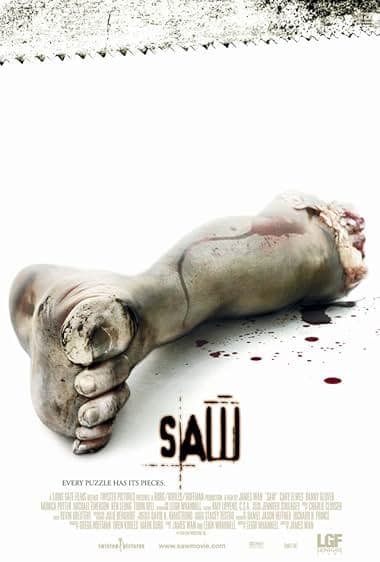
Feature presentation
Saw drops you in a grubby, unbearable room and then politely refuses to make the rules easy. James Wan’s debut pairs a single-location nightmare with a parallel police hunt, and it’s the collision of those two engines—personal desperation and procedural obsession—that still makes the film breathe. If you remember a twist, a trap or Dr. Lawrence Gordon standing in the middle of it all, there’s a reason.
THE MOVIE
Dr. Lawrence Gordon is still the reason this movie works
You know the set-up: two men wake up shackled at opposite ends of a filthy bathroom, a dead body between them, and no manual for how any of this is supposed to make sense. That terrible, intimate premise is the film’s opening push—everything else is the movie trying to answer how and why they ended up there.
Saw doesn’t stay in the room. It keeps cutting to an external police story about detectives hunting a murderer called Jigsaw, and that constant switch—close claustrophobia versus outside investigation—gives the film a heartbeat. The contrast makes the bathroom feel less like a spectacle and more like a collapsed personal life suddenly laid bare.
And at the centre of the collapse is Dr. Lawrence Gordon: a successful oncologist whose private and professional life turn out to be crucial to what’s happening inside that room. Put simply, you can watch Saw for the traps and the twist, but you stay because the film keeps asking uncomfortable questions about survival, punishment and the cost of obsession.
THE SETUP
The idea that sets Saw in motion
At its simplest, Saw runs on a single cruel idea: an antagonist constructs symbolic, lethal tests that force people into terrible choices if they want to survive. The tests aren’t random shocks; they’re designed to be moral puzzles, which gives the film a grim kind of logic.
That premise began very small. James Wan and Leigh Whannell shot a short version of one scene to sell the feature idea, and that short helped secure the financing and the involvement of producers. The feature is essentially the short stretched into a shape that could hold an investigation and a reveal.
Because the film’s energy comes from the concept, you can see why many viewers were split. The core setup is clever and compact. It also relies on a willingness to follow sometimes uncomfortable formal choices—so some critics loved the craft and the premise, while others found fault with plotting and certain narrative devices.
As a result, Saw’s setup feels both tight and deliberately provocative: it demands the audience decide whether they want to be shown the machine, or to inspect the mechanics behind it.
THE CHARACTER
Why Dr. Lawrence Gordon matters
Dr. Lawrence Gordon isn’t just a name on the poster; he’s the personal fault line that the film keeps nudging. As a successful oncologist, his life carries weight outside the bathroom, and those outside responsibilities turn the confined test into something that reaches beyond the tiles.
When a character’s professional life bleeds into a setup like this, you get texture: reputations, secrets, obligations. The movie turns Gordon’s status and choices into stakes that feel plausibly expensive, not merely theatrical.
That’s partly why Cary Elwes’s casting registers: the role needs someone who can plausibly be a respected doctor while also being a man with problems that matter to the plot. The character’s decisions—both public and private—drive much of the film’s tension.
In short, Gordon matters because he makes the trapped-room drama mean more than shock value. His situation asks the audience to think about what survival costs when someone with power and responsibility gets pulled into a moral puzzle.
UNDER THE SURFACE
Saw has more on its mind than the plot suggests
Beneath the gore and the traps, Saw is principally an argument about moral judgment and punishment. The tests are staged as if they could reform or expose a person’s true value through suffering—that’s a grim philosophical experiment dressed up as horror cinema.
There’s also obsession on both sides of the fence. Detectives become consumed by the hunt; the perpetrator is consumed by the design of punishments. That mirroring makes the movie less a simple who-dunnit and more a study of what happens when people take righteousness too far.
Survival tests in the film are therefore double-edged: they ask what someone will do to live, and they ask whether surviving by those means is worth the cost. It’s an unpleasant question, and Saw doesn’t quiet it with easy answers.
Finally, the film nudges at the ethics of suffering as a route to change. If you set suffering up as a test for enlightenment, who judges the outcome? That moral slipperiness keeps the audience squirming in their seats long after the traps are closed.
THE FILMMAKING
How Saw was put together
Saw is a movie that wears its crew credits where you can see them. The names attached to the technical side—David A. Armstrong on cinematography, Kevin Greutert editing, Charlie Clouser composing—are part of the film’s identity because the whole production depends on coherently joining cramped set pieces to a wider investigation.
That short-to-feature origin story also matters here: the pair behind the project had to convince producers that a single, intense scene could be expanded into a tight, 103-minute thriller. Making that leap is as much a production puzzle as any of the traps on screen.
So when you feel the film holding itself together—or sometimes pulling apart—you’re seeing the result of those behind-the-scenes roles working against a very specific conceit. The mechanics of craft are obvious in a movie like this because the premise leaves little room for loose ends.
In other words: Saw’s filmmaking is pragmatic and purposeful. It’s built to make an awkward idea play as a coherent, if provocative, piece of genre cinema.
PURE 00s
Saw could not belong to any other decade
Saw’s trajectory feels very much of the 2000s: it premiered at Sundance in early 2004 and then, after being acquired, arrived in theatres that October—timing that helped it become a talking-point among genre audiences and distributors alike. The period was ready for tight, high-concept horror to find a mainstream foothold.
Critically, the film became part of a broader conversation about the decade’s darker horror strand; commentators later grouped it into debates around what people called the 'torture porn' trend. Whether you agree with that label or not, Saw sits squarely inside those mid-decade discussions about how far horror should go.
Commercially, the film’s immediate follow-up came quickly: Saw II was released the next year, and that began a rhythm of sequels through the 2000s. The yearly return to the concept is very much a sign of the era’s appetite for franchised horror properties.
Finally, the fact that Saw began as a festival find and then became a recurring theatrical franchise is telling. It’s a story about how small, risky ideas could, in that decade, be pulled into much bigger commercial cycles.
THE LEGACY
Why Saw still matters
Much of Saw’s afterlife is straightforward: the film launched a long-running franchise, with Saw II following in 2005 and more instalments arriving over the subsequent years. That alone keeps the original in conversations, since it’s the seed of a much larger commercial project.
Beyond franchise mechanics, the picture’s commercial success established Twisted Pictures as a company able to produce serial horror releases. In other words, Saw didn’t just spawn sequels—it helped create a production model that supported annual follow-ups throughout the decade.
Because of that twin legacy—creative premise and commercial template—the film is still referenced when people talk about 2000s horror business models and the kinds of risks that hit the market back then.
So Saw’s importance is less about a single image and more about what it set in motion: a repeatable idea that the industry ran with for years.
THE VERDICT
Does Saw still hold up?
Yes—if what you want is a tight, unnerving premise that refuses to be merely a set of shocks. The core situation—two men chained in a bathroom, a dead body between them—remains a compact engine for tension, and the film’s back-and-forth with the police investigation keeps the whole thing from feeling like a one-note stunt.
The symbolic, lethal tests are the movie’s central gambit: they force characters into brutal choices, and that moral pressure is what gives the film a lingering weight. Framed flashbacks and intercut sequences reveal connections without immediately showing the killer’s identity, which helps the drama feel earned rather than accidental.
That said, you should watch knowing contemporary critics had reservations. Reviewers praised the craft and the premise but found issues with plotting and some of the narrative devices—the film sometimes strains to make every reveal land neatly. If you’re picky about narrative polish, that will register.
But for viewers willing to trade a tidy plot for a provocative concept, Saw is still worth your time. It’s a movie built around a question you can’t stop answering for yourself: what would you do, and who has the right to judge the answer?
Share this movie
Keep watching
More movies from the 00s
2002
The Pianist
A quiet life unmade by war — and a pianist who refuses to stop listening.
Read the retrospective
→
2006
Blood Diamond
A mercenary, a fisherman and a pink diamond — and a film that still asks who pays for our jewellery.
Read the retrospective
→
2003
Kill Bill: Volume 1
A yellow jumpsuit, a long list of enemies and one woman who refuses to be finished.
Read the retrospective
→