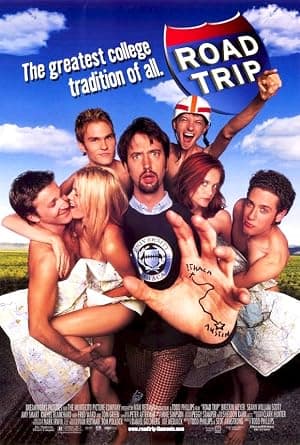
Road Trip
A panicked cross-country scramble to save a relationship — and everyone's dignity.
Feature presentation
Road Trip is the sort of movie you can summarise in one humiliating sentence: a college bloke shoots a private tape, his mates accidentally mail it to the wrong person, and off they go. Todd Phillips’s first big-studio feature keeps the premise tight — time is short, stakes are embarrassingly personal, and that pressure turns pratfalls into character moments. If you remember it fondly, it’s probably because Josh is the reason the whole thing hangs together.
THE MOVIE
Josh is still the reason this movie works
The hook is a perfectly awkward modern panic: Josh has recorded a sex tape, and an accidental mailing turns a private mistake into a ticking crisis. That single misfire is the engine under Road Trip — it sets a clear, time-sensitive objective and gives the whole film somewhere to drive.
What keeps those jokes from just being one gags after another is who’s doing the worrying. Josh is trying to protect a long-distance relationship and fix the problem he caused; that motivation makes the trip feel less like glorified chaos and more like an ill-advised rescue mission.
Todd Phillips directs a compact, 93-minute comedy that blends romantic-comedy stakes with road-movie escalation, and he surrounds Josh with a crew whose male-bonding rituals are constantly tested under pressure.
THE SETUP
The idea that sets Road Trip in motion
At its simplest, Road Trip is a tidy comic premise stretched across a highway: a student named Josh records a sexual encounter and, because of a roommate screw-up, the tape is mailed to the woman he’s actually trying to keep as his long-distance girlfriend.
That mailed videotape works as more than a joke — it’s a real deadline. The film arranges a sequence of episodic misadventures around the single objective of intercepting the tape before Tiffany sees it, which keeps the pace brisk and the stakes consistently personal.
Todd Phillips wraps parts of the story in a framing device: a college tour-guide character narrates sections, giving certain scenes a wink and a shape rather than leaving them as random detours.
There’s also a soundtrack-side crew behind the jokes — the film credits music contributors and a supervisor who help the film hit its comic beats — but the motor is always that intercepted tape and the race to stop the embarrassment.
THE CHARACTER
Why Josh matters
Josh is the ordinary centre of an extraordinary mess. He isn’t the loudest or the daftest in the group; he’s the guy whose relationship is genuinely at risk, and that gives his panic actual consequence.
Breckin Meyer plays Josh, and the writing keeps him grounded: his aim isn’t to be hilarious, it’s to fix what went wrong. That makes him a relatable fingertip of seriousness amid the chaos.
The film balances Josh’s problem against the other players: the woman in the tape, Beth, and the girlfriend, Tiffany, are the two poles between impulse and commitment. Josh’s choices — and his attempts to put them right — are what turn the road trip into a rite-of-passage rather than just a string of gags.
Crucially, the movie is about male friendship as much as about the relationship at stake; Josh’s mates are the ones who mobilise, bungle and sometimes salvage the plan. Their rituals under pressure reveal how the group holds together when the consequences feel real.
THE PERFORMANCE
Why Breckin Meyer's performance matters
Contemporary critics tended to describe Meyer as the likable, sympathetic anchor in an ensemble that often thrives on louder comic types. That kind of role is easy to overlook until you realise everything else spins off it.
Because Josh is the character who genuinely cares about fixing a mistake, the film needs someone the audience can root for — not the scene-stealer, but the stabiliser. That’s Meyer’s job in the movie’s chemistry.
Put bluntly: if Josh didn’t feel plausible as someone with a relationship to lose, the plot would be a string of mean-spirited set pieces. The way reviewers noted Meyer’s anchoring presence points to why the movie doesn’t entirely collapse into chaos.
UNDER THE SURFACE
Road Trip has more on its mind than the plot suggests
On the surface it’s a gross-out, R-rated college comedy, but the film keeps returning to a handful of simple ideas: friendship, embarrassment, and the consequences of being reckless. Those themes are the glue between the pratfalls.
Male friendship is central: the trip is as much an endurance test for the group’s bonds as it is a salvage mission for one bloke’s relationship. The rituals and loyalty that come out of pressure are a running concern.
Sexual embarrassment fuels the comedy — the mailed tape is humiliation turned literal — and the movie mines that awkwardness for both cheap laughs and, occasionally, clearer stakes about responsibility.
Underneath the jokes there’s a rite-of-passage feel: mistakes are made, friendships are tested, and characters have to account for what grown-up choices look like after a foolish night.
THE FILMMAKING
How Road Trip was put together
Todd Phillips made Road Trip as his first major-studio narrative feature, and the production credits read like a straightforward, professional comedy setup: a credited director of photography and a named production designer gave the film a steady technical backbone.
Mark Irwin is listed as director of photography and Clark Hunter as production designer — sensible, workmanlike roles that let the movie move briskly between set pieces without calling attention to themselves.
Editing duties went to established hands, which matters in a comedy that trades on timing: the editors on the credits shaped how the episodic misadventures land and how the momentum carries the audience from one embarrassment to the next.
All told, the filmmaking side is less about flashy authorship than about keeping a 93-minute comedy taut and fun across a variety of short, escalating set pieces.
PURE 00s
Road Trip could not belong to any other decade
Road Trip arrived in 2000 squarely inside the late‑1990s/early‑2000s wave of R-rated teen and college comedies. It shares a template with those films: sex-based embarrassment, gross-out setups and a cast of young characters whose recklessness gets comic treatment.
Critics at the time regularly paired it with titles like American Pie, and the comparison still makes sense — not because the films are identical, but because they were part of the same market and audience appetite.
Todd Phillips’s role here places the film in his early bro‑comedy lineage; you can trace a through-line from this compact studio picture to his next mainstream efforts.
Even the fact it later spawned a low-participation direct-to-video follow-up feels like a very 2000s footnote: a modest franchise afterlife rather than a cultural takeover.
WATCHING IT NOW
What has aged — and what hasn't
Modern takes on Road Trip tend to be pragmatic: some jokes and references now read dated, while the basic comic timing of particular scenes still lands for plenty of viewers. The film’s era is visible, but it doesn’t entirely dominate the experience.
What survives best is the central interplay — the male friendship and the way the group reacts when a real consequence appears. Those relational beats feel human enough to outlast throwaway pop-culture jokes.
By contrast, material that trades purely on ephemeral references or the shock-value of sexual embarrassment can look creaky today; not every gag ages at the same rate.
In short: Road Trip reads like an early‑2000s comedy — some of it is pleasantly nostalgic, some of it shows its age, but the film’s core dynamics still explain why people remember it.
THE LEGACY
Why Road Trip still matters
Road Trip’s afterlife is modest but concrete: it led directly into Todd Phillips’s mainstream career and produced a low-key sequel years later. Those are practical measures of a film that did its job commercially and launched careers.
More pointedly, the movie remains a shorthand for that particular strain of college comedy — the sort of film that trades embarrassment for narrative momentum and relies on male-bonding chaos to create stakes.
Its lasting presence isn’t about being a seismic influence; it’s about being a clear example of a form that shaped a slice of early‑2000s cinema and of launching a director who kept working in similar territory.
That kind of legacy is steady rather than flashy: Road Trip matter-of-factly pushed its creators into the next phase of their careers and left a recognisable template behind.
THE VERDICT
Does Road Trip still hold up?
Yes — with reservations. If you watch it for what it set out to be, a 93-minute R-rated road comedy fuelled by an embarrassingly specific ticking clock, it mostly delivers. The mailed videotape gives the plot a clear spine, and the episodic misadventures keep the film moving toward Austin with a sensible urgency.
The film works best when Josh’s problem feels real: Breckin Meyer’s role as a likable, sympathetic anchor helps sell the idea that this is a mistake worth fixing, not just an excuse for escalating stunts.
Where it shows its age is in material that depends on throwaway shock or references of the era; those moments land unevenly for a modern audience. But the themes of male friendship, responsibility versus recklessness, and the awkward business of growing up still register.
So should you watch it now? If you want a compact, era-specific comedy that mixes genuine stakes with broad set pieces — and you accept a few dated jokes in exchange for scenes that still have comic timing — Road Trip is worth a revisit. It’s essentially an apology tour on wheels that can still make you laugh.
Share this movie
Keep watching
More movies from the 00s

2002
The Pianist
A quiet life unmade by war — and a pianist who refuses to stop listening.
Read the retrospective
→
2006
Blood Diamond
A mercenary, a fisherman and a pink diamond — and a film that still asks who pays for our jewellery.
Read the retrospective
→
2003
Kill Bill: Volume 1
A yellow jumpsuit, a long list of enemies and one woman who refuses to be finished.
Read the retrospective
→