Feature presentation
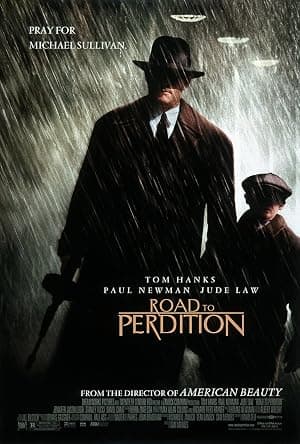
Road to Perdition feels, even now, like a film that knows exactly which scenes to make hush-hush and which moments to let roar. Sam Mendes took a graphic-novel frame and stretched it into a Depression-era fable about a killer trying — desperately and quietly — to be a good father. It’s the kind of grown-up studio picture that the early 2000s still made with real confidence.
THE MOVIE
Michael Sullivan is still the reason this movie works
Road to Perdition starts with a neat, brutal premise: Michael Sullivan is a mob enforcer whose life is set apart not by swagger but by a fierce, private focus on family. That setup — a professional killer whose instincts are domestic — gives the film its odd, magnetic tension.
Everything that follows feels propelled by one small, terrible fact: Sullivan’s young son sees a gangland murder and suddenly father and son are running for their lives. The flight across towns and motels turns the picture into a road story that’s also a schooling in adult compromises.
Tom Hanks is literally at the centre of that project and Sam Mendes, arriving after American Beauty, stages it as a deliberately paced, visually obvious piece. It’s a 2002 film that prefers slow reckonings to bravura set-pieces, and it wears that choice like a suit cut to fit the story.
THE SETUP
The idea that sets Road to Perdition in motion
At its simplest, the film is triggered by one scene that rearranges everything: a child witnesses a hit. That moment turns Michael Sullivan’s work-life — violent and secretive — into a domestic emergency where the usual rules don’t apply.
From there the screenplay keeps two tracks moving at once: Sullivan trying to keep his surviving son safe, and the ruptures inside the Rooney crime family that make that protection both urgent and messy. Loyalty frays; revenge begins to drive decisions that used to feel automatic.
Mendes organises the story as a literal journey. The road gives them somewhere to go and lets the film set up episodic encounters — bank jobs, motels and diners — that test the boy and expose adult compromises.
That structure also frames the younger Michael’s coming-of-age: the travel and the confrontations force him into moral choices and into a real glimpse of what his father’s life actually costs.
THE CHARACTER
Why Michael Sullivan matters
Michael Sullivan isn’t a gangster with a moustache twirling in the rain. He’s a working man of violence whose home life is the clearest measure of who he is. The film keeps returning to that split — the hand that wipes a child’s brow and the hand that does very different work after dark.
That tension is what makes Sullivan memorable: his professional identity constantly butts up against a paternal instinct that, for him, is not sentimental but practical. Protecting his family becomes the logic that justifies choices other people might see as monstrous.
The screenplay deliberately sharpens the father–son focus. Young Michael’s experiences push him toward adult truths about the kind of life his father leads, and those discoveries are what carry much of the film’s emotional freight.
There’s also another domestic strain to Sullivan’s life: his relationship with John Rooney, who operates as a kind of surrogate father and mob boss. Their affection is real, but it’s laced with the resentments and loyalties that come from running a criminal family.
THE PERFORMANCE
Why Paul Newman's performance matters
Paul Newman’s John Rooney is the movie’s elder statesman: a gangster who combines personal warmth with the hard calculus of mob rule. Contemporary coverage singled both Newman and Hanks out — they were the performances that critics kept returning to.
Newman’s work was acknowledged in awards talk and it earned him an Academy Award nomination for Best Supporting Actor. That recognition matters because it underlines how central Rooney’s presence is to the film’s emotional stakes.
Rooney functions as a paternal figure who complicates Sullivan’s own fatherhood: affection sits beside obligation, and the film mines that friction for its quieter moral dilemmas.
When the story asks who deserves protection and who pays for loyalty, Rooney’s character is often the human face on the question — the one who makes those compromises look inevitable rather than abstract.
UNDER THE SURFACE
Road to Perdition has more on its mind than the plot suggests
On the surface it’s a crime drama about hits and retribution, but the film is really keyed to questions of fatherhood — both biological and surrogate. Who teaches a child how to be a man when the teacher’s trade is violence?
That ties directly into the film’s argument about revenge and protection. The difference between killing to defend and killing for revenge isn’t always clear, and Mendes lets the movie sit in that uncomfortable grey area.
There’s also an insistently tragic coming-of-age at the film’s heart: the boy matures under traumatic circumstances and the road becomes a schooling in adult compromises rather than a neat moral lesson.
All of this adds up to another idea that keeps returning: violence leaves a legacy. Loyalty and betrayal are not abstract terms here but things that shape families, careers and the choices a child inherits.
THE FILMMAKING
How Road to Perdition was put together
A big part of the film’s identity is the way it looks. Conrad L. Hall’s photography was widely noted at the time for its composed, painterly frames and strong contrasts, and that attention to how each shot is set up gives the story a formal weight.
Mendes treated the film like a visual period piece and worked with a production designer and editor to set a deliberate rhythm. The result is a movie that breathes; scenes aren’t hurried — they’re meant to be absorbed.
The production also leaned on location work to create its early-1930s Midwestern world, using well-chosen towns and historic sites to give the film a lived-in sense of place.
Hall’s contribution was recognised after his death with a posthumous Academy Award, which underscores how central the cinematography is to the picture’s lasting impression.
PURE 00s
Road to Perdition could not belong to any other decade
There’s a particular early-2000s confidence to Road to Perdition: a studio film aimed at adults that adapts a graphic novel without leaning on comic-book spectacle. It’s part of a moment when prestige filmmakers treated illustrated source material as mood and structure rather than franchise fodder.
Mendes’s move from American Beauty into this territory feels like a logical progression — both films share an interest in family dynamics, but this one folds that concern into the grammar of a crime story.
Released in 2002, the film sits alongside a handful of grown-up mainstream adaptations from the period: its style and ambitions are very much of that moment, when big-name directors still made tentpole-calibre dramas for adult audiences.
WATCHING IT NOW
What has aged — and what hasn't
If you go back to Road to Perdition now, two things are the clearest: the father–son relationship still cuts through, and the visual compositions still feel like the film’s strongest calling card. Those elements are the reasons people bring the film up in retrospective conversations.
The screenplay’s decision to broaden the graphic novel’s father–son focus and to give the antagonism a quirky, dangerous shape in the form of a contract killer–photographer keeps the drama specific rather than generic. That specificity helps it hold up.
Mendes’s continuation of themes he had been working on — family, domestic ruptures, careful framing — gives the movie a distinct personality that hasn’t worn away with time.
Put simply: the movie’s emotional scaffolding and its looks are what still stick with you on a rewatch.
THE LEGACY
Why Road to Perdition still matters
Part of the film’s afterlife rests on the look. Conrad L. Hall’s cinematography was recognised with a posthumous Academy Award, and that formal achievement is often the first reason the movie is still mentioned in discussions of 2000s crime dramas.
It also earned other awards attention: Paul Newman’s supporting role and Thomas Newman’s score were both singled out with Academy Award nominations. That level of recognition kept the picture in the critical conversation after its release.
Beyond trophies, the film remains frequently cited when people talk about visually driven crime pictures of the era — especially for its production design and cinematography. Those elements have become shorthand for the film’s continuing value.
Finally, the story choices — expanding the father–son centrepiece and giving the antagonist a memorable, strange edge — helped the film attach itself to an emotional idea rather than merely a period crime tale.
THE VERDICT
Does Road to Perdition still hold up?
Yes — and for straightforward reasons. At its heart the film is a tight combination of a single potent premise (a son witnesses a hit), a moral knot (a professional killer who insists his priority is protecting his family) and a structurally sensible form (a road journey made of episodic tests). Those are durable ingredients.
Tom Hanks as Michael Sullivan anchors the movie’s difficult balance between domestic care and brutal work, and the screenplay’s expansion of the father–son relationship — plus the addition of a striking antagonist — gives the drama emotional shape rather than reverting to gangster tropes.
Technically, the film still impresses: Conrad L. Hall’s cinematography received a posthumous Academy Award and Thomas Newman’s score gained awards notice, both of which underline how much of the movie’s power is in the way it looks and sounds.
If you’re deciding whether to watch it now, think of Road to Perdition as a grown-up studio film that still trusts slow revelation and moral ambiguity. It doesn’t dazzle with spectacle; it asks you to sit with a father and his son as they learn what their lives will cost them.
Share this movie
Keep watching
More movies from the 00s

2002
The Pianist
A quiet life unmade by war — and a pianist who refuses to stop listening.
Read the retrospective
→
2006
Blood Diamond
A mercenary, a fisherman and a pink diamond — and a film that still asks who pays for our jewellery.
Read the retrospective
→
2003
Kill Bill: Volume 1
A yellow jumpsuit, a long list of enemies and one woman who refuses to be finished.
Read the retrospective
→