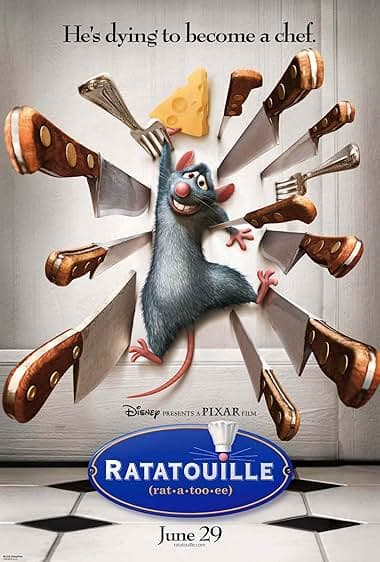
Ratatouille
A rat with a taste for better things, a shy kitchen novice, and a stubborn conviction: anyone really can cook.
Feature presentation
Remy — a rat who wants to cook — is the simplest thing and the cleverest thing about Ratatouille. That tiny, griping premise lets the film juggle big ideas: art versus commerce, who gets to belong at the table, and what a critic’s words actually do. It also gives Brad Bird a graceful way to make a family film that trusts adults to follow it.
THE MOVIE
Remy is still the reason this movie works
If you remember one image from Ratatouille, it’s probably not a cityscape of Paris or a critic at a table; it’s the little rat who wants better. Remy is a rat with an unusually refined sense of smell and taste whose appetite for experimentation makes him leave the scavenging life of his colony and head toward proper cooking.
That shift — a creature born to survive suddenly chasing artistry — is the movie’s motor. Remy ends up beneath Gusteau’s restaurant, close enough to professional kitchens and to the late chef’s cookbook to imagine a different life; and because he wants to create, the film can talk about the squeeze between artistry and commercial pressure without ever getting preachy.
All of this is filtered through Brad Bird’s direction and a voice cast centred on Patton Oswalt as Remy. The result is a 2007 family animation that manages to be warm and ambitious at once — and it still feels like a film made by people who cared about food, craft and the argument that creativity should be open to everyone.
THE SETUP
The idea that sets Ratatouille in motion
Ratatouille doesn’t need a complicated engine. The movie’s inciting idea is straightforward and wonderfully daft: Remy and Alfredo Linguini form an alliance in which the rat hides under Linguini’s toque and literally controls the boy’s movements so that he can cook.
That odd partnership scaffolds the film’s conflicts. On one hand there’s the obvious, visceral problem — Remy is a rat, and rats are the very definition of prejudice in the restaurant world. On the other hand there are institutional pressures: an environment shaped by reputation, money and rigid expectations of how chefs should behave.
The plot also gives those stakes a clear emotional landmark. Linguini’s connection to Gusteau is discovered and the story’s signature layered vegetable dish, the confit byaldi, becomes an emotional turning point — the place where technique and heart meet and where the film’s arguments about artistry land.
THE CHARACTER
Why Remy matters
Remy’s not memorable because he’s cute — though he is — but because his wants are plain and unusual: he wants to make things better. His refined palate and hunger for experimentation push him to leave the rat colony, and that choice makes him the kind of character who turns a simple family film into a conversation about belonging.
He’s set against two sensible forces. Django, his father, stands for the rat community’s survival-first mentality — the voice that tells Remy to look after the family, not his tastebuds. And then there’s Alfredo Linguini: a shy, unskilled garbage boy who has no idea how to be a cook and who needs a purpose, which makes him unusually receptive to a secret collaboration.
All those pulls — family, belonging, the lure of craft, dependence on a human friend — are what make Remy feel like a full character rather than a cute gimmick. Patton Oswalt provides the voice of Remy, which is a casting choice the film leans on when it asks viewers to root for a rat at a stove.
THE PERFORMANCE
Why Patton Oswalt's performance matters
If you’re reading interviews or contemporary reviews, one regular note is simply casting: Patton Oswalt is identified as the voice of Remy, and critics also flagged Peter O’Toole’s contribution as Anton Ego in discussions of the film.
That’s useful to remember because Ratatouille’s characters are tied to the people who give them voice. Naming the performers is how critics and audiences talked about how the characters registered — it’s part of the film’s conversation with its viewers, not an unrelated bit of trivia.
So when you watch Remy work through the movie’s emotional beats, you’re also watching a character framed by those casting choices. How much weight that gives the scenes is a viewer’s call — but the casting was part of the film’s critical conversation from the start.
UNDER THE SURFACE
Ratatouille has more on its mind than the plot suggests
Beneath the gags about squeaking and sewers, Ratatouille keeps returning to one plain set of arguments. First: artistry versus commercial pressure. The film places genuine craft — the kind of food that risks money and opinion — up against the demands of reputation and profit in a high-end kitchen.
Second: the film insists on a democracy of creativity. ‘Anyone can cook’ is more than a slogan; it’s a challenge to who we allow into creative spaces. That idea sits uneasily and productively next to the film’s third set of concerns: prejudice, belonging and identity, summed up in the fact that the protagonist is an animal most kitchens would rather exterminate than employ.
Finally, Ratatouille is quietly about mentorship and collaboration and also about the critic-creator relationship. The movie asks how creators respond to criticism, how mentors shape talent, and what happens when the person who judges your work is more human — or less monstrous — than you expected.
THE FILMMAKING
How Ratatouille was put together
Ratatouille’s shape owes something to production choices behind the scenes. Pixar assigned Brad Bird to take over direction and revise the story after early development, while Jan Pinkava and Jim Capobianco retained story credits for the work they started.
The crew credits underline that this was a carefully composed production: Harley Jessup is listed as production designer, with Sharon Calahan and Robert Anderson credited in director-of-photography roles for lighting and camera, and Darren T. Holmes as editor. Those are the people whose jobs, on paper, explain why the film looks and moves the way it does.
Mentioning those names matters because the film mixes research and craft — the production’s choices about who steered design, light and cutting helped the story’s blend of whimsy and seriousness land for audiences.
PURE 00s
Ratatouille could not belong to any other decade
Ratatouille arrived in 2007 at a moment when Pixar was making original, grown-up-friendly animation that didn’t sacrifice family accessibility. It followed Brad Bird’s The Incredibles and sits comfortably in that stretch of 00s features that trusted older viewers without leaving children behind.
The film participates in a mid-2000s trend of animated features aiming for a slightly older emotional register while remaining broadly appealing. That willingness to be adult in its themes — art versus commerce, identity, the role of critics — is part of what marks it as a film of its time.
So yes: Ratatouille belongs to 2007 not only by release date but by temperament. It’s a studio picture that expected its audience to keep up and to think about what cooking — and creativity generally — actually costs.
WATCHING IT NOW
What has aged — and what hasn't
At a glance, Ratatouille still reads as a family film with some teeth. Its status as animation aimed at all ages means the themes — prejudice, belonging and the critic-creator relationship — remain easy to follow and still useful: debates about who gets to make and be taken seriously haven’t gone away.
Because those concerns are story-driven rather than trendy dress-up, they survive time reasonably well. The film’s argument that talent can come from unexpected places still lands; its scenes about critique and reputation still feel pertinent to anyone who’s worried about who decides value in an art form.
What doesn’t age is a question of taste for the viewer: some may find parts of the device — a rat literally pulling a human’s strings — too whimsical on a second watch, but the central conflicts remain intact and readable.
THE LEGACY
Why Ratatouille still matters
There are concrete reasons Ratatouille still gets airtime in conversations about 00s animation. It won the Academy Award for Best Animated Feature and picked up nominations in other major categories, which keeps it visible in the record of the decade.
Beyond the trophies, Ratatouille has a place in Pixar’s catalogue as one of the studio’s more overtly ambitious emotional pieces — a family film that makes a clear argument about art, exclusion and mentorship while doing so through the unlikely eyes of a rat.
Those factors — awards and the film’s reputation inside the studio’s run of films — are why people still name Remy, Linguini, Skinner or the figure of Gusteau when they talk about ambitious animation from the period.
THE VERDICT
Does Ratatouille still hold up?
Yes — mostly. The central conceit (a rat and a shy garbage boy forming an alliance so the rat can cook) is still clever enough to carry the film. That premise is not a stunt for its own sake: it lets the movie stage arguments about artistry, prejudice and belonging in ways that stay intimate rather than preachy.
Remy’s motivation — his appetite for experimentation and refined palate — continues to feel like a sturdy emotional engine, and the discovery of Linguini’s connection to Gusteau plus the film’s emotional hinge around the confit byaldi keep the story focussed when it could easily have scattered.
Other facts help the film’s staying power: Brad Bird’s authorship, the thought that went into research and even the casting choices are part of how the movie assembled its case and its charm. The film lands most of what it sets out to say about who gets to create and who gets to be judged.
So should you watch it now? If you want a family film that trusts its viewers with grown-up questions and prizes the idea that ‘anyone can cook,’ Ratatouille still rewards watching — and it’s a neat reminder that good taste, in film as in food, can be quietly subversive.
Share this movie
Keep watching
More movies from the 00s
2002
The Pianist
A quiet life unmade by war — and a pianist who refuses to stop listening.
Read the retrospective
→
2006
Blood Diamond
A mercenary, a fisherman and a pink diamond — and a film that still asks who pays for our jewellery.
Read the retrospective
→
2003
Kill Bill: Volume 1
A yellow jumpsuit, a long list of enemies and one woman who refuses to be finished.
Read the retrospective
→