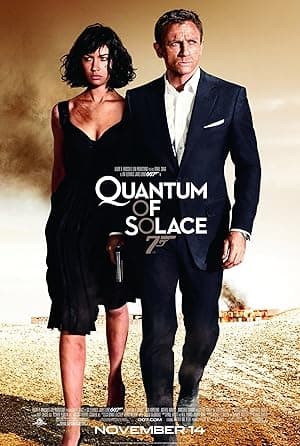
Quantum of Solace
A short, sharp sequel where Bond’s heartbeat matters as much as his trigger finger.
Feature presentation
Quantum of Solace picks up its story so close to Casino Royale that you can almost hear the echo. Marc Forster’s follow-up pares the Bond recipe down to two blunt instruments: a man who won’t let go, and an organisation that won’t stop taking. It’s a compact, sometimes uncomfortable thrill — and that’s exactly why it’s worth revisiting.
THE MOVIE
James Bond is still the reason this movie works
Quantum of Solace wastes no time. It drops you back into Bond’s world almost immediately after Casino Royale finished, which means this one’s less a fresh start and more the next, angrier chapter of a single story.
That choice matters because the film is built around Bond’s need for answers about Vesper Lynd’s betrayal. The plot pulls double duty: it’s a straight spy hunt that also maps a very personal search for closure. Daniel Craig is the through-line — physically driven and emotionally raw — and the film makes sure you know that what’s at stake isn’t just geopolitics but something private and painful.
Directed by Marc Forster and running a tight 106 minutes, the film keeps its focus narrow: Bond, the organisation called Quantum, and the people who orbit them. That concentration is exactly why it still invites discussion now.
THE SETUP
The idea that sets Quantum of Solace in motion
At its simplest, the film is Bond following a loose thread from one heartbreak into a much larger conspiracy. It begins almost where Casino Royale left off and spends its breath following the fallout rather than re-telling the origin.
That fallout takes Bond across borders and into an investigation that steadily reveals a clandestine network called Quantum. The plot keeps the hunt procedural: surveillance, confrontations and careful unpicking of who’s connected to whom.
There are also clear set-piece mechanics at work — an opera-house infiltration is the kind of tidy spy-movie turning point that names people and raises the stakes — while the action sequences lean on a four-element motif (air, earth, water, fire) to give the film visual punctuation.
The decision to tie this film directly to the prior story — including returning characters from that earlier chapter — gives the setup a shape more like a bridge than a standalone instalment.
THE CHARACTER
Why James Bond matters
This Bond isn’t a tuxedoed cipher; he’s on the move — literally and emotionally. The movie makes him a physically driven figure whose actions are directed as much by grief and a need for answers as by orders.
That wounded momentum is what gives the film its urgency. Bond’s pursuit of closure after Vesper’s death is threaded through the investigation, so every chase and confrontation reads partly as catharsis.
Camille Montes is not decoration: she’s a co-protagonist with her own vendetta, which means Bond isn’t the only person turning personal pain into a mission. Their goals overlap, and that overlap keeps the movie interested in motive as well as method.
Bond also operates against a world of institutions. René Mathis turns up as a reminder of the earlier story and — crucially — as a moral counterpoint who, by the film’s end, urges a different way forward. And M functions as the institutional voice that checks Bond’s lone-operator instincts, so the film lives in the tension between official duty and private retribution.
THE PERFORMANCE
Why Daniel Craig's performance matters
Contemporary coverage emphasised Craig’s leaner, harder take on Bond, and on this film that note is useful. His portrayal gives the movie an emotional anchor: the physicality serves the pain, not the other way around.
That framing lets the action feel less ornamental and more personal. When Bond hits or is hit, the scene reads as part of a man trying to finish something unfinished — not as a set piece shoehorned between famous locations.
Because the film is compact and focused on Bond’s inner business, having a performance that the press identified as a clear centre gives the whole thing coherence.
In short: the way the role is played matters here because the plot asks you to care about why Bond keeps going, not just how.
UNDER THE SURFACE
Quantum of Solace has more on its mind than the plot suggests
On the surface it’s espionage and action. Underneath it’s about revenge and the awkward business of trying to close a chapter that won’t stay closed. Bond’s personal drive colours every choice the film makes.
Betrayal and trust are in the DNA of the story: the film keeps returning to the idea that loyalties are fragile and that the work of spying often involves figuring out who deserves trust.
There’s also a political angle — a storyline about corporate and political control of natural resources — which gives the villainy a worldly, modern rationale instead of cartoon motivation.
Finally, the film lives in the push-and-pull between duty and vendetta. Bond is both agent and avenger, and that split is what gives the film its moral friction.
THE FILMMAKING
How Quantum of Solace was put together
The movie’s technical team gives you a clue about its intentions. Roberto Schaefer is credited as director of photography; the editing team of Matt Chessé and Richard Pearson shape the film’s rhythm; Dennis Gassner is the production designer responsible for the film’s physical environments.
Those credits matter because the choices of camera, cut and space are where a tight, revenge-driven Bond lives or dies. The team’s job here was to keep the pace lean and the geography clear enough for the plot to breathe.
You won’t find elaborate diversionary subplots: the filmmaking leans into efficiency. Name technicians aren’t just names; they’re the people who stitch a compact thriller together.
Put simply: the crew’s roles — DP, editors, production designer — are the practical nuts-and-bolts that let this Bond feel like a direct continuation rather than a glossy detour.
PRACTICAL EFFECTS
The effects work that gives Quantum of Solace its physical personality
A lot of the film’s physicality comes from practical decisions. The freefall-style sequence with Bond and Camille was staged using a Bodyflight wind-tunnel rather than an actual high-altitude jump — a production choice that lets the scene feel airborne without the danger of a real skydive.
For the Siena rooftop chase the crew removed and reinforced real roof tiles so performers could run without unexpectedly crashing through roofs. It’s tidy, effective problem-solving: the result reads as continuous physical danger because the production prepared the space to handle it.
The climax relied on controlled, physical pyrotechnics: multiple practical explosions were staged on the 007 Stage, and the special-effects unit ran hundreds of rounds of blank-ammunition firing during testing, training and filming.
Those kinds of choices give the film a tactile personality. When things break or fly apart, you can usually tell the filmmakers prepared the set to take it.
PURE 00s
Quantum of Solace could not belong to any other decade
This is very much a product of the Daniel Craig era: it’s a direct follow-up to Casino Royale and part of the franchise’s reorientation toward a grittier, more emotionally charged Bond in the 2000s.
The film’s production was shaped by the moment in which it was made. Late-stage scripting pressures during the 2007–2008 writers’ actions affected how larger productions finished screenplays, and the film’s finishing process reflects that era’s practical constraints.
It also participates in a mid-2000s trend toward shorter, punchier runtimes and kinetic editing in franchise cinema — a leaner Bond for an attention-shifted age.
Released in 2008, it sits at a point where mainstream action cinema was speeding up and franchise storytelling was becoming more serialized.
THE LEGACY
Why Quantum of Solace still matters
It matters because it’s an explicit piece of the modern Bond puzzle: the twenty-second official Eon entry and the one that formally names and introduces Quantum as a controlling network in the contemporary continuity.
The film also hardened the franchise’s serialized instinct: characters and plot elements from this story — notably Mr. White and the Quantum idea — turn up again in later entries and conversations about how the Craig era ties its films together.
Musically, it’s notable for offering a different kind of Bond song moment: David Arnold’s score anchors the film while the theme single — a duet by Jack White and Alicia Keys — marked a first for the series.
Put simply, it’s a film that matters to the modern Bond storyline even if it’s not everyone’s favourite Bond movie. It helped define what the series would be doing for the rest of that era.
THE VERDICT
Does Quantum of Solace still hold up?
If you want a Bond that feels like the continuation of a single, bruising story, this still works. The film picks up where Casino Royale left off and keeps the emotional thread — Bond’s search for answers about Vesper Lynd — front and centre.
Its compact structure helps: at 106 minutes the film refuses to wander. You get cross-border investigations, an opera-house reveal and a string of set pieces that use an elemental motif to give variety to the action. The movie also foregrounds a modern villainy: Dominic Greene’s environmental front hides a ploy to control freshwater, which gives the stakes a contemporary bite.
The central performances and relationships matter here. Bond teams with Camille Montes — another character driven by personal revenge — and his interactions with René Mathis and M keep the film pointed toward questions of trust, betrayal and whether duty should ever be sidestepped by vendetta.
So should you watch it now? Yes, if you want a short, sharp Bond chapter that continues an emotional arc rather than resets it. It’s not a perfect film, but as a piece of serialized storytelling in the Craig era it earns its place: messy, purposeful and stubborn about finishing what it started.
Share this movie
Keep watching
More movies from the 00s

2002
The Pianist
A quiet life unmade by war — and a pianist who refuses to stop listening.
Read the retrospective
→
2006
Blood Diamond
A mercenary, a fisherman and a pink diamond — and a film that still asks who pays for our jewellery.
Read the retrospective
→
2003
Kill Bill: Volume 1
A yellow jumpsuit, a long list of enemies and one woman who refuses to be finished.
Read the retrospective
→