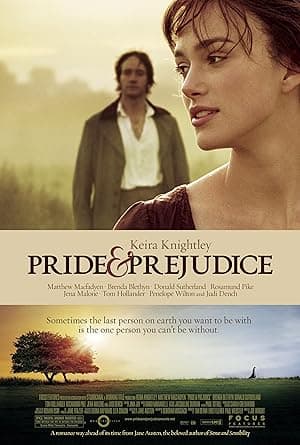
Pride & Prejudice
Elizabeth Bennet, messy houses and very awkward proposals — Austen with a 2000s pulse.
Feature presentation
If you remember one thing from Pride & Prejudice (2005), it's probably Elizabeth Bennet refusing to play by anyone else's script. Joe Wright's debut funnels Austen into a brisk, character‑first cinema: country houses and marriage talks, yes, but seen through a woman who moves, doubts and argues her way through the story. That restless energy is why the film still rewards a revisit.
THE MOVIE
Elizabeth Bennet is still the reason this movie works
Pride & Prejudice in Joe Wright’s hands is stubbornly centred on one irrepressible thing: Elizabeth Bennet. The film follows the Bennet family — and, most importantly, Elizabeth — as five sisters navigate a rural marriage market that measures people by rank and prospect rather than feeling.
Everything that happens is set off by two arrivals: the affable Charles Bingley and his friend Fitzwilliam Darcy. Their landing in the neighbourhood rearranges the social furniture and forces private instincts into public performance, which is where most of the misunderstandings and drama come from.
Knightley and Macfadyen are the faces who carry that friction — Keira Knightley as Elizabeth and Matthew Macfadyen as Darcy — and Wright, making his feature debut, pitched the film as a younger, more kinetic take on Austen. The production leans into a grubby, lived‑in realism that wanted to feel less museum piece, more lived life in late‑eighteenth/early‑nineteenth‑century England.
THE SETUP
The idea that sets Pride & Prejudice in motion
The plot engine is straightforward: a wealthy newcomer — Charles Bingley — arrives with his friend Darcy, and the social choreography of balls, visits and proposals begins. Austen’s novel supplies the scaffolding; the film trims and reorders material to keep the whole thing moving at a cinematic pace.
What matters are the small technologies of social life: letters that travel gossip and evidence, assemblies where public behaviour is visible to all, and the uneasy split between what people say in private and what they must perform in company. The film turns those mechanics into the things that make characters look good or foolish.
Because it’s a film and not a novel, scenes are compressed and rearranged so that misunderstandings have faster payoffs and confrontations hit harder. That condensation sharpens the story into a neat set of public embarrassments and private reckonings.
Even the locations were tidied for period authenticity: digital clean‑up removed modern intrusions from the shooting locations, helping the film feel more uninterruptedly of its era.
THE CHARACTER
Why Elizabeth Bennet matters
Elizabeth is the engine: curious, physically active and distinctly sceptical of social posturing. The film keeps her at the centre so that what could be a parade of polite society becomes a story about one woman deciding how to live.
Her refusals matter. She repeatedly rejects easy, convenient matches rather than accept marriage as merely a transaction — and that refusal shapes almost every choice she makes on screen.
That stance exists in tension with the rest of her household. Mrs Bennet’s single, loud aim is to secure good marriages for her daughters, and that constant pressure colours family scenes with real anxiety and absurdity.
The social web around Elizabeth also contains obvious foils: Wickham’s presence and the contrast with Jane and Bingley help expose where Elizabeth’s judgments are sharp — and where they miss the truth.
THE PERFORMANCE
Why Keira Knightley's performance matters
Contemporary critics singled out Keira Knightley’s work in the role, and the film’s awards season buzz culminated in an Academy Award nomination for Best Actress. That level of recognition is a sign that the performance did more than just fill the lead slot — it anchored the film in ways that reviewers noticed.
An Oscar nomination doesn’t explain exactly how she does it — only that her interpretation of Elizabeth cut through to audiences and industry voters alike. In a project that set out to make Austen feel immediate, her presence became the shorthand for that younger, more cinematic ambition.
That attention also shaped how people discussed the movie: Knightley’s casting and the critical response framed the film as a vehicle for a new, accessible kind of period drama where the lead was allowed to be energetic and physically engaged.
So, whether you watch for the writing, the direction, or the period detail, the performance is one of the reasons the film landed as a fresh take on a familiar story.
UNDER THE SURFACE
Pride & Prejudice has more on its mind than the plot suggests
At surface level it’s a romance and a drama about who marries whom. Underneath, the film keeps returning to class and social rank as real obstacles. Rank isn’t just background colour; it’s what makes certain relationships scandalous, awkward or impossible.
Prejudice and misapprehension are the book’s famous engines and the film keeps them: first impressions, gossip and social assumptions repeatedly distort what characters think they know about one another. Most of the story’s movement comes from people learning to look again.
Marriage is shown in double‑register: a social and economic transaction for some characters and a genuine choice for others. That tension supplies both the comic and the darker moments — the push and pull between security and feeling.
Finally, there’s a deliberate choice in how the story looks. The production favoured a more realist, lived‑in approach rather than pristine heritage prettiness, which keeps those thematic struggles visibly messy and human rather than museum‑polished.
THE FILMMAKING
How Pride & Prejudice was put together
This was Joe Wright’s first feature and he brought a restless energy to the material: a deliberate move away from the pristine museum‑piece period drama toward something more immediate, with the camera often following characters closely through social encounters.
Production design and dressing were pushed in the same direction. Sarah Greenwood and Katie Spencer aimed to make rooms and clothes feel lived‑in; costumes by Jacqueline Durran were chosen to mark social rank while still letting the younger characters move with ease.
The team didn’t try to reinvent the period film so much as make it feel textured and real. Where a spotless stately home would read like a display case, these interiors and wardrobes suggest people actually inhabit the spaces — with all the mess and awkwardness that implies.
On the technical side, Roman Osin photographed the locations and Paul Tothill handled the edit, combining to keep scenes breathing and the story visually driven rather than purely talky.
PRACTICAL EFFECTS
The effects work that gives Pride & Prejudice its physical personality
Even when the film plays like a straightforward period drama, some modern headaches had to be smoothed away: location shooting in real English houses brings authenticity — and the occasional modern artifact.
Double Negative were employed to digitally clean up those location shots, removing anachronisms and enhancing period detail so the eye doesn't snag on something that would pull you out of the story.
That sort of invisible work matters because it lets audiences accept the world on screen without the distraction of a stray satellite dish or modern signage. The film’s sense of time depends on that kind of discreet, technical care.
So while the movie foregrounds tangible details that make rooms and clothes feel lived‑in, the digital tidy‑up quietly keeps the image believable as its period.
PURE 00s
Pride & Prejudice could not belong to any other decade
Released in 2005, the film arrived during a mid‑2000s boom in Austen and heritage adaptations aimed at younger mainstream audiences. It was billed as the big‑screen, more cinematic answer to previous television treatments.
That positioning mattered: casting a young Keira Knightley and hiring a director making the leap from television to features were choices very much of that moment, part of a trend where fresh faces and TV talent crossed into prestige period filmmaking.
Contemporary coverage routinely measured it against the 1995 BBC serial — an earlier, much‑loved screen version of the same story — and against other recent takes like the Bollywood‑inflected Bride & Prejudice (2004). The conversations framed the 2005 film as a modern, brisk alternative.
In short, it’s a film of the 00s not because of costume detail but because of how it was packaged and who it was aimed at: younger viewers who wanted Austen but not necessarily the polite, gleaming heritage gloss of earlier adaptations.
THE LEGACY
Why Pride & Prejudice still matters
The film’s awards season presence — including four Academy Award nominations and multiple BAFTA nods — helped cement its standing and gave Joe Wright a clear launch into features.
Keira Knightley’s Best Actress nomination became a milestone in her career and linked this particular Elizabeth to wider public recognition; that single fact has kept the movie in many people's conversation about notable Austen adaptations.
Beyond awards, the film keeps turning up in lists and discussions of successful twenty‑first‑century adaptations of classic literature; it’s commonly referenced when people talk about cinematic, modernised Austen on the big screen.
In short: the combination of critical recognition, a recognisable lead performance and a deliberate attempt to make Austen feel immediate are why the film still gets mentioned when adaptation choices are debated.
THE VERDICT
Does Pride & Prejudice still hold up?
Yes — if you come to it for characters and the social games they play. The film keeps Elizabeth Bennet’s perspective front and centre, and the story’s engine is her changing appraisal of Darcy: misjudgement, anger, reappraisal and eventual understanding. That emotional throughline survives the condensing required for a 127‑minute feature.
The movie stages a handful of formally important confrontations — Darcy’s unexpected proposal and Elizabeth’s refusal, and the crisis involving Lydia — and uses letters, assemblies and private conversations to move the stakes. Those scenes still land because their tension is human rather than plot‑mechanical.
Wright’s 2005 production choices — location shooting, design that leans lived‑in, and a younger lead — give the film a particular personality. Keira Knightley’s Elizabeth is the hinge that lets those choices feel intentional rather than gimmicky, which is part of why the performance attracted awards attention.
So should you watch it now? Absolutely. It’s a smart, brisk take on Austen that keeps the novel’s central arguments about class, prejudice and marriage in play while offering a cinematic energy that marked out the mid‑2000s adaptations. If you want Austen as motion and argument, not just as antique scenery, this one still moves.
Share this movie
Keep watching
More movies from the 00s

2002
The Pianist
A quiet life unmade by war — and a pianist who refuses to stop listening.
Read the retrospective
→
2006
Blood Diamond
A mercenary, a fisherman and a pink diamond — and a film that still asks who pays for our jewellery.
Read the retrospective
→
2003
Kill Bill: Volume 1
A yellow jumpsuit, a long list of enemies and one woman who refuses to be finished.
Read the retrospective
→